





Brand Finance’s first-of-its-kind research evaluates the economic impact and brand strength of the world’s top 50 marathons
MUMBAI, 3rd September 2025 – The Mumbai and Bengaluru marathons collectively channel an economic contribution of USD65 million to their respective host cities, according to the Marathons 50 2025 report by Brand Finance, the world's leading brand valuation consultancy.
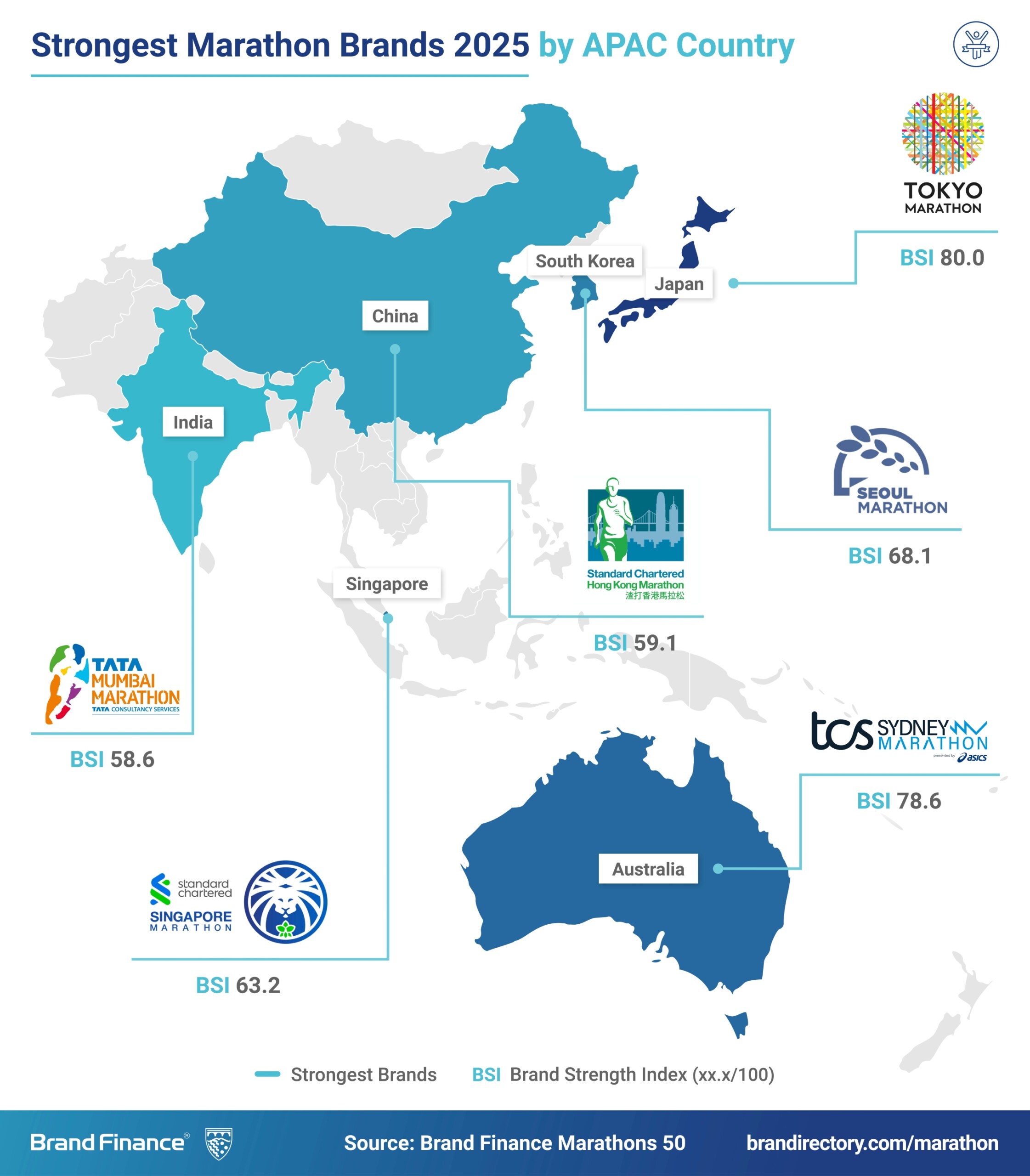
The Mumbai Marathon contributed an estimated USD57 million to the city, while Bengaluru contributed USD8 million. Brand Finance’s inaugural research reveals that the Mumbai Marathon ranks as the 45th strongest marathon brand globally, with a Brand Strength Index (BSI) score of 58.6/100. Closely following, the Bengaluru Marathon is positioned at 47th, achieving a BSI score of 57.5/100.
According to Brand Finance’s research data, both the Mumbai and Bengaluru marathons are particularly well-regarded by local respondents for their innovative approaches and integration of new technologies. They also earned commendable recognition for their commitment to environmental sustainability, reflecting a growing appreciation for socially and ecologically responsible sporting events among local respondents.
Further insights from the study indicate high levels of local engagement across a diverse range of touchpoints. A significant proportion of local respondents reported having participated in the marathons, considered taking part, or supported the events by watching them live, on television, or via social media platforms.
Additional forms of engagement included donating to associated charities, fundraising, purchasing official merchandise, and volunteering, highlighting the community’s commitment to meaningful support beyond just awareness.
A growing trend in the Indian marathon landscape is the rise of corporate-led events organised by major IT firms such as TCS, Infosys, IBM, and Wipro. Designed to foster employee engagement and strengthen workplace culture, these internal marathons have gained significant traction in recent years, attracting widespread attention on social media. As participation and visibility continue to grow, these events are emerging as valuable opportunities for sponsorship and partnerships with leading sports brands.
Ajimon Francis, Managing Director, Brand Finance India, commented:
“Marathons in key Indian cities are transforming the lifestyles and disciplines of an entire generation. Training, stamina building, digital tracking, and the community of runners is exponentially growing in India. This analysis shows, together generating USD65 million in economic value and securing top global brand rankings, the TCS Mumbai and Bengaluru Marathons highlight how city marathons can be effective tools for economic development, healthy lifestyle, philanthropy and urban branding. Their ability to engage with the corporate leaders, local populace, not only as runners, but as volunteers, donors, and spectators, reflects the growing role of such sport related events in shaping inclusive, future-forward cities on the global stage. This study is also a tool for IP owners to evaluate the significant value that Marathons are creating both to cities as well as for sponsors.”
Hugo Hensley, Valuation Director at Brand Finance, commented:
“Marathons are simultaneously elite athletic competitions and public mass participation events, and usually also major charity initiatives. This unique position is evident in the strength and value of marathon brands, as well as the USD5.2 billion economic impact they have on the cities where they run. Marathons are extremely attractive and effective sponsorship opportunities for brands that genuinely align with the events’ values of community, charity, and competition.”
Global insights
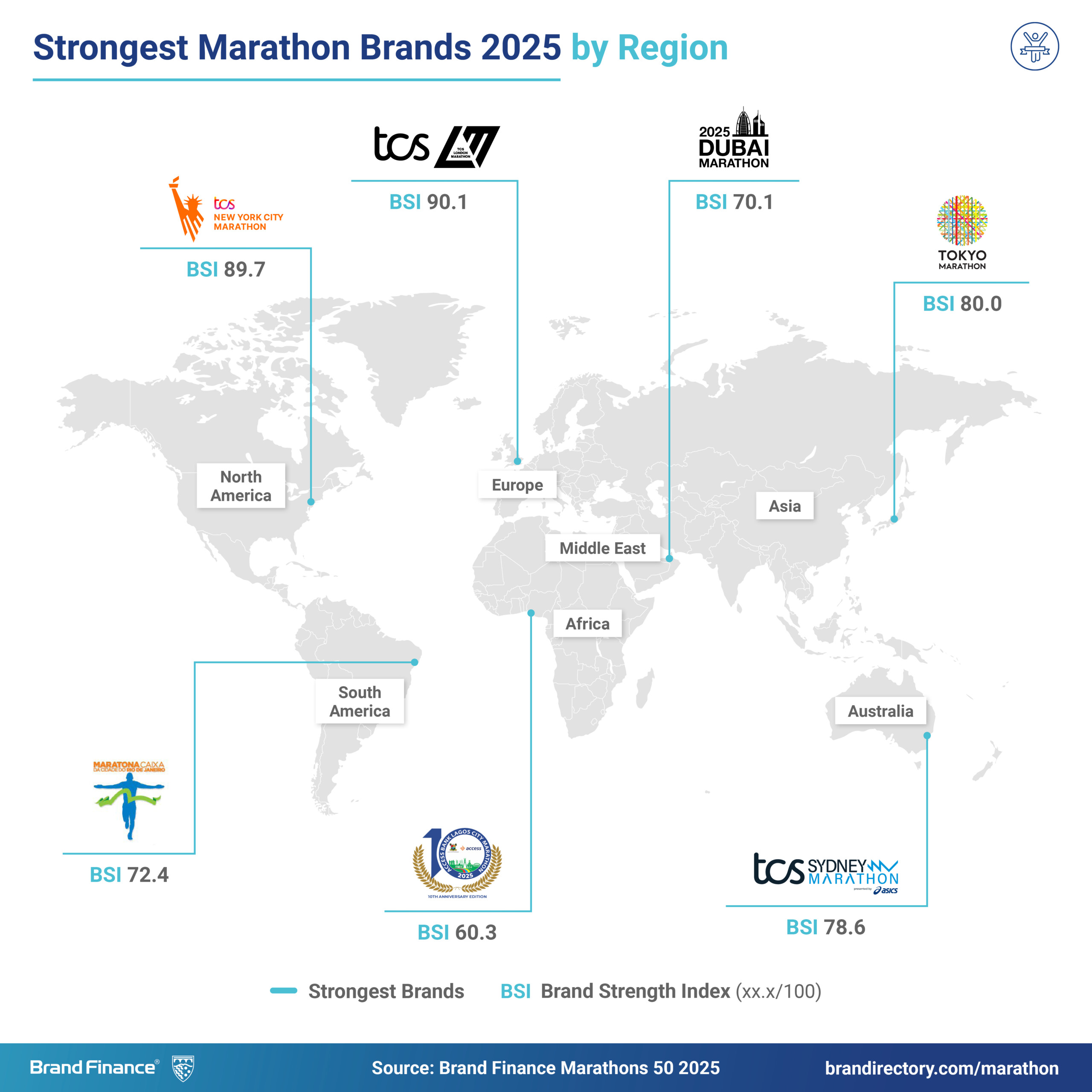
Brand Finance data reveals that the London Marathon is the strongest marathon brand, with a BSI score of 90.1/100, while the New York City Marathon is the most valuable marathon brand (USD292 million) among seven Abbott World Marathon Majors.
Tokyo Marathon ranks as the sixth strongest marathon brand among the world’s top 50 with a BSI score of 80.0/100 and stands out as Asia’s leading marathon, being the only Asian brand in the top 20.
The Abbott World Marathon Majors’ collective brand value is USD937 million. They also collectively raised USD276 million for charity in 2024, more than half of the total charitable funds raised by the world’s top 50 marathons at an estimated USD425 million.
Brand Finance launched its inaugural Marathons 50 report, in partnership with Tata Consultancy Service (TCS), at the London Stock Exchange Group on 24th April 2025.




Brand Finance is the world’s leading brand valuation consultancy. Bridging the gap between marketing and finance, Brand Finance evaluates the strength of brands and quantifies their financial value to help organisations make strategic decisions.
Headquartered in London, Brand Finance operates in over 25 countries. Every year, Brand Finance conducts more than 6,000 brand valuations, supported by original market research, and publishes over 100 reports which rank brands across all sectors and countries.
Brand Finance also operates the Global Brand Equity Monitor, conducting original market research annually on 6,000 brands, surveying more than 175,000 respondents across 41 countries and 31 industry sectors. By combining perceptual data from the Global Brand Equity Monitor with data from its valuation database — the largest brand value database in the world — Brand Finance equips ambitious brand leaders with the data, analytics, and the strategic guidance they need to enhance brand and business value.
In addition to calculating brand value, Brand Finance also determines the relative strength of brands through a balanced scorecard of metrics, compliant with ISO 20671.
Brand Finance is a regulated accountancy firm and a committed leader in the standardisation of the brand valuation industry. Brand Finance was the first to be certified by independent auditors as compliant with both ISO 10668 and ISO 20671 and has received the official endorsement of the Marketing Accountability Standards Board (MASB) in the United States.
Brand is defined as a marketing-related intangible asset including, but not limited to, names, terms, signs, symbols, logos, and designs, intended to identify goods, services, or entities, creating distinctive images and associations in the minds of stakeholders, thereby generating economic benefits.
Brand strength is the efficacy of a brand’s performance on intangible measures relative to its competitors. Brand Finance evaluates brand strength in a process compliant with ISO 20671, looking at Marketing Investment, Stakeholder Equity, and the impact of those on Business Performance. The data used is derived from Brand Finance’s proprietary market research programme and from publicly available sources.
Each brand is assigned a Brand Strength Index (BSI) score out of 100, which feeds into the brand value calculation. Based on the score, each brand is assigned a corresponding Brand Rating up to AAA+ in a format similar to a credit rating.
Brand Finance calculates the values of brands in its rankings using the Royalty Relief approach – a brand valuation method compliant with the industry standards set in ISO 10668. It involves estimating the likely future revenues that are attributable to a brand by calculating a royalty rate that would be charged for its use, to arrive at a ‘brand value’ understood as a net economic benefit that a brand owner would achieve by licensing the brand in the open market.
The steps in this process are as follows:
1 Calculate brand strength using a balanced scorecard of metrics assessing Marketing Investment, Stakeholder Equity, and Business Performance. Brand strength is expressed as a Brand Strength Index (BSI) score on a scale of 0 to 100.
2 Determine royalty range for each industry, reflecting the importance of brand to purchasing decisions. In luxury, the maximum percentage is high, while in extractive industry, where goods are often commoditised, it is lower. This is done by reviewing comparable licensing agreements sourced from Brand Finance’s extensive database.
3 Calculate royalty rate. The BSI score is applied to the royalty range to arrive at a royalty rate. For example, if the royalty range in a sector is 0-5% and a brand has a BSI score of 80 out of 100, then an appropriate royalty rate for the use of this brand in the given sector will be 4%.
4 Determine brand-specific revenues by estimating a proportion of parent company revenues attributable to a brand.
5 Determine forecast revenues using a function of historic revenues, equity analyst forecasts, and economic growth rates.
6 Apply the royalty rate to the forecast revenues to derive brand revenues.
7 Discount post-tax brand revenues to a net present value which equals the brand value.
Brand Finance has produced this study with an independent and unbiased analysis. The values derived and opinions presented in this study are based on publicly available information and certain assumptions that Brand Finance used where such data was deficient or unclear. Brand Finance accepts no responsibility and will not be liable in the event that the publicly available information relied upon is subsequently found to be inaccurate. The opinions and financial analysis expressed in the study are not to be construed as providing investment or business advice. Brand Finance does not intend the study to be relied upon for any reason and excludes all liability to any body, government, or organisation.
The data presented in this study form part of Brand Finance's proprietary database, are provided for the benefit of the media, and are not to be used in part or in full for any commercial or technical purpose without written permission from Brand Finance.