




This article was originally published in the Brand Finance Global Soft Power Index 2026
Soft power describes a nation’s influence on others, underpinned by its policies, values, and positions. With this in mind, it is clear that sustainability perceptions help define soft power: the actions a nation chooses to take on topics like climate change, AI governance, and gender empowerment have a clear effect on reputation.

Strategy
& Sustainability Director,
Brand Finance

Senior Strategy &
Sustainability Consultant,
Brand Finance
What does the data show?
Analysis of the results of the Global Soft Power Index demonstrates this relationship clearly. The Sustainable Future pillar evaluates nation brands on four key aspects of environmental sustainability: cities and transport, support for global action on climate change, green energy and technologies, and
environmental protection. We observe strong correlations between national performance on this pillar and other aspects of the Index.
Perceived national influence in Business in Trade has a correlation of r=0.97 with Sustainable Future, and there is a correlation of r=0.93 between sustainability and influence in International Relations. Sustainable Future is also linked with national Reputation Scores, with a correlation of 0.89.
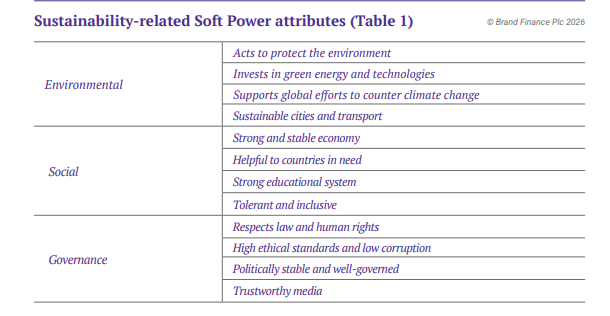
Sustainability goes beyond these environmental concerns to encompass social and governance factors too. In total, 12 attributes from across the index contribute to sustainability (Table 1), collectively responsible for driving as much as 34% of a nation’s soft power.
Which countries lead the way?
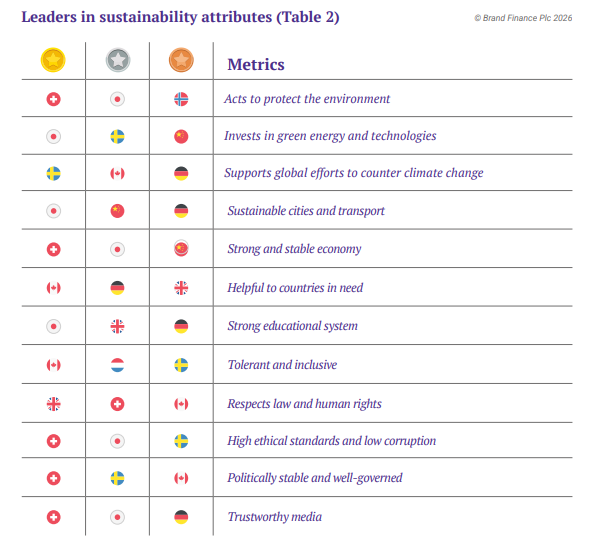
We see consistently strong sustainability perceptions for eight nations: Switzerland, Japan, Sweden, Germany, the UK, Canada, China, and the Netherlands. (Table 2)
The United States, which makes the podium on most metrics notably did not receive any top 3 scores on sustainability attributes. This may not be surprising given President Trump’s pivot away from the green policies, initiatives, and investments built up by prior administrations.
Does perception match reality?
There is not necessarily a close alignment between sustainability perceptions and the reality of countries’ progress against the UN Sustainable Development Goals. Our analysis continues to demonstrate that many nations, particularly smaller ones, that have made strong progress against the UN Sustainable Development Goals (SDGs), are missing out on deserved recognition and soft power benefits.
We find that European nations, especially Central and Eastern Europe, largely comprise the set of nations who have an opportunity to grow their sustainability perceptions to match their levels of performance and generate soft power. Among the top 10 are Finland, Ukraine, Croatia, France, Slovenia, Latvia, Czechia, Serbia, Poland, and Denmark.
Finland holds the top score of sustainability performance in the latest UN SDG Index. It is seen to be relatively committed to sustainability, but not to the extent that its standout performance merits.
Denmark and France make the top 5 on performance, with Croatia, Poland, and Czechia making the top 10. For all of these nations, their efforts are not fully translating into public perception. Collectively, their SDG progress is comprehensively strong, especially on KPIs related to Affordable and Clean Energy (SDG #7), Gender Equality (SDG #5), and Industry, Innovation, and Infrastructure (SDG #9). These nations should seek to more effectively communicate their strong sustainability position to enhance their soft power and leadership on this theme.
On the other hand, there are many cases where sustainability perception exceeds relative performance levels, which may pose a reputational risk. The most economically developed nations may be taking some of the largest-scaled measures to address sustainability, thanks to greater finances and means to promote investment and tourism.
However, the large footprint that their consumption and lifestyles have means a greater environmental footprint, and therefore sustainability perceptions that tend to exceed performance.
Will sustainability continue to be key to Soft Power?
COP30 was hosted in Belem, Brazil in November 2025, and its negotiations package saw new targets for tripling climate adaptation finance by 2035 and recognizing the just transition imperative. Despite these wins, no binding roadmap to phase out fossil fuels or reverse deforestation was developed. International cooperation and motivation appear quite uneven. Environmental degradation, damage from climate change, and carbon emissions continue to cost nations in terms of money, productivity, and human health.
With the United States no longer backing many environmental treaties and associations, including the Paris Agreement, and the EU continuing to revise and dilute its corporate sustainability reporting requirements, the outlook for sustainability may seem challenging.
Yet the results of the Global Soft Power indicate that for many countries, if they are prepared to step up, make progress, and most importantly, confidently communicate about that progress, there are significant benefits to secure from trade, to talent, to tourism.
There remains a platform for nations to step up when the steering forces of the climate discourse change position or stand down. In a fragmented sustainability landscape, consistency and ambition will distinguish leaders from followers. Our research supports the soft power benefits of a commitment to sustainability, as well as the public association and recognition that come with it.