New Brand Finance survey shows the island nation recording consistent performance across key indicators for island nation
SINGAPORE, 27 January 2026 – Singapore has once again emerged as ASEAN’s most influential nation in the Brand Finance Global Soft Power Index 2026, maintaining its regional leadership since 2025, according to a new report from Brand Finance, the world's leading brand valuation consultancy.
Brand Finance publishes the Global Soft Power Index based on a survey of more than 150,000 respondents from over 100 countries to gather data on global perceptions of all 193 member states of the United Nations. Thanks to the scope of the survey, the Index is the world’s most comprehensive study on perceptions of nation brands, providing an in-depth analysis of the evolving status of Soft Power as nations navigate significant global changes and challenges.
Soft Power is defined as a nation’s ability to influence the preferences and behaviours of various actors in the international arena (states, corporations, communities, publics, etc.) through attraction and persuasion rather than coercion. Each nation is scored across 55 different metrics to arrive at an overall score out of 100 and ranked in order from 1st to 193rd.
In the latest rankings, Singapore held steady at 21st out of 193 countries, reinforcing its reputation as a benchmark for effective leadership, economic strength, and long-term vision. The city-state outperformed its ASEAN peers across several key pillars including Business & Trade, Governance, and Education & Science, underlining its enduring global appeal and influence.
Alex Haigh, Managing Director Asia Pacific, Brand Finance, commented:
“Singapore’s performance in the Global Soft Power Index 2026 highlights how sustained credibility, institutional trust, and global engagement translate into enduring influence. By consistently performing strongly across governance, business, and innovation, Singapore demonstrates how soft power is built through stability, competence, and a clear long-term vision, allowing it to lead in ASEAN while remaining highly respected on the global stage.”
In Business & Trade, Singapore remains a powerhouse, ranking 4th globally for ‘ease to do business in and with’ and 9th for ‘future growth potential’. The country also placed 17th for ‘strong and stable economy’ and 21st for producing well-loved products by global community.
Under the Governance pillar, Singapore strengthened its standing for integrity and stability. The nation advanced to 9th place (up one rank) for ‘high ethical standards and low corruption’ while also ranking 15th for ‘internationally admired government leaders’, 17th for ‘politically stable and well-governed' and 13th for being ‘safe & secure’.
In Education & Science, Singapore retained its position at 12th globally, reflecting its continued commitment to developing future-ready talent. The country further reinforced its innovation credentials by ranking ninth for being ‘advanced in technology and innovation’ and climbing two places to 21st in invests in space exploration, strengthening its reputation as a global hub for research and technological excellence.
Singapore’s sustainability efforts also received positive recognition. The nation ranked 13th for ‘sustainable cities and transport’ and remained focused on green energy and technology, securing 17th place in this category. The nation also went up two places to 18th for ‘acts to protect the environment’, underscoring its focus on long-term, sustainable development.
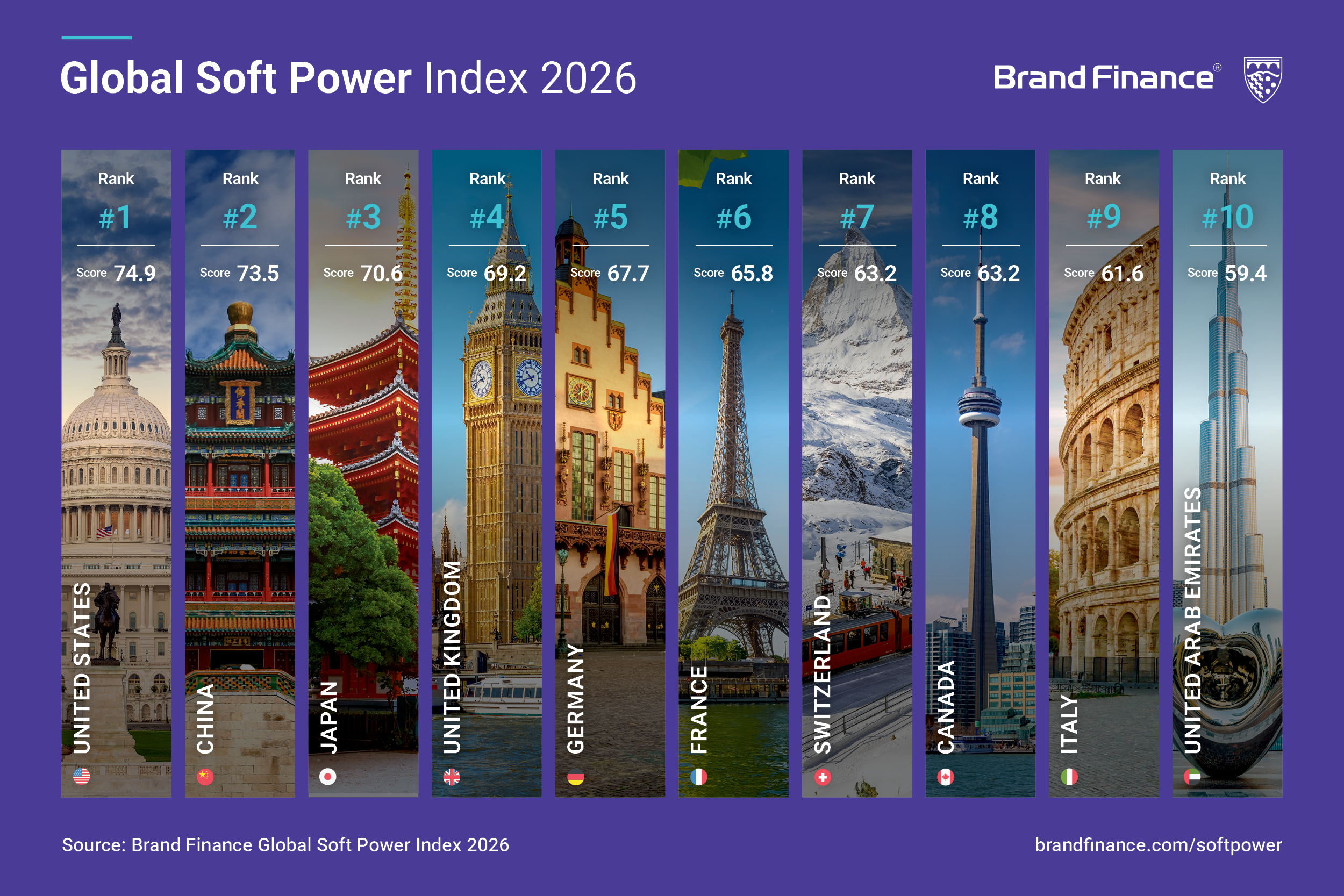
Global Insights: US Soft Power declines as China rises, while Japan overtakes the UK to take 3rd place
The Global Soft Power Index 2026 highlights a broad global decline of nation brand perceptions, driven by economic uncertainty, geopolitical tension, and social pressures. Audiences worldwide are more cautious and more likely to scrutinise nations’ behaviour, leading to lower scores across the Index and echoing the trust erosion seen during the COVID-19 period.
Despite retaining 1st place overall, the United States records the steepest overall decline among all nation brands ranked, driven by sharp declines in Reputation (26th, -11) and key nation brand attributes amid international backlash to “America First” policies. Key declines are observed in friendliness (-32), generosity (-68), ease of doing business (-21), support for climate action (-16), political stability (-8), human rights (-10), and ethical standards (-4). Nevertheless, the US retains its number one position for Familiarity and Influence, underpinned by continued global leadership in arts and entertainment (1st), sport (3rd), iconic brands (2nd), innovation (3rd), and space exploration (1st).
China has consolidated its second-place position, overtaking the US for the first time in Reputation (18th, +9), supported by improvements in People & Values, Governance, and Sustainable Future. China has reinforced perceptions in Business & Trade (2nd, +2) and Education & Science (1st, +2), ranking 1st globally for ease of doing business, future growth potential, technology and innovation, and advanced science. It has also risen to 3rd globally (+5) for perceptions of strong and stable economy, with these combined factors helping to sustain China’s high levels of Influence (2nd) and Familiarity (4th).
Japan’s rise to 3rd, now overtaking the United Kingdom (4th), exemplifies its ability to build Soft Power through a direct experience of the nation brand. Japan has maintained strengths in Business & Trade (1st), Sustainable Future (1st), Education & Science (2nd), and Governance (2nd), while tourism has boosted Familiarity (6th, +1) and related attributes, including appealing lifestyle (4th, +9), visit appeal (8th, +3), friendliness (7th, +12), and fun (21st, +15).
Konrad Jagodzinski, Place Branding Director, Brand Finance, commented:
“The negative shift in the global mood highlights a critical lesson about Soft Power in 2026. Publics are increasingly sensitive to the alignment of values, actions, and outcomes. Nations that fail to demonstrate reliability, credibility, and impact face erosion not only in specific domains but also in broader international reputation and relevance. Soft power is not solely about visibility or size; it is about perception that a nation is delivering on promises implicit in its brand. Nations failing to uphold these promises are penalised by global audiences.”





Brand Finance is the world’s leading brand valuation consultancy. Bridging the gap between marketing and finance, Brand Finance evaluates the strength of brands and quantifies their financial value to help organisations make strategic decisions.
Headquartered in London, Brand Finance operates in over 25 countries. Every year, Brand Finance conducts more than 6,000 brand valuations, supported by original market research, and publishes over 100 reports which rank brands across all sectors and countries.
Brand Finance also operates the Global Brand Equity Monitor, conducting original market research annually on 6,000 brands, surveying more than 175,000 respondents across 41 countries and 31 industry sectors. By combining perceptual data from the Global Brand Equity Monitor with data from its valuation database — the largest brand value database in the world — Brand Finance equips ambitious brand leaders with the data, analytics, and the strategic guidance they need to enhance brand and business value.
In addition to calculating brand value, Brand Finance also determines the relative strength of brands through a balanced scorecard of metrics, compliant with ISO 20671.
Brand Finance is a regulated accountancy firm and a committed leader in the standardisation of the brand valuation industry. Brand Finance was the first to be certified by independent auditors as compliant with both ISO 10668 and ISO 20671 and has received the official endorsement of the Marketing Accountability Standards Board (MASB) in the United States.
Brand is defined as a marketing-related intangible asset including, but not limited to, names, terms, signs, symbols, logos, and designs, intended to identify goods, services, or entities, creating distinctive images and associations in the minds of stakeholders, thereby generating economic benefits.
Brand strength is the efficacy of a brand’s performance on intangible measures relative to its competitors. Brand Finance evaluates brand strength in a process compliant with ISO 20671, looking at Marketing Investment, Stakeholder Equity, and the impact of those on Business Performance. The data used is derived from Brand Finance’s proprietary market research programme and from publicly available sources.
Each brand is assigned a Brand Strength Index (BSI) score out of 100, which feeds into the brand value calculation. Based on the score, each brand is assigned a corresponding Brand Rating up to AAA+ in a format similar to a credit rating.
Brand Finance calculates the values of brands in its rankings using the Royalty Relief approach – a brand valuation method compliant with the industry standards set in ISO 10668. It involves estimating the likely future revenues that are attributable to a brand by calculating a royalty rate that would be charged for its use, to arrive at a ‘brand value’ understood as a net economic benefit that a brand owner would achieve by licensing the brand in the open market.
The steps in this process are as follows:
1 Calculate brand strength using a balanced scorecard of metrics assessing Marketing Investment, Stakeholder Equity, and Business Performance. Brand strength is expressed as a Brand Strength Index (BSI) score on a scale of 0 to 100.
2 Determine royalty range for each industry, reflecting the importance of brand to purchasing decisions. In luxury, the maximum percentage is high, while in extractive industry, where goods are often commoditised, it is lower. This is done by reviewing comparable licensing agreements sourced from Brand Finance’s extensive database.
3 Calculate royalty rate. The BSI score is applied to the royalty range to arrive at a royalty rate. For example, if the royalty range in a sector is 0-5% and a brand has a BSI score of 80 out of 100, then an appropriate royalty rate for the use of this brand in the given sector will be 4%.
4 Determine brand-specific revenues by estimating a proportion of parent company revenues attributable to a brand.
5 Determine forecast revenues using a function of historic revenues, equity analyst forecasts, and economic growth rates.
6 Apply the royalty rate to the forecast revenues to derive brand revenues.
7 Discount post-tax brand revenues to a net present value which equals the brand value.
Brand Finance has produced this study with an independent and unbiased analysis. The values derived and opinions presented in this study are based on publicly available information and certain assumptions that Brand Finance used where such data was deficient or unclear. Brand Finance accepts no responsibility and will not be liable in the event that the publicly available information relied upon is subsequently found to be inaccurate. The opinions and financial analysis expressed in the study are not to be construed as providing investment or business advice. Brand Finance does not intend the study to be relied upon for any reason and excludes all liability to any body, government, or organisation.
The data presented in this study form part of Brand Finance's proprietary database, are provided for the benefit of the media, and are not to be used in part or in full for any commercial or technical purpose without written permission from Brand Finance.