





Brand Finance’s Ireland 25 2026 study finds the collective brand value of the nation’s top 25 brands holding steady at €24.8 billion
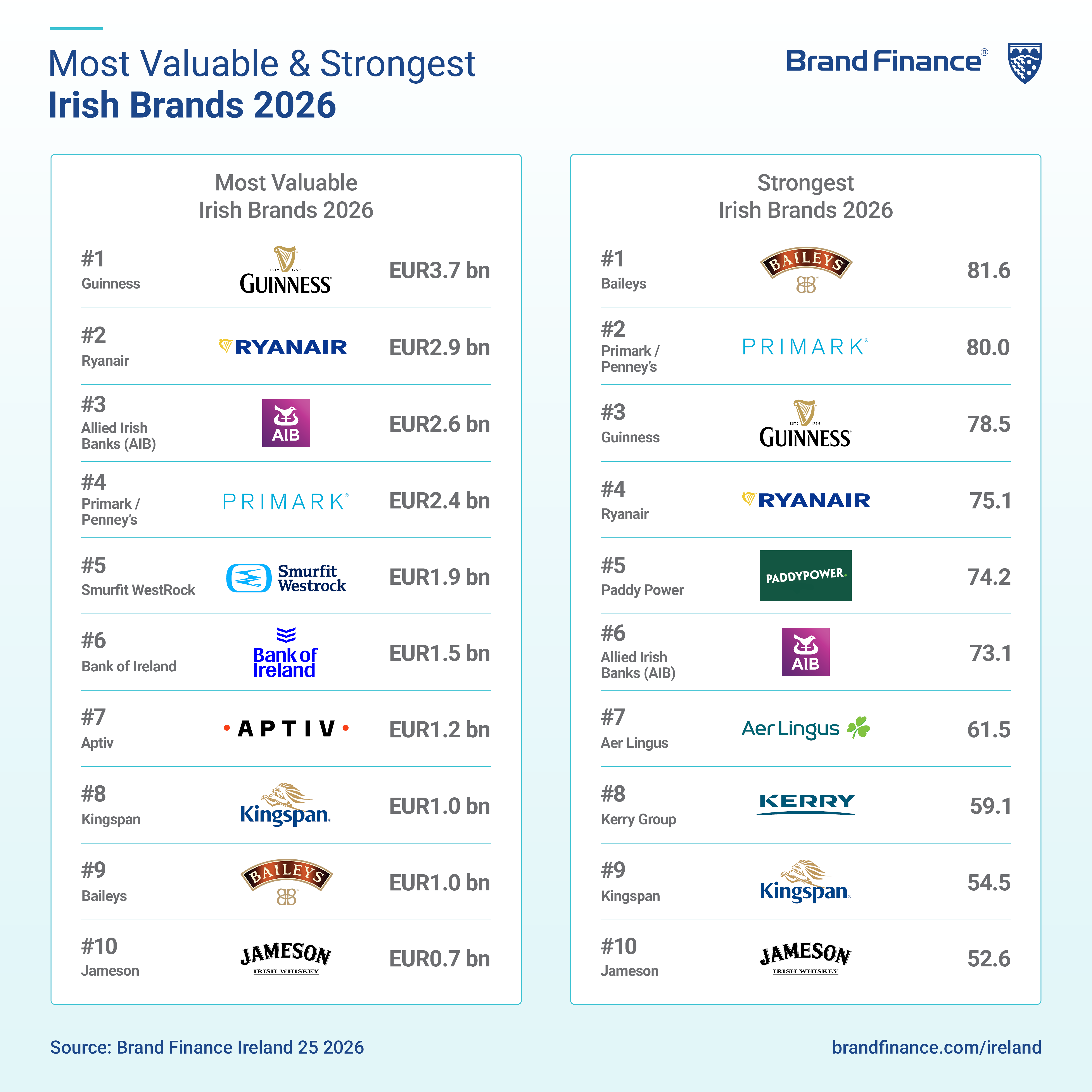
DUBLIN, 17 March 2026 – Three of Ireland’s most iconic alcoholic drink brands sit among the top 10 most valuable and strongest brands overall, according to the Ireland 25 2026 ranking by Brand Finance, the world's leading brand valuation consultancy. Despite market shifts, the nation’s top 25 brands maintained a collective brand value of EUR24.8 billion, supported by stronger consumer spending, higher public expenditure, and sustained international interest in Irish culture.
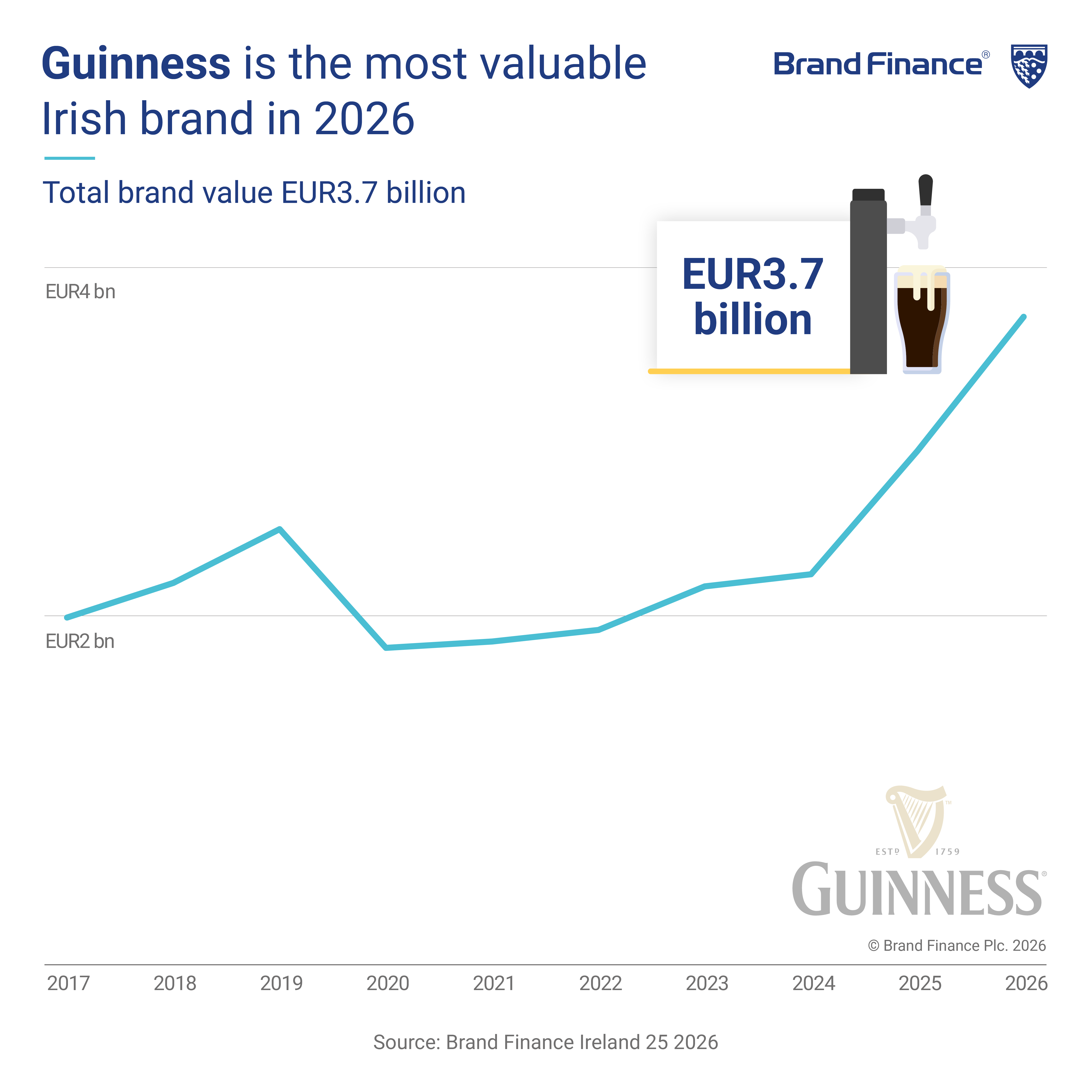
Guinness (brand value up 22% to EUR3.7 billion) retains its position as the most valuable Irish brand for the fifth consecutive year, reflecting not only its commercial momentum but also its enduring significance and presence in Irish pub culture worldwide. The brand has undergone a modern resurgence, driven by its growing appeal among women and younger consumers, evolving beyond its long-held ‘old man’s drink’ stereotype to establish itself as a contemporary lifestyle choice. The stout beer brand also ranks as the third strongest brand in Ireland, with a Brand Strength Index (BSI) score of 78.5/100 and an AA+ brand strength rating, supported by a rise in social media popularity and strong partnerships with both the Men’s and Women’s Six Nations.
Baileys (brand value down 18% to EUR991 million) posted mixed results this year. While its brand value declined, its brand strength remains steadfast, retaining its position as Ireland’s strongest brand with a BSI score of 81.6/100 and an AAA‑ brand strength rating, reflecting its deep roots in domestic and international perceptions, as well as an appreciation for the cream liqueur’s place in Irish culture. In an effort to combat stalling global demand for spirits, Baileys is looking towards product diversification, including the addition of oat‑milk and non‑dairy liqueurs to its regular lineup, appealing to lactose‑intolerant and plant‑based consumers while aligning with growing café‑style flavour trends
Jameson (brand value down 30% to EUR722 million) is the third alcoholic drink brand in the top 10, holding steady as the 10th most valuable brand this year, despite facing economic headwinds, including tariff uncertainties that disrupted distributor inventories and declining consumer confidence across Europe, Asia, and the Americas. Jameson also ranks as the nation’s 10th strongest brand, with a BSI score of 52.6/100 and an A‑ brand strength rating.
Ryanair (brand value up 10% to EUR2.9 billion) is up one spot this year to become the second most valuable brand, driven by strong passenger growth, reaching 200 million travellers, which marks a 9% increase from 2025. Robust post‑pandemic travel demand, disciplined cost management, and a large, unencumbered fleet supported both financial performance and resilience in a high‑interest‑rate environment. The airline also demonstrates improved brand strength, rising one spot to become the fourth strongest in the ranking with a BSI score of 75.1/100 and an AA+ brand strength rating, underpinned by effective social media strategies that resonated with online audiences. In January this year, Ryanair attracted significant online attention following a public exchange on social media involving Elon Musk and the airline’s CEO, Michael O’Leary. The interaction generated widespread publicity for the brand, contributing to increased online visibility.
Allied Irish Banks (AIB) (brand value down 12% to EUR2.6 billion) ranks as the third most valuable despite a dip in brand value driven by lower revenues and geopolitical headwinds from the US trade tariffs implemented in August 2025. However, the bank was able to return to full private ownership after the state sold its remaining shares in June 2025, ending nearly two decades of government involvement following the 2008 financial crisis.
Primark / Penney's (brand value down 2% to EUR2.4 billion) climbs one spot to become the second strongest brand in Ireland, with a BSI score of 80/100 and an AAA- brand strength rating. The apparel brand’s performance this year was supported by strong reception in several markets such as Spain and Portugal, as well as US, Central and Eastern Europe, where it recorded double-digit growth in sales, offsetting slightly underperforming UK and Ireland markets.
Optimum Nutrition (brand value up 48% to EUR312 million) experiences significant brand value growth to emerge as Ireland’s fastest growing brand in 2026, driven by global demand for protein supplements. In October 2025, the brand became the official nutrition partner of the Irish Rugby Football Union (IRFU). This effort elevated the brand’s engagement with its target market, improved brand visibility, broadened its cultural relevance, and strengthened its leadership position in the global sports nutrition market.
Henry Farr, Valuation Director, Brand Finance, commented:
The performance of Ireland’s leading brands reflects the power of strong heritage combined with modern relevance. Iconic names such as Guinness, Baileys, and Jameson continue to demonstrate how well-established Irish brands can evolve with changing consumer preferences while maintaining global appeal. At the same time, brands like Ryanair highlight Ireland’s ability to compete through scale, efficiency, and digital engagement. Meanwhile, Optimum Nutrition illustrates the growing strength of Ireland-linked consumer brands in high-growth wellness categories, benefiting from surging global demand for protein supplements and increasing engagement with fitness-focused consumers.
Together, these brands illustrate how Ireland’s brand ecosystem blends tradition, innovation, and strong market positioning to sustain long-term brand value growth
Other brands featured in the top 10 of the Ireland 25 2026 rankings are:
Sustainability
Brand Finance also assesses the brands consumers consider most committed to sustainability. The 2026 Sustainability Perceptions Index, to be released later this year, reveals which brands are perceived to have the strongest commitment to sustainability globally, the changing role of sustainability in driving demand, and the large amounts of value at risk, being missed, and being secured by the world’s biggest brands.
Guiness ranks as the top Irish brand for its perceived sustainability efforts across the environment, social, and governance pillars, scoring 4.0, 4.0, and 4.2, respectively. Guinness advances all three ESG pillars through efforts such as investing EUR100 million for the St. James’s Gate brewery decarbonisation plan, supporting regenerative farming, and operating under a robust, science‑based and government‑backed sustainability governance framework.




Brand Finance is the world’s leading brand valuation consultancy. Bridging the gap between marketing and finance, Brand Finance evaluates the strength of brands and quantifies their financial value to help organisations make strategic decisions.
Headquartered in London, Brand Finance operates in over 25 countries. Every year, Brand Finance conducts more than 6,000 brand valuations, supported by original market research, and publishes over 100 reports which rank brands across all sectors and countries.
Brand Finance also operates the Global Brand Equity Monitor, conducting original market research annually on 6,000 brands, surveying more than 175,000 respondents across 41 countries and 31 industry sectors. By combining perceptual data from the Global Brand Equity Monitor with data from its valuation database — the largest brand value database in the world — Brand Finance equips ambitious brand leaders with the data, analytics, and the strategic guidance they need to enhance brand and business value.
In addition to calculating brand value, Brand Finance also determines the relative strength of brands through a balanced scorecard of metrics, compliant with ISO 20671.
Brand Finance is a regulated accountancy firm and a committed leader in the standardisation of the brand valuation industry. Brand Finance was the first to be certified by independent auditors as compliant with both ISO 10668 and ISO 20671 and has received the official endorsement of the Marketing Accountability Standards Board (MASB) in the United States.
Brand is defined as a marketing-related intangible asset including, but not limited to, names, terms, signs, symbols, logos, and designs, intended to identify goods, services, or entities, creating distinctive images and associations in the minds of stakeholders, thereby generating economic benefits.
Brand strength is the efficacy of a brand’s performance on intangible measures relative to its competitors. Brand Finance evaluates brand strength in a process compliant with ISO 20671, looking at Marketing Investment, Stakeholder Equity, and the impact of those on Business Performance. The data used is derived from Brand Finance’s proprietary market research programme and from publicly available sources.
Each brand is assigned a Brand Strength Index (BSI) score out of 100, which feeds into the brand value calculation. Based on the score, each brand is assigned a corresponding Brand Rating up to AAA+ in a format similar to a credit rating.
Brand Finance calculates the values of brands in its rankings using the Royalty Relief approach – a brand valuation method compliant with the industry standards set in ISO 10668. It involves estimating the likely future revenues that are attributable to a brand by calculating a royalty rate that would be charged for its use, to arrive at a ‘brand value’ understood as a net economic benefit that a brand owner would achieve by licensing the brand in the open market.
The steps in this process are as follows:
1 Calculate brand strength using a balanced scorecard of metrics assessing Marketing Investment, Stakeholder Equity, and Business Performance. Brand strength is expressed as a Brand Strength Index (BSI) score on a scale of 0 to 100.
2 Determine royalty range for each industry, reflecting the importance of brand to purchasing decisions. In luxury, the maximum percentage is high, while in extractive industry, where goods are often commoditised, it is lower. This is done by reviewing comparable licensing agreements sourced from Brand Finance’s extensive database.
3 Calculate royalty rate. The BSI score is applied to the royalty range to arrive at a royalty rate. For example, if the royalty range in a sector is 0-5% and a brand has a BSI score of 80 out of 100, then an appropriate royalty rate for the use of this brand in the given sector will be 4%.
4 Determine brand-specific revenues by estimating a proportion of parent company revenues attributable to a brand.
5 Determine forecast revenues using a function of historic revenues, equity analyst forecasts, and economic growth rates.
6 Apply the royalty rate to the forecast revenues to derive brand revenues.
7 Discount post-tax brand revenues to a net present value which equals the brand value.
Brand Finance has produced this study with an independent and unbiased analysis. The values derived and opinions presented in this study are based on publicly available information and certain assumptions that Brand Finance used where such data was deficient or unclear. Brand Finance accepts no responsibility and will not be liable in the event that the publicly available information relied upon is subsequently found to be inaccurate. The opinions and financial analysis expressed in the study are not to be construed as providing investment or business advice. Brand Finance does not intend the study to be relied upon for any reason and excludes all liability to any body, government, or organisation.
The data presented in this study form part of Brand Finance's proprietary database, are provided for the benefit of the media, and are not to be used in part or in full for any commercial or technical purpose without written permission from Brand Finance.