




This article was originally published in the Brand Finance Telecoms 150 Report 2026.

Global Head of
Strategic Services,
Brand Finance
Across markets, there is a growing sense that the world has become harder to interpret. Information circulates rapidly, economic pressures persist, and digital systems underpin more of daily life than ever before. Connectivity is no longer a background utility; it enables work, commerce, education and social interaction. As dependence on digital infrastructure increases, so does scrutiny of the brands that provide it. In this environment, trust has become more fragile and more decisive.
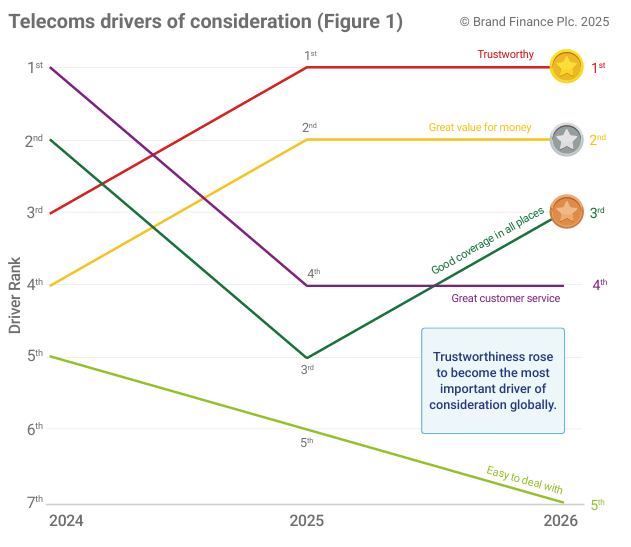
Global telecoms data over the past three years reveals a clear structural shift in what drives brand consideration. In 2024, operational factors dominated. Great customer service and strong coverage were the leading reasons people considered a provider, while trustworthiness ranked third. Consumers were primarily evaluating whether the service would perform reliably and whether support would be available when needed.
By 2025, and sustained into 2026, the hierarchy changed. Trustworthiness rose to become the most important driver of consideration globally, while value for money moved firmly into second place. Coverage and customer service, though still essential, no longer led decision-making in the same way. (See Figure 1)
This does not mean operational performance matters less. On the contrary, it highlights an important evolution. While strong coverage, digital tools and responsive service lose power as distinguishing features, they remain fundamental to building or breaking trust.
How to build trust
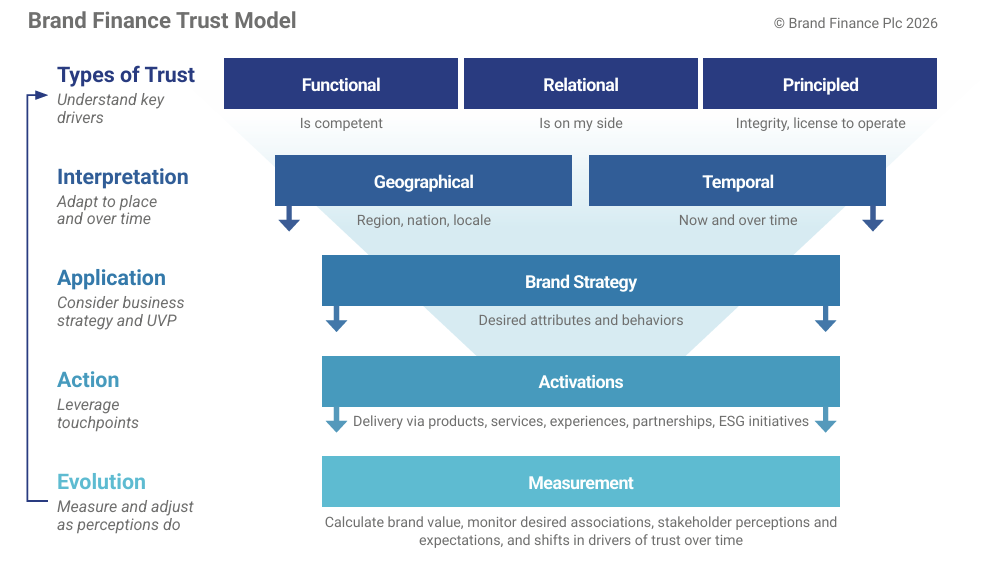
At Brand Finance, we define trust through three interconnected pillars: functional performance, relational experience and integrity. The movement observed in telecoms consideration drivers over 2024–2026 can be read directly through this framework.
Functional trust forms the foundation. In telecoms, this means reliable connectivity, resilient infrastructure and seamless digital performance. In 2024, when customer service and coverage topped the ranking, functional signals were the clearest route to consideration.
Today, those same attributes remain essential – but they are increasingly assumed. When they fail, trust is quickly undermined; when they work, they create the stability that allows higher-order perceptions to develop.
Relational trust reflects how customers feel they are treated. As service expectations standardise and digital self-service becomes ubiquitous, the tone and clarity of communication gain importance.
The drop in “easy to deal with” as a differentiating driver suggests that friction has been reduced across the industry. Yet this does not eliminate the relational dimension; rather, it raises the bar. As automation expands, empathy and fairness in interactions become more visible markers of trust.
Integrity has become particularly decisive in recent years. The rise of trustworthiness to the top position in 2025 and 2026 reflects growing sensitivity to data privacy, regulatory scrutiny and the expanding role telecoms operators play in digital ecosystems. Consumers are no longer assessing providers solely on whether the network works; they are evaluating whether the company behind it acts responsibly. Transparent pricing, ethical data governance and clear accountability signal that a brand is principled as well as capable.
The simultaneous rise of value for money reinforces this point. In many markets, economic pressure has sharpened attention on recurring costs. Value perception is not only about price levels, but about fairness and justification.
When consumers rank both trustworthiness and value at the top, they are expressing a combined expectation: that providers will act reliably and charge fairly.
Importantly, the relative weight of these pillars varies across geographies. Cultural norms, regulatory environments and economic conditions shape how trust is interpreted. In some markets, functional robustness may remain the dominant signal. In others, transparency or corporate responsibility may carry greater influence. For global telecoms brands, the framework remains constant, but its emphasis must adapt to local expectations and through the lenses of the brand strategy.
What does this mean for telecoms brands in 2026?
First, functional excellence is non-negotiable. Coverage, network resilience and service standards are no longer differentiators – they are prerequisites for credibility. Failure at this level directly erodes trust.
Second, relational clarity must accompany technological advancement. As AI and digital interfaces become more prevalent, communication must remain transparent and human-centred. Efficiency cannot come at the expense of empathy and perceived fairness.
Third, integrity must be visible. Responsible data practices, straightforward pricing structures and clear corporate conduct reinforce the trust that now sits at the top of consideration drivers.
Brand Finance studies demonstrate that these perceptions influence behaviours such as usage, loyalty and willingness to pay. These directly influence financial performance, so as trustworthiness moves to the number one driver in telecoms, its commercial significance intensified.
The telecoms sector was once defined primarily by infrastructure. Today, it is defined by confidence. Coverage connects customers and service supports them, but trust, grounded in functional reliability, relational fairness and integrity that is clearly demonstrated and visible to those outside the organisation, is what secures long-term relationships, building resilience and enduring brand value.