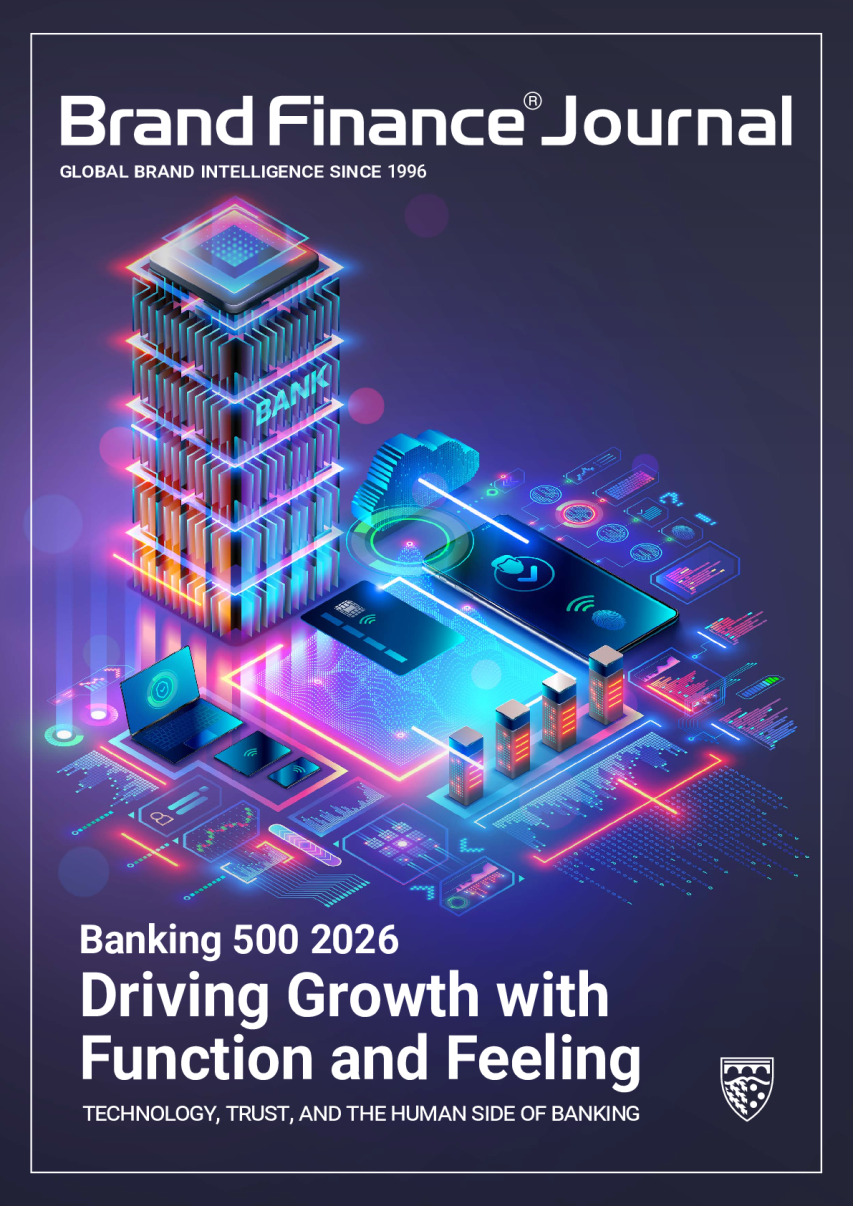





Read the full Brand Finance Banking 500 Journal 2026.
To mark the release of the latest Brand Finance Banking 500 Journal, Brand Finance brought together senior leaders and industry experts to explore the trends reshaping the sector for a Brand Exchange event: the Banking 500 CMO Roundtable.
The conversation explored key insights from the Banking 500 Journal 2026 and examined how banks are navigating geopolitical uncertainty, evolving customer expectations, and rapid technological change while maintaining the trust that underpins the sector.
Despite global volatility, roundtable participants noted that the banking system today is structurally stronger than in previous crises. Years of regulatory reform, stronger capital buffers, and improved risk management frameworks have increased the banking sector’s overall resilience. This stability is reflected in the Banking 500, which shows continued growth in the combined brand value of the world’s leading banks, rising 10% to reach approximately USD1.8 trillion in 2026.

Customer behaviour is also evolving. Many people now maintain relationships with multiple financial institutions, using traditional incumbents for long-term financial needs while turning to digital-first challenger banks for speed and convenience in everyday transactions. A central theme identified in the Journal, and reinforced during the roundtable, was the continued maturation of neobanks. In 2026, Revolut remains the world’s fastest-growing banking brand, with its brand value more than tripling (+239%) since 2025 to reach USD6.6 billion, following an earlier 795% increase from 2024. While Brand Finance research finds neobanks compete strongly with traditional banks at the top of the brand funnel and achieve awareness levels close to incumbents, traditional banks still tend to have an advantage when it comes to trust in more complex or high-stakes financial decisions.
Trust therefore remains central to the strength of banking brands. Participants emphasised that it is not only built through reliable services and secure systems, but also through human support and transparent governance. Customers increasingly expect banks to demonstrate fairness, clarity, and accountability in how they operate, particularly as regulatory requirements and customer protections continue to evolve.

Artificial intelligence is beginning to play a larger role across banking operations. The session highlighted its growing use in areas such as data analysis and operational efficiency to customer communications, as well as emerging applications including transcription, summarisation, and AI-assisted copywriting for marketing and internal communications. Some participants also underlined the potential of more advanced agentic AI to improve operational workflows and enable personalised experience at a greater scale.
However, while AI can improve speed and personalisation, many agreed that technology cannot replace the reassurance customers seek when making important financial decisions. They emphasised that complex or emotionally significant interactions still need a human touch, noting that banks relying too heavily on automation risk appearing too transactional.
Successful AI adoption, the roundtable suggested, will depend not only on capability but also on strong governance and clear alignment with a bank’s broader values. AI can amplify how a brand behaves and communicates with its customers, positively or negatively, making responsible oversight essential to avoid poor-quality outputs or loss of trust.
Beyond this, participants noted that banks are continuing to look beyond the financial services sector for inspiration. Customer expectations are increasingly shaped by experiences, with marketing and brand leaders taking inspiration from other industries, from retail to hospitality.

At the same time, areas like wealth management are emerging as key growth opportunities. The Brand Finance Banking 500 Journal found that the wealth management segment within banking institutions recorded 45% brand value growth in 2026, the highest of any segment in the sector. Contributors to the roundtable pointed out that as the intergenerational transfer of wealth/assets accelerates, demand for financial advice and long-term planning services is increasing. They also emphasised that in these areas, brand trust and strong relationships remain particularly important.
Brand Finance hopes the Banking 500 Journal proves valuable to senior marketing leaders around the world, providing a benchmark for measuring, managing, and maximising the long-term value of banking brands. We welcome further conversations about how Brand Finance can help bridge the gap between marketing and finance within your organisation.
We also invite senior marketing and business leaders to become part of the Brand Exchange Club – a private, global community bringing together voices from marketing, finance, sport, politics, and beyond. Originally established over a decade ago and relaunched in 2024, the Club is known for its insightful discussions, influential speakers, and growing network of decision-makers.
If you are interested in joining the community and attending our private events, or would like to hear more, please get in touch at events@brandexchange.com.
The Brand Exchange event: Banking 500 CMO Roundtable was held in London on Wednesday 4 March 2026.