




This article was originally published in the Brand Finance Airlines 50 2026.
Turkish Airlines is strengthening its position as a leading global aviation brand, with brand value rising on the back of disciplined execution, network scale, and sustained financial performance. In a volatile operating environment, competitive advantage is increasingly defined by the ability to grow profitably while maintaining resilience and consistency. Professor Murat Şeker, Chairman of the Board of Directors and the Executive Committee, Turkish Airlines, highlights how the airline continues to translate scale into performance through its diversified business model, strategic network advantage via Istanbul, and a disciplined focus on long-term value creation.
Interview with Professor Murat Şeker
Turkish Airlines delivered the strongest increase in brand value among its global airline peers airline peers in 2026, reinforcing the strength of a platform built on scale, resilience and disciplined execution. This performance reflects more than visibility or reputation. It reflects a business model that has continued to grow, generate earnings and strengthen its competitive position in a highly volatile operating environment.

Chairman of the Board
of Directors and the
Executive Committee,
Turkish Airlines
In 2025, Turkish Airlines navigated geopolitical tensions, macroeconomic uncertainty, aircraft delivery delays and engine-related disruptions, while continuing to deliver growth, profitability and long-term strategic progress. This performance is the product of a diversified business model, a flexible operating structure and a clear focus on cash generation.
The increase in brand value has been underpinned by measurable operating and financial performance. In 2025, Turkish Airlines generated USD24.1 billion in total revenue, USD2.9 billion in net income and USD5.7 billion in EBITDAR - sustaining an EBITDAR margin of almost 24%. Passenger numbers reached close to 93 million, load factors improved to 83%, and total capacity rose by nearly 8% year on year. These results show that the strengthening of the brand is being supported by demand, continued traffic growth and strong earnings capacity.
What distinguishes Turkish Airlines is its ability to translate growth into returns while preserving financial discipline. In 2025, capacity growth ran approximately 2 percentage points above the industry average, and more than 45% above 2019 levels, while profitability remained ahead of sector benchmarks.
Turkish Airlines also continued to outperform on return on invested capital, reflecting disciplined capital allocation, prudent financial management and agile execution. In an industry where growth alone is rarely sufficient, the ability to expand while protecting margins and capital efficiency remains a defining sign of structural strength. This performance is rooted in a durable competitive position. Turkish Airlines ended 2025 with a fleet of 516 aircraft and an international network spanning 303 destinations across 131 countries, preserving its position as the airline flying to more countries than any other.
The strategic value of this network is amplified by the geographic advantage of Istanbul. From Istanbul, we can access roughly 4 billion people, 35% of global GDP and 60% of global trade volume – all within approximately six hours of narrow-body range. This natural connectivity advantage supports network relevance, schedule strength, aircraft utilisation and long-term traffic capture across Europe, Asia, the Middle East and Africa.
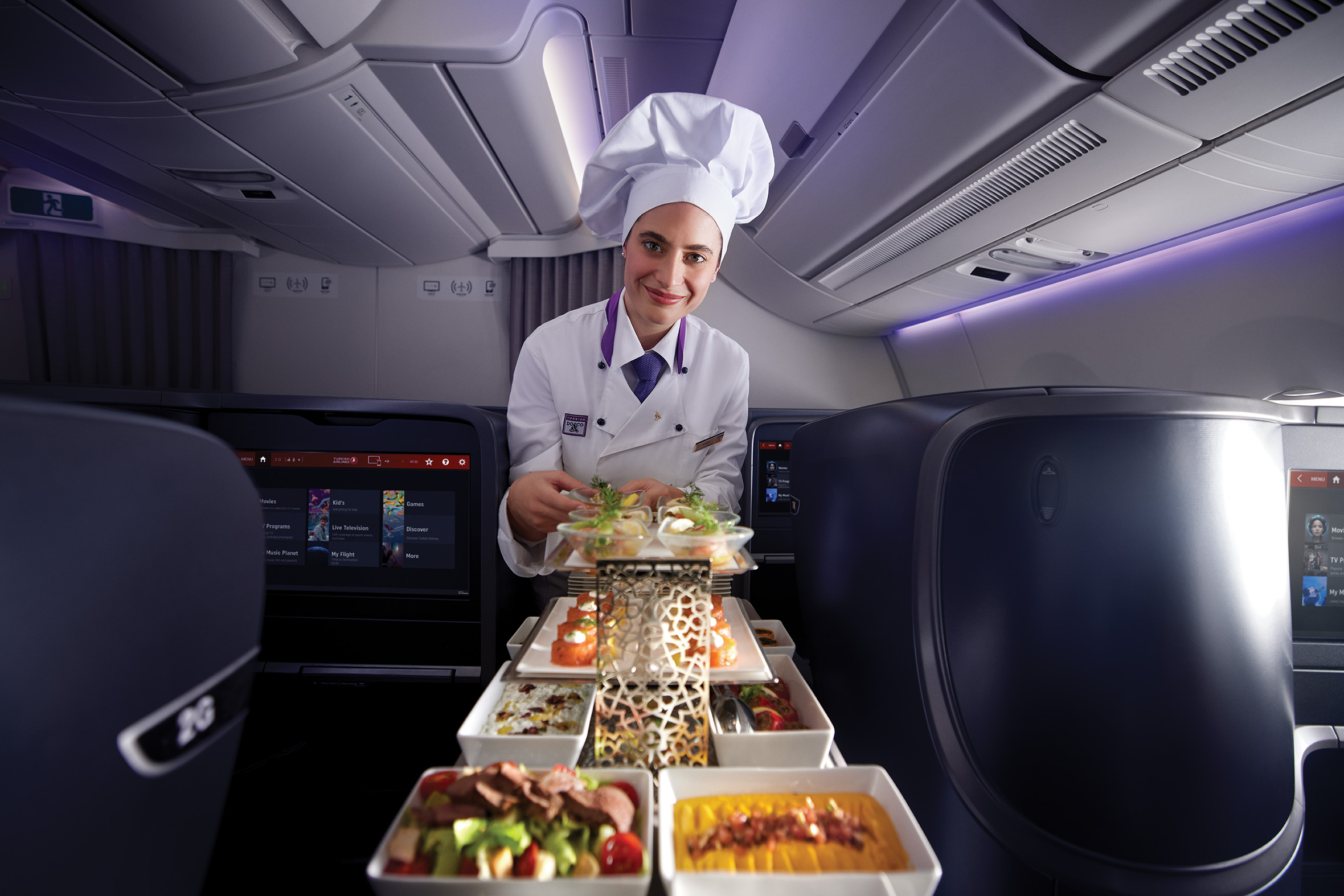
Brand strength has also been reinforced by product quality, customer relevance and operational consistency. Turkish Airlines was recognised by Skytrax as Best Airline in Europe for the 10th time and was given the fifth consecutive APEX World Class Award and a second consecutive Best in Class for Sustainability distinction. Customer satisfaction reached nearly 86%, while on-time departure performance stood at the 81% region. These are important indicators because in aviation, brand strength becomes commercially valuable only when it translates into preference, loyalty, repeat traffic and a stronger revenue mix.
Another important pillar of this story is diversification. Turkish Airlines today represents more than a passenger airline. In 2025, cargo volume increased to over 8% to 2.2 million tonnes, while cargo revenues remained close to USD3.4 billion for the year. Turkish Cargo has also cemented its position among the world’s leading air cargo carriers.
In parallel, external technical revenues increased by 25% to USD676 million, supported by strong maintenance demand and expanding ecosystem capabilities. Alongside these businesses, Turkish Airlines benefits from a 24 million-member Miles&Smiles loyalty base and a growing portfolio of adjacent service platforms. This diversified structure broadens earnings sources, strengthens resilience and supports value creation across multiple business lines.
Cash generation further underscores the quality of this momentum. Strong operating cash flow and lower aircraft pre-delivery payments resulted in USD2.5 billion of free cash flow in 2025, equivalent to a 10% free cash flow margin and a 37% increase year on year.
At the same time, Turkish Airlines continued to invest in its long-term growth platform, with infrastructure projects across cargo, technical maintenance, catering, data centres and training facilities totaling more than USD2.5 billion.
These investments are not only designed to add capacity, but also to deepen operational capability, improve service delivery and reinforce ecosystem strength over time.
Taken together, these results explain why the increase in brand value is meaningful. It reflects a company that is expanding with discipline, converting scale into profitability, strengthening customer preference and building a broader aviation ecosystem with long-term relevance.
Turkish Airlines is not being recognised for promise alone; it is being recognised for performance. The brand is strengthening because the business is strengthening. This is what makes this outcome more than a reputational achievement. It is a visible sign of
improving competitive durability, stronger earnings quality and rising long-term value creation.