





View the full Brand Finance World's Most Valuable B2B Brands 2026 report here.
Understanding and influencing key stakeholders' perceptions and behaviours

Brand Finance Asia Pacific
Many B2B businesses underestimate their brands. They should not. The collective value of the top 300 B2B brands globally is over USD4 trillion - more or less the total value of the South Korean, Taiwanese or French stock markets and only slightly less than the UK’s. At a business level, brands are one of the most important assets in B2B companies, making up an average of 11% of their business’ value. The imperative to manage their strength effectively is clear.
A clear positioning and strong brand are particularly important within B2B industries, where people’s jobs and livelihoods can be on the line for hiring the wrong supplier. It is often assumed that brands are not so important in B2B industries and, granted, there is still a gap between the importance of brands in B2B industries (11% of business value) and B2C industries (18% of business value).
However, the best-performing B2B businesses outperform competitors and defend their position by establishing a clear, distinctive niche in the minds of their clients. Microsoft’s clear positioning as a productivity enabler puts it top of mind for new services like cloud and AI integration. Amazon’s reputation for simplicity and cost efficiency has helped AWS become the largest cloud provider globally. EY has in recent years succeeded in placing itself higher up the chain of command as an advisor to the C-Suite, partly by relying more heavily on emotional messaging. DP World has become the world’s fastest growing logistics brand in recent years by building a positioning “changing what’s possible” through trade and connecting goods “from factory floor to customer door”.
These examples show the opportunity for other B2B businesses to catch up with their counterparts in categories that sell to end consumers by defining and reinforcing the brand’s familiarity and positioning more clearly in their market. To do that, it’s firstly critical to understand how marketing activities affect brand strength and how brand strength impacts brand value in a business-to-business context.
The chain reaction between marketing actions, brand strength and value
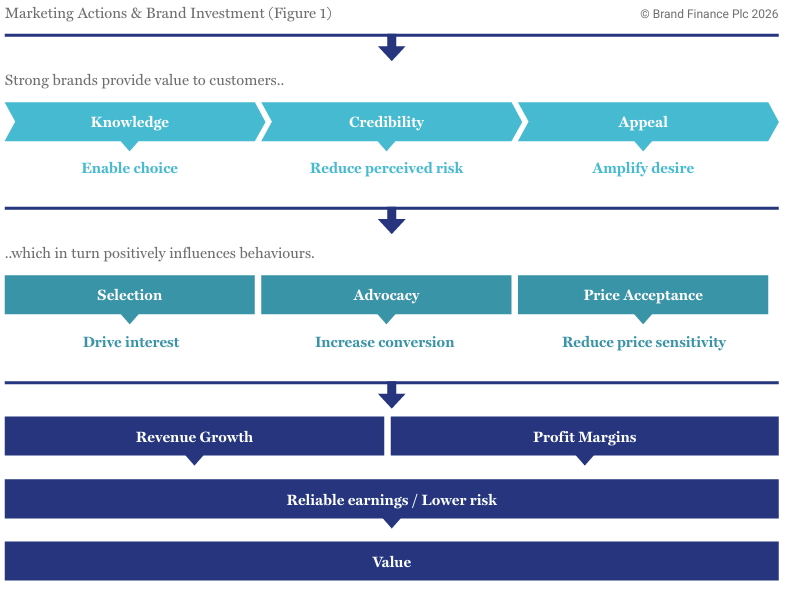
To understand how brands deliver value, it’s useful to read the chart in Figure 1 from bottom to top. Within our businesses, we are trying to maximise revenue, profit and ultimately business value. We do this by trying to influence the behaviour of stakeholders. These behaviours – which focus on selection, active advocacy and acceptance of a higher price – are driven by the number of people who know about each brand and how they perceive it – in particular whether they think they are functionally credible and emotionally appealing. These perceptions are driven by what we do as marketers.
The unique complexity of B2B business' stakeholder environment
Typically, we prioritise customers and potential customers within this framework. However, what makes B2B marketing especially complex is the wide, overlapping network of stakeholders we are trying to influence.
All brands affect a wide range of stakeholders. But in a B2B context, these stakeholders tend to be more varied and important. These start with internal stakeholders. B2B businesses – being less publicly known – often struggle more so than with B2C brands to attract graduate staff.
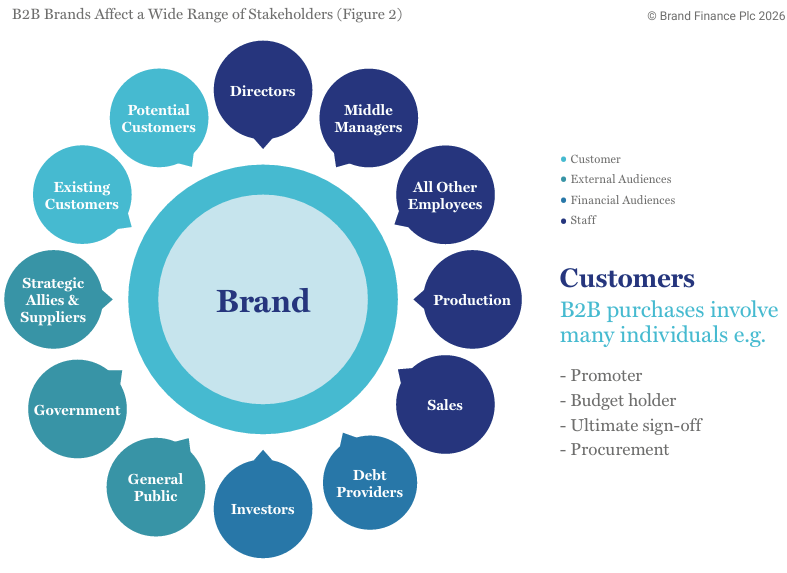
Beyond employees, financial stakeholders are a key group as they facilitate what are often significant capital expenditure requirements.
General Public and Government stakeholders are often key for providing consent to investment and commercial activities in a way that far exceeds the consent required for B2C brands.
An individual B2B purchase tends to involve various individuals – for example, an initial promoter or project lead, a budget holder, ultimate sign-off directors and procurement to name some with influence over the decisions. This is further complicated given that, depending on the time, the same company can be a customer, competitor or supplier.
What this means for B2B brand leaders
At Brand Finance, we champion the power and value of B2B brands, but our analysis shows that there is clearly work to be done. That said, in some B2B companies, brand is a dirty word and marketing is underinvested in compared to hard assets like property; factories; land and distribution capabilities.
Proving their importance starts with measurement. Our B2B brands ranking demonstrates the impact brands can have, while brand valuations - especially when supported by a clear explanation of their effects on revenue and profit - help make a compelling case in the boardroom. Through that process, it’s key to interrogate the brand strength research integral to the valuation. This research helps us to understand the behaviours and perceptions that drive value and help us link back to the impact of our brand strategy and marketing activities.
But we need to use that measurement to make our brands more effective. Emotional advertising works well to differentiate B2B brands which are often staid and functional. B2B brands’ positioning is sometimes inconsistent and unclear. Brand architecture and the creation of new brands can be confusing and ad hoc. Often, too little time is spent on making B2B brands known and remembered beyond existing customers.
The opportunity for B2B brand leaders is to actively shape their brands’ value. In complex stakeholder environments where decisions are high-stakes and multi-layered, brands that are clearly positioned, emotionally resonant, and consistently activated will outperform those that remain purely functional or invisible. Those organisations that recognise brand as a driver of commercial performance, rather than a cost centre, will be best placed to influence behaviour, command price premiums, and secure long-term growth.