





New Brand Finance data shows South African brands dominate the top 10 positions in this year’s Africa 200 ranking
LONDON, 25 May 2026 – Africa’s top 200 brands have grown by 11% to reach a combined value of USD62.6 billion in 2026, driven by strong performance across the banking, telecoms, and retail sectors, according to the Africa 200 2026 report by Brand Finance, the world’s leading brand valuation consultancy.
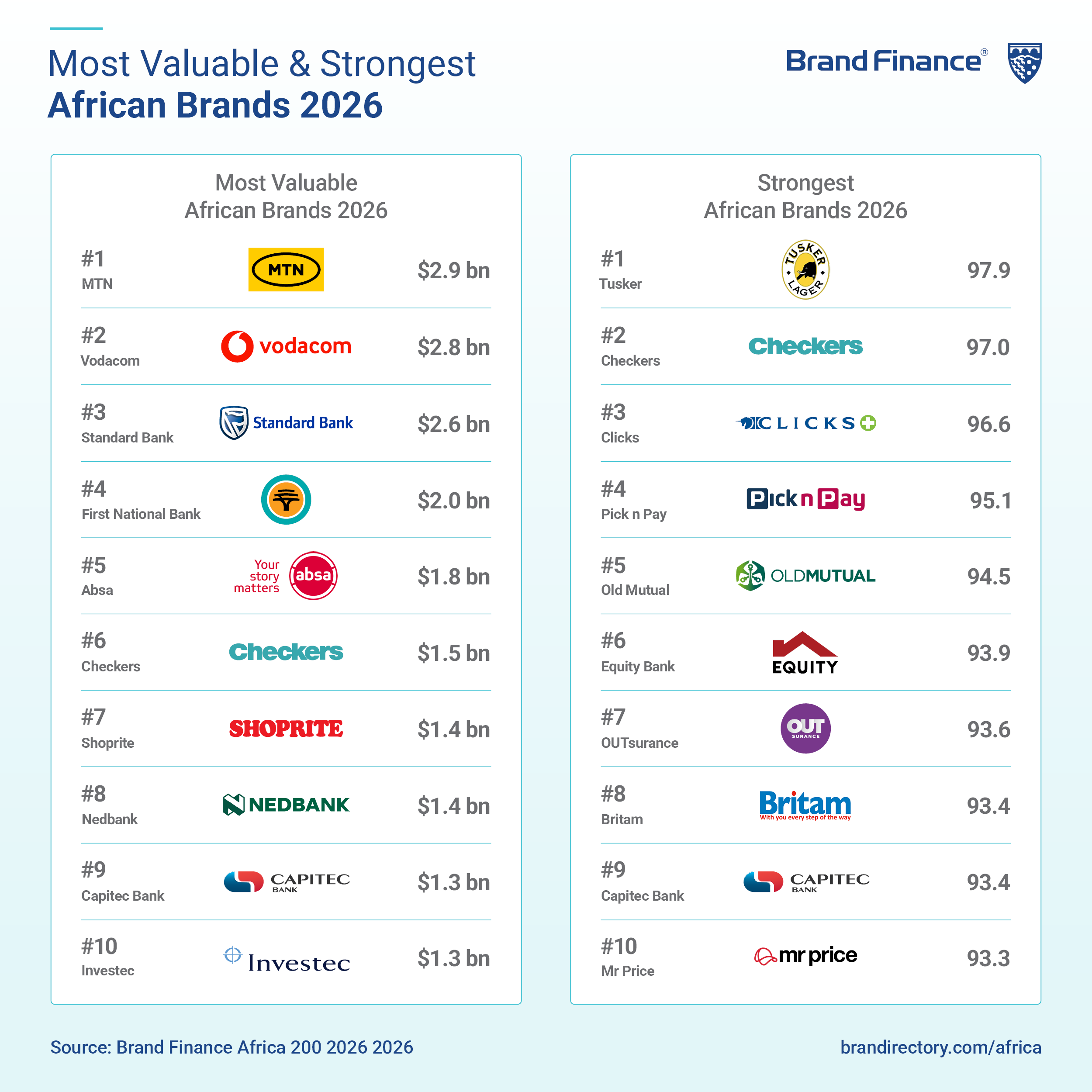
South Africa continues to dominate Africa’s brand landscape, accounting for 71% of total brand value with 104 brands worth USD44.6 billion, driven by the scale and sophistication of its banking, telecoms, and retail sectors, and home to all the top 10 most valuable brands within this year’s ranking. While MTN maintains its position as Africa’s most valuable brand for the 13th consecutive year, the gap separating MTN from second-placed Vodacom and third-ranked Standard Bank has narrowed significantly.
At its peak in 2022, MTN was 100% more valuable than Vodacom and 156% more valuable than Standard Bank. By 2026, this lead had narrowed to just 6% and 13% respectively, signalling intensifying competition at the top of the ranking. Beyond this, a tier of emerging regional markets is gaining ground: Morocco’s 13 brands contribute just over 7% (USD4.5 billion), led by Attijariwafa Bank (up 20% to USD1.3 billion), Egypt holds 6.6% (USD4.1 billion) with 25 brands, anchored by National Bank of Egypt (up 10% to USD788 million), while Nigeria accounts for 5.5% (USD3.4 billion), driven by strong growth from Seplat Energy (up 119% to USD135 million), the fastest-growing African brand. Kenya’s 15 brand contribute around 4% (USD2.6 billion), continues to outperform on brand strength, with Tusker ranked as Africa’s strongest brand. Overall, Africa’s brand landscape remains highly concentrated but is showing increasing momentum across key regional markets.
MTNremains Africa’s most valuable brand for the 13th year running, with its brand value holding steady at USD2.9 billion, supported by sustained growth in data and fintech and consistent execution across its 16 markets. With approximately 301 million subscribers and 5G coverage reaching 44% of the population, the brand continues to scale its reach and relevance.
Vodacom ranks second, with its brand value rising 9% to USD2.8 billion, driven by geographic expansion into Egypt and Ethiopia and growing contributions from digital platforms such as VodaPay, M-Pesa, and Vodafone Cash, reinforcing its evolution into a broader digital ecosystem player.
Standard Bank places third, with a 19% brand value increase to USD2.6 billion, underpinned by strong performance in corporate and investment banking, increased fee and trading income, and continued investment in technology infrastructure, enhancing client experience whilestrengthening brand visibility through high-profile partnerships.
Jeremy Sampson, Chairman, Brand Finance Africa, commented:
“This year’s Africa 200 ranking reflects the growing confidence of Pan‑African brands. Many of the continent’s most valuable brands are no longer defined solely by their domestic markets. They are expanding across borders, exporting African expertise, and increasingly competing with global players on equal footing. This evolution carries significance beyond commercial success. Strong African not only create shareholder value, but also strengthen the continent’s economic narrative, support intra‑African trade, and enhance Africa’s standing on the global stage. The progress is clear: intra-African trade accounted for just around 3% in the late 1950s, compared to nearly 20% today, with momentum continuing to build.”
Tusker ranks as Africa’s strongest brand, achieving a Brand Strength Index (BSI) score of 97.9/100 and an AAA+ rating. Its leadership is driven by exceptional performance across familiarity, preference, and reputation, reflecting deep cultural resonance and strong emotional connection with consumers in its home market, supported by consistent brand building and enduring loyalty.
Checkers ranks second with a BSI score of 97.0/100 and an AAA+ rating, underpinned by a compelling blend of credibility and a premium value proposition focused on quality, innovation, and convenience. This positioning is further strengthened by Shoprite Group’s scale and advanced digital capabilities, which continue to expand customer reach and enhance engagement.
Clicks follow closely in third, also achieving an AAA+ rating with a BSI score of 96.6/100, driven by high levels of trust in the health and beauty category. Its performance is supported by the continued expansion of its omnichannel ecosystem and the success of its ClubCard loyalty programme, enabling more personalised offerings and fostering sustained, long-term customer relationships.
Seplat Energy is Africa’s fastest-growing brand in 2026, with its brand value soaring 119% to USD135 million, rising 46 places to 91st. Growth is driven by strong financial performance, with revenue increasing 204% in the first nine months of 2025, supported by higher production and asset integration. Its repositioning as an “Energy Transition Champion”, alongside projects such as ANOH, has strengthened its role in Nigeria’s gas-led energy transition and broader sustainability agenda.
Other notable brands in the Africa 200 2026 report are:
14 new brands entered the Africa 200 report year:
Sustainability
The 2026 Sustainability Perceptions Index reveals which brands are perceived to have the strongest commitment to sustainability globally, the evolving role of sustainability in driving demand, and the substantial value tied to sustainability for the world’s biggest brands.
M-PESA’s sustainability credentials demonstrate how strong ESG performance can deepen trust and support long-term brand value. In 2025, M-PESA achieved a 99% recycling rate according to Safaricom’s Sustainable Business Report, collecting 190 tonnes of e-waste and 62 tonnes of plastic through M-PESA Green Points, a programme that rewards users for eco-friendly actions.
Socially, the brand has strengthened financial inclusion in underserved areas, improving access to education and healthcare. From a governance perspective, M-PESA has also helped identify illicit activity, including poaching and money laundering linked to transactions on its platform.
Safaricom, Kenya Commercial Bank, and Tusker from Kenya, alongside Woolworths from South Africa also score strong sustainability perceptions among African brands.




Brand Finance is the world’s leading brand valuation consultancy. Bridging the gap between marketing and finance, Brand Finance evaluates the strength of brands and quantifies their financial value to help organisations make strategic decisions.
Headquartered in London, Brand Finance operates in over 25 countries. Every year, Brand Finance conducts more than 6,000 brand valuations, supported by original market research, and publishes over 100 reports which rank brands across all sectors and countries.
Brand Finance also operates the Global Brand Equity Monitor, conducting original market research annually on 6,000 brands, surveying more than 175,000 respondents across 41 countries and 31 industry sectors. By combining perceptual data from the Global Brand Equity Monitor with data from its valuation database — the largest brand value database in the world — Brand Finance equips ambitious brand leaders with the data, analytics, and the strategic guidance they need to enhance brand and business value.
In addition to calculating brand value, Brand Finance also determines the relative strength of brands through a balanced scorecard of metrics, compliant with ISO 20671.
Brand Finance is a regulated accountancy firm and a committed leader in the standardisation of the brand valuation industry. Brand Finance was the first to be certified by independent auditors as compliant with both ISO 10668 and ISO 20671 and has received the official endorsement of the Marketing Accountability Standards Board (MASB) in the United States.
Brand is defined as a marketing-related intangible asset including, but not limited to, names, terms, signs, symbols, logos, and designs, intended to identify goods, services, or entities, creating distinctive images and associations in the minds of stakeholders, thereby generating economic benefits.
Brand strength is the efficacy of a brand’s performance on intangible measures relative to its competitors. Brand Finance evaluates brand strength in a process compliant with ISO 20671, looking at Marketing Investment, Stakeholder Equity, and the impact of those on Business Performance. The data used is derived from Brand Finance’s proprietary market research programme and from publicly available sources.
Each brand is assigned a Brand Strength Index (BSI) score out of 100, which feeds into the brand value calculation. Based on the score, each brand is assigned a corresponding Brand Rating up to AAA+ in a format similar to a credit rating.
Brand Finance calculates the values of brands in its rankings using the Royalty Relief approach – a brand valuation method compliant with the industry standards set in ISO 10668. It involves estimating the likely future revenues that are attributable to a brand by calculating a royalty rate that would be charged for its use, to arrive at a ‘brand value’ understood as a net economic benefit that a brand owner would achieve by licensing the brand in the open market.
The steps in this process are as follows:
1 Calculate brand strength using a balanced scorecard of metrics assessing Marketing Investment, Stakeholder Equity, and Business Performance. Brand strength is expressed as a Brand Strength Index (BSI) score on a scale of 0 to 100.
2 Determine royalty range for each industry, reflecting the importance of brand to purchasing decisions. In luxury, the maximum percentage is high, while in extractive industry, where goods are often commoditised, it is lower. This is done by reviewing comparable licensing agreements sourced from Brand Finance’s extensive database.
3 Calculate royalty rate. The BSI score is applied to the royalty range to arrive at a royalty rate. For example, if the royalty range in a sector is 0-5% and a brand has a BSI score of 80 out of 100, then an appropriate royalty rate for the use of this brand in the given sector will be 4%.
4 Determine brand-specific revenues by estimating a proportion of parent company revenues attributable to a brand.
5 Determine forecast revenues using a function of historic revenues, equity analyst forecasts, and economic growth rates.
6 Apply the royalty rate to the forecast revenues to derive brand revenues.
7 Discount post-tax brand revenues to a net present value which equals the brand value.
Brand Finance has produced this study with an independent and unbiased analysis. The values derived and opinions presented in this study are based on publicly available information and certain assumptions that Brand Finance used where such data was deficient or unclear. Brand Finance accepts no responsibility and will not be liable in the event that the publicly available information relied upon is subsequently found to be inaccurate. The opinions and financial analysis expressed in the study are not to be construed as providing investment or business advice. Brand Finance does not intend the study to be relied upon for any reason and excludes all liability to any body, government, or organisation.
The data presented in this study form part of Brand Finance's proprietary database, are provided for the benefit of the media, and are not to be used in part or in full for any commercial or technical purpose without written permission from Brand Finance.