




This article was originally published alongside the Brand Finance Nation Brand Value 2026 ranking and subsequently included in the Brand Finance Global Soft Power Index 2026.

Managing Director,
Brand Finance Asia Pacific
Nation brand value in 2026 has been buffeted by major economic and reputational trends, with overall brand value declining by 6%. Behind this headline figure, one of the biggest falls in recent reports, are three key trends: Declining values among Western nations as reputation falters; the stabilising effect of non-cyclical sectors supporting valuations; and economic headwinds limiting the benefits of improving perceptions in emerging markets.
Western countries see falling values
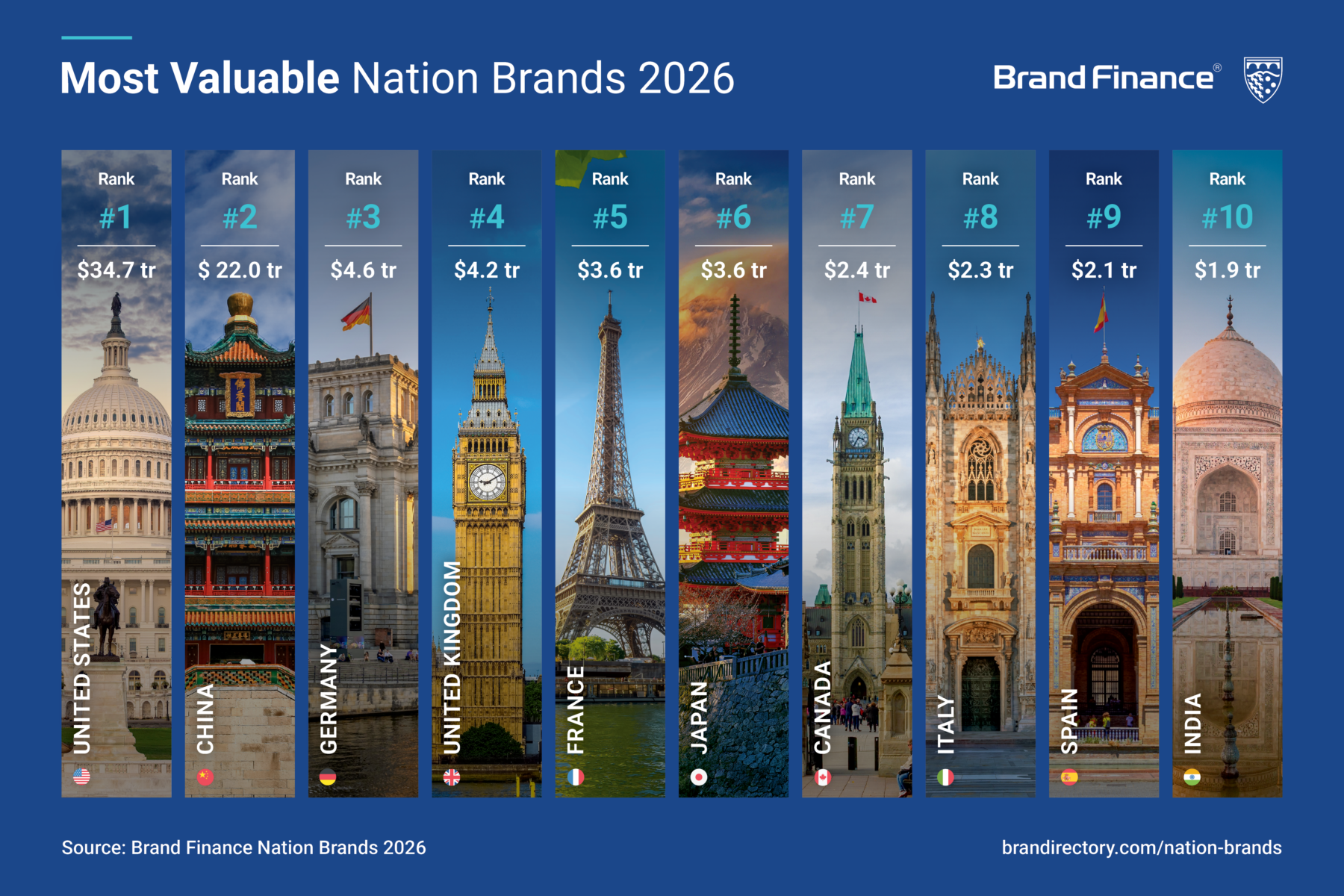
This year we have seen a concerning fall in both Soft Power scores and nation brand value among major Western powers, particularly within the top 10. The USA fell by 7%, Germany by 8%, the UK by 5%, France by 7%, and Canada by 12%.
As the Western alliance seems more fragile than at any point in recent history, tariffs and geopolitical turbulence are damaging perceptions and, combined with persistently high costs, particularly energy prices, are weakening the economic outlook for many traditional leaders.
Meanwhile, China’s nation brand value continues to surge, increasing by USD1.49trn (7%), as it sidesteps the effects of U.S. tariffs by redirecting exports to compensate for softer domestic consumption, narrowing the gap with the U.S. by 24% in a single year.
Non-cyclical sectors supporting nation brand values
Several nations have recorded strong performances in 2026, including Ireland (up 8 places, with nation brand value rising 22%), Denmark (+4, +10%) and Switzerland (no rank change, value +6%), UAE (no rank change, +5%), Saudi Arabia (no rank change, +2%) and Qatar (+5, +12%).
These markets are supported by non-cyclical sectors such as technology, pharmaceuticals, chemicals, and energy, which have maintained their resilience despite disruption caused by tariffs and geopolitics affecting other parts of the global economy. Many also benefit from the strength of globally recognised companies, including Novo Nordisk in Denmark and Aramco in Saudi Arabia, as well as visionary plans for the future such as Saudi Arabia’s Vision 2030, AI leadership in the UAE, and Qatar’s North Field Expansion, which is set to unlock significant new LNG supply.
These middle-tier powers have successfully supported nation brand value growth by building on their distinctive strengths and establishing strong relationships with visitors, investors and customers that help them to maintain their Soft Power and brand value despite recent global turbulence.
Economic pressures blunting the impact of improving emerging market perceptions
One of the most analytically interesting trends in the 2026 ranking is the growing cohort of nations where Soft Power scores are rising while brand value falls.
Brazil is the clearest example in absolute terms. Although its Soft Power score climbed 0.4 points, its brand value fell by USD186 billion (-19%) to USD788bn, costing it a place in the ranking. Other nations in this ‘score up, value down’ category include Russia (+0.6; -11%), Vietnam (+0.5; -11%), Pakistan (+0.7; -36%), Kazakhstan (+0.8; -26%), Argentina (+0.5; -21%), Bangladesh (+0.3; -29%) and Romania (+0.9; -10%).
The underlying causes for this are diverse. Romania has experienced significant fiscal consolidation over the last year – seeing VAT rises, public sector wage freezes and pension restraints – to curb a budget deficit which hit a peak of 9.3%. Elsewhere, currency weakness and volatility, much caused by structural inflation, is holding countries like Argentina, Brazil and Turkey back in brand value terms. Despite the U.S. Supreme Court’s rollback of tariffs in February, the spectre of tariffs has held back projections for nations like Vietnam and Bangladesh. Meanwhile, political isolation and economic distortion hold back Russia’s outlook.
However, much like continued investment in marketing during a recession for corporate brands, these reputational improvements set the ground for future differentiation and growth, despite current economic setbacks.
What does this mean for Nation Brand leadership teams?
The 2026 Brand Finance Nation Brand Value ranking reflects a huge number of changes driven by a similarly large number of causes. Despite this complexity, they expose some important lessons for those responsible for managing nation brand image and reputation.
Firstly, a clear focus on specific sectors can help differentiate and propel middle-tier powers. Denmark has strengthened its position through pharmaceuticals, Ireland through strong technology and business services industries, the UAE through financial services and logistics, and Saudi Arabia and Qatar through Oil & Gas. This focus can help make a nation’s messaging clearer, more distinctive and more memorable, but caution needs to be made to avoid limiting a nation’s image. Finding a way to use strengths in one or a few industries to project capabilities in others can work well – much as Germany has historically done with engineering or Italy with design.
Secondly, companies play a critical role in building nation brand value. Novo Nordisk for Denmark; Pfizer, Google, and Apple for Ireland, Emirates in the UAE; and Aramco for Saudi Arabia all demonstrate how the international success of major corporates can have a notable impact on the performance of the nation brand – providing spillover benefits to many other parts of the economy. Supporting national champions and using their FDI as a tool to leverage and communicate Soft Power can be a winning formula, particularly where there are opportunities for a joint platform such as expos, pavilions and cultural events.
Finally, it is important to continue investing in Soft Power despite current economic difficulties. Many emerging economies are currently seeing declines in nation brand values alongside weaker economic performance. It is important to bear in mind that Soft Power is an investment for the future, protecting economies in challenging periods and propelling them in positive ones. Consistent messaging around long-term strengths or changes can help sustain Soft Power even where economic issues are being resolved. Argentina’s efforts to reposition its economic and political management, along with Vietnam and Bangladesh’s continued emphasis on their business environments are good examples this year.
Given competing interests and influences, running nation brands is a far more complex task than doing so for corporate ones. Nevertheless, these lessons may help make the task slightly simpler, and perhaps contribute to a broader return to growth in next year’s ranking. In the meantime, Brand Finance remains available to support organisations navigating these challenges.