





New Brand Finance data shows Spain’s top 100 brands are valued at €143.7 billion in 2026, up 9% year-on-year
MADRID, 9 July 2026 – Spain’s leading brands demonstrated continued resilience in 2026, with the total value of the Spain 100 ranking rising 9% year-on-year to EUR143.7 billion, according to the Spain 100 2026 report by Brand Finance, the world’s leading brand valuation consultancy.
Strong domestic demand, rising wages, robust tourism activity, and resilient international operations helped support brand growth despite broader macroeconomic pressures across Europe. Banking remained the strongest contributor to growth, with Santander and BBVA driving sector performance through record financial results and international diversification, while tourism continued to reinforce the strength of airline, hotel, retail, and service brands across the Spanish economy.
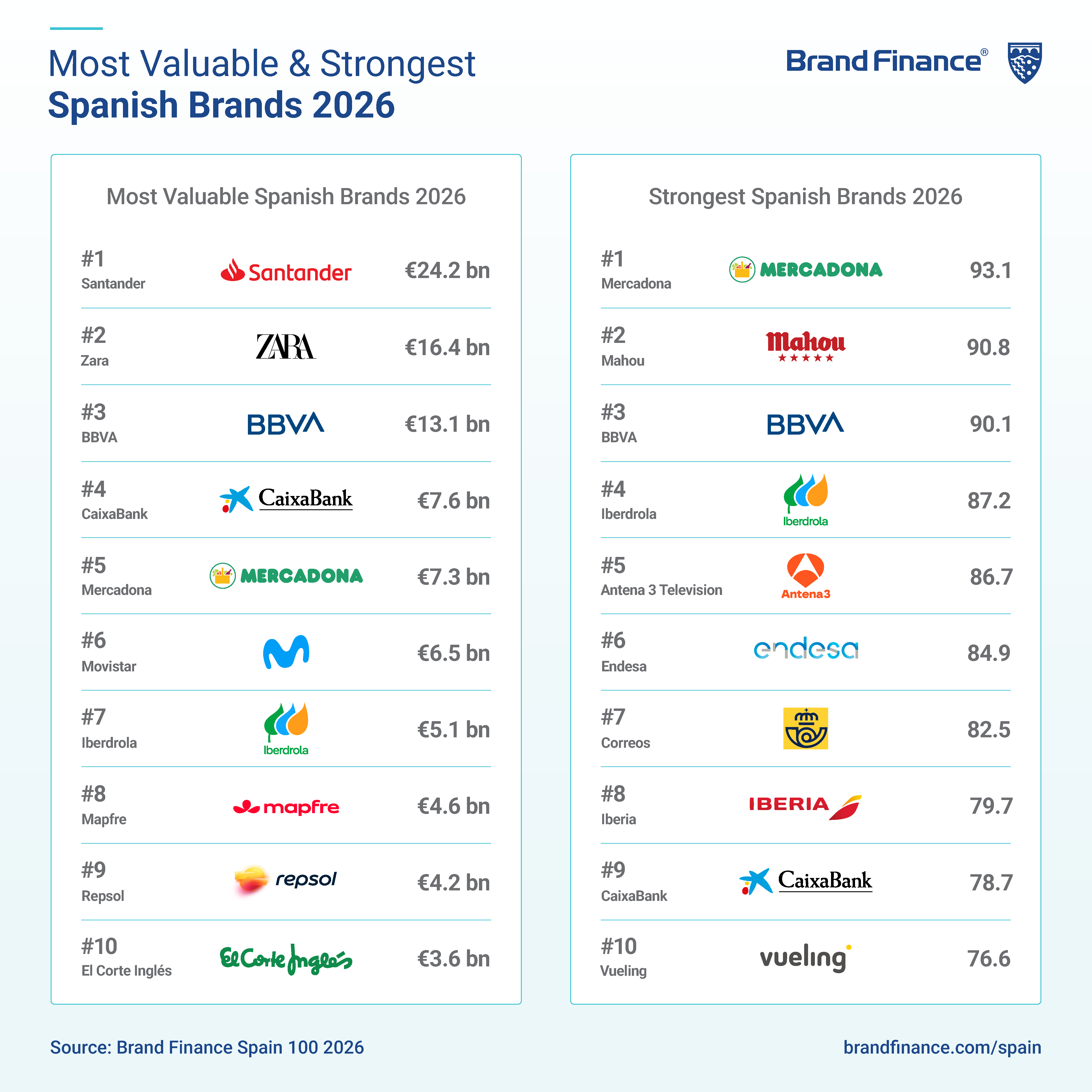
Santander retains its position as Spain’s most valuable brand in 2026, with its brand value up 23% to EUR24.2 billion. The bank’s performance was supported by record financial results and continued international growth, with net income reaching EUR14.1 billion in 2025 and its global customer base expanding to 180 million, reinforcing its position among Europe’s leading banking brands.
Zara remains in second place, with its brand value stable at EUR16.4 billion. Backed by strong international demand and continued profitability across the wider Inditex group. The brand also retains its position as the world’s largest fashion retailer by revenue, supported by strong international demand and continued profitability across the wider Inditex group, while continuing to optimise its store network and advance sustainability initiatives. BBVA is third, with its brand value soaring 58% to EUR13.1 billion, marking one of the biggest increases among the country’s top 10 brands. The bank delivered record financial results in 2025, supported by strong loan growth, rising revenues, and market share gains across Spain, Mexico, and Turkey, while its partnership with OpenAI and rollout of the “Blue” assistant reinforced its position as one of Europe’s leading digital banking brands.
Pilar Alonso Ulloa, Managing Director for Iberia (Spain & Portugal) and South America, Brand Finance, commented:
“Spain’s brand landscape in 2026 reflects a market where resilience is increasingly defined by quality rather than scale alone. Banking continues to anchor the economy, with Santander and BBVA showing how international diversification, digital capability, and disciplined execution translate into sustained brand leadership. At the same time, the strength of consumer-facing brands like Mercadona demonstrates the enduring power of trust, consistency, and customer centricity in driving brand equity. What is particularly notable this year is the emergence of transformation-led growth stories, such as SuperCOR, where strategic repositioning rather than expansion has been the key driver of value creation, signalling a more nuanced and mature phase of brand development in Spain.”
Mercadona (brand value up 22% to EUR7.3 billion) is Spain’s strongest brand in 2026, achieving a Brand Strength Index (BSI) score of 93.12/100 and an AAA+ brand strength rating. The brand’s strength reflects exceptionally high consumer awareness, strong purchase preference, and deep-rooted loyalty across Spain’s grocery sector, driven by its customer-centric “Jefe” philosophy, consistently high product quality, competitive pricing, and strong private label strategy.
Mahou (brand value up 13% to EUR821.6 million) ranks second, achieving a BSI score of 90.8/100 and an AAA+ brand strength rating. The brewery continues to benefit from exceptionally high familiarity, strong reputation, and deep emotional connection among Spanish consumers, underpinned by its long-standing heritage and leadership in Spain’s beer market. Continued investment in premium positioning, sponsorships, experiential marketing, and innovation across premium and low-alcohol categories has helped sustain strong customer loyalty and brand relevance, reinforcing its association with Spanish social and hospitality culture.
BBVA (brand value up 58% to EUR13.1 billion) retains third position with a BSI score of 90.1/100 and an AAA+ rating. BBVA’s strength reflects growing consumer acceptance of its digital-first transformation, particularly its AI-led banking strategy and strong mobile app performance, now among the top financial apps in Europe for customer satisfaction. The bank’s strengthening ESG credentials, supported by EUR63 billion in sustainable lending in the first half of 2025, have further enhanced trust, relevance, and engagement among retail and corporate customers in its home market.
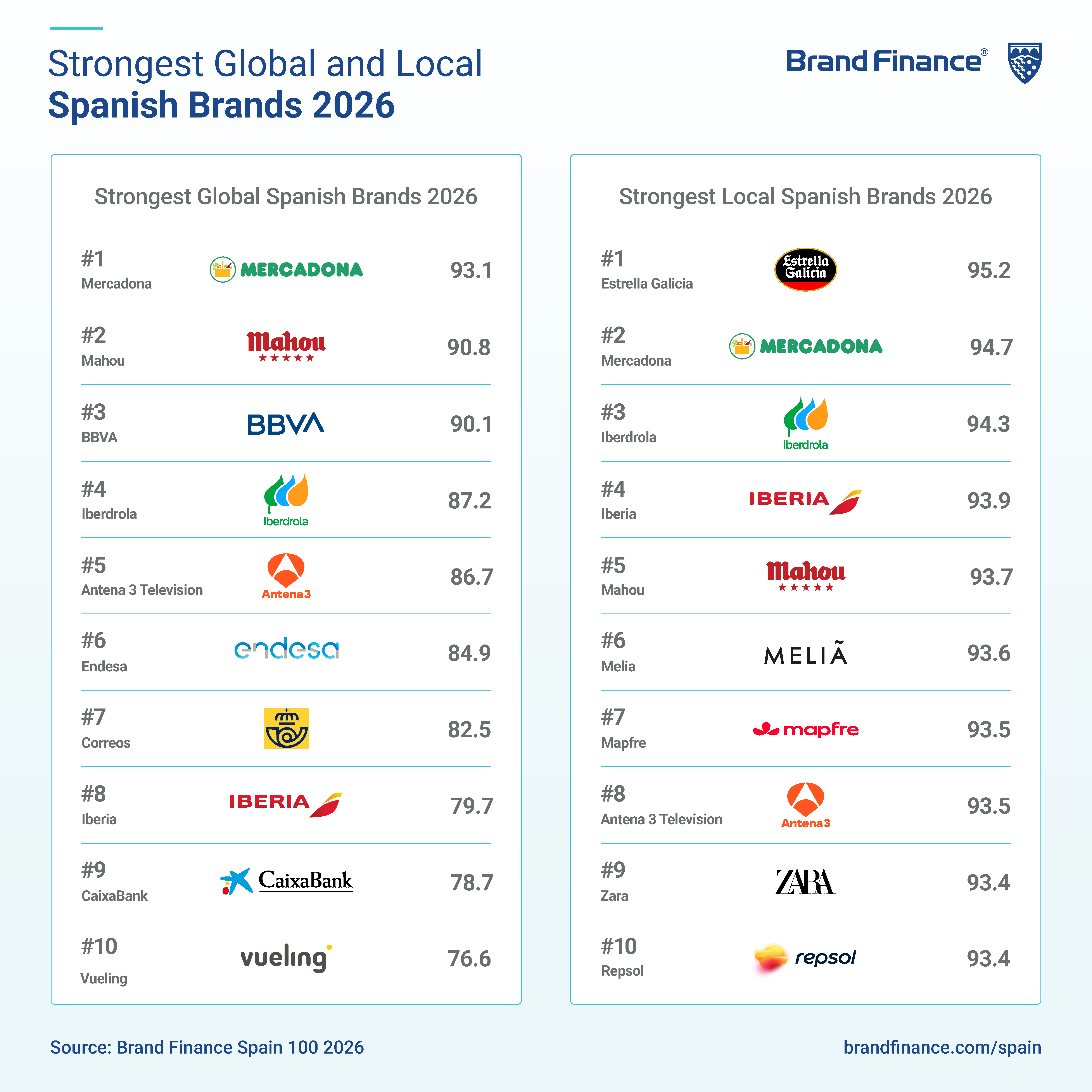
Based on Brand Finance market research data from local Spanish consumers only, Estrella Galicia emerges as Spain's strongest domestic brand, with a local BSI score of 97.7/100. It is followed by Mercadona (94.9/100), Iberdrola (92.9/100), Iberia (92.5/100), Mahou (90.8/100) Meliá (88.7/100), MAPFRE (86.7/100), Antena 3 (86.7/100), Zara (85.2/100), and Repsol (85.1/100).
Moeve (brand value up 4% to EUR1.4 billion) emerges as a brand to watch in 2026, reflecting a year of strong momentum following one of Europe's most significant corporate rebranding programmes. Formerly known as Cepsa, the company has undertaken a comprehensive transformation of its strategy and identity as part of its long-term transition towards green molecule-based energy and mobility solutions, positioning itself as a key player in Europe's energy transition.
SuperCOR emerges as the fastest-growing Spanish brand in 2026, recording a 108% increase in brand value to EUR212 million alongside a significant improvement in its Brand Strength Index (BSI), which rose from 37.8/100 to 52.1/100. This performance is driven not by expansion, but by a deliberate strategic repositioning within the El Corte Inglés portfolio, following the 2024 sale of 47 non-core stores to Carrefour for EUR60 million, enabling a shift away from lower-performing mass-market locations. SuperCOR now operates over 180 stores across Spain, with a renewed focus on proximity retailing, local assortments, and an upmarket shift towards larger, modernised supermarket formats that strengthen its premium positioning and brand strength.
Other notable brands in the Spain 100 2026 report are:
Brand Finance research reveals that, among Spanish consumers, Iberia and Estrella Galicia record the strongest sustainability perceptions across the environmental, social, and governance (ESG) pillars. Iberia leads in the environmental dimension in particular, supported by strong perceptions of its commitment to achieving net zero emissions by 2050, the large-scale adoption of sustainable aviation fuel (SAF), and its participation in the Círculo SAF alliance in 2025, which aims to accelerate the decarbonisation of the aviation sector.
Meliá and NH Hotels & Resorts also record strong sustainability perceptions across all ESG pillars for the third consecutive year, supported by their commitment to employee engagement, inclusive leadership, and transparent ESG reporting aligned with the United Nations Sustainable Development Goals (SDGs).




Brand Finance is the world’s leading brand valuation consultancy. Bridging the gap between marketing and finance, Brand Finance evaluates the strength of brands and quantifies their financial value to help organisations make strategic decisions.
Headquartered in London, Brand Finance operates in over 25 countries. Every year, Brand Finance conducts more than 6,000 brand valuations, supported by original market research, and publishes over 100 reports which rank brands across all sectors and countries.
Brand Finance also operates the Global Brand Equity Monitor, conducting original market research annually on 6,000 brands, surveying more than 175,000 respondents across 41 countries and 31 industry sectors. By combining perceptual data from the Global Brand Equity Monitor with data from its valuation database — the largest brand value database in the world — Brand Finance equips ambitious brand leaders with the data, analytics, and the strategic guidance they need to enhance brand and business value.
In addition to calculating brand value, Brand Finance also determines the relative strength of brands through a balanced scorecard of metrics, compliant with ISO 20671.
Brand Finance is a regulated accountancy firm and a committed leader in the standardisation of the brand valuation industry. Brand Finance was the first to be certified by independent auditors as compliant with both ISO 10668 and ISO 20671 and has received the official endorsement of the Marketing Accountability Standards Board (MASB) in the United States.
Brand is defined as a marketing-related intangible asset including, but not limited to, names, terms, signs, symbols, logos, and designs, intended to identify goods, services, or entities, creating distinctive images and associations in the minds of stakeholders, thereby generating economic benefits.
Brand strength is the efficacy of a brand’s performance on intangible measures relative to its competitors. Brand Finance evaluates brand strength in a process compliant with ISO 20671, looking at Marketing Investment, Stakeholder Equity, and the impact of those on Business Performance. The data used is derived from Brand Finance’s proprietary market research programme and from publicly available sources.
Each brand is assigned a Brand Strength Index (BSI) score out of 100, which feeds into the brand value calculation. Based on the score, each brand is assigned a corresponding Brand Rating up to AAA+ in a format similar to a credit rating.
Brand Finance calculates the values of brands in its rankings using the Royalty Relief approach – a brand valuation method compliant with the industry standards set in ISO 10668. It involves estimating the likely future revenues that are attributable to a brand by calculating a royalty rate that would be charged for its use, to arrive at a ‘brand value’ understood as a net economic benefit that a brand owner would achieve by licensing the brand in the open market.
The steps in this process are as follows:
1 Calculate brand strength using a balanced scorecard of metrics assessing Marketing Investment, Stakeholder Equity, and Business Performance. Brand strength is expressed as a Brand Strength Index (BSI) score on a scale of 0 to 100.
2 Determine royalty range for each industry, reflecting the importance of brand to purchasing decisions. In luxury, the maximum percentage is high, while in extractive industry, where goods are often commoditised, it is lower. This is done by reviewing comparable licensing agreements sourced from Brand Finance’s extensive database.
3 Calculate royalty rate. The BSI score is applied to the royalty range to arrive at a royalty rate. For example, if the royalty range in a sector is 0-5% and a brand has a BSI score of 80 out of 100, then an appropriate royalty rate for the use of this brand in the given sector will be 4%.
4 Determine brand-specific revenues by estimating a proportion of parent company revenues attributable to a brand.
5 Determine forecast revenues using a function of historic revenues, equity analyst forecasts, and economic growth rates.
6 Apply the royalty rate to the forecast revenues to derive brand revenues.
7 Discount post-tax brand revenues to a net present value which equals the brand value.
Brand Finance has produced this study with an independent and unbiased analysis. The values derived and opinions presented in this study are based on publicly available information and certain assumptions that Brand Finance used where such data was deficient or unclear. Brand Finance accepts no responsibility and will not be liable in the event that the publicly available information relied upon is subsequently found to be inaccurate. The opinions and financial analysis expressed in the study are not to be construed as providing investment or business advice. Brand Finance does not intend the study to be relied upon for any reason and excludes all liability to any body, government, or organisation.
The data presented in this study form part of Brand Finance's proprietary database, are provided for the benefit of the media, and are not to be used in part or in full for any commercial or technical purpose without written permission from Brand Finance.