





Brand Finance’s Japan 300 2026 reveals broad brand value growth, with nearly half of ranked brands up by double digits
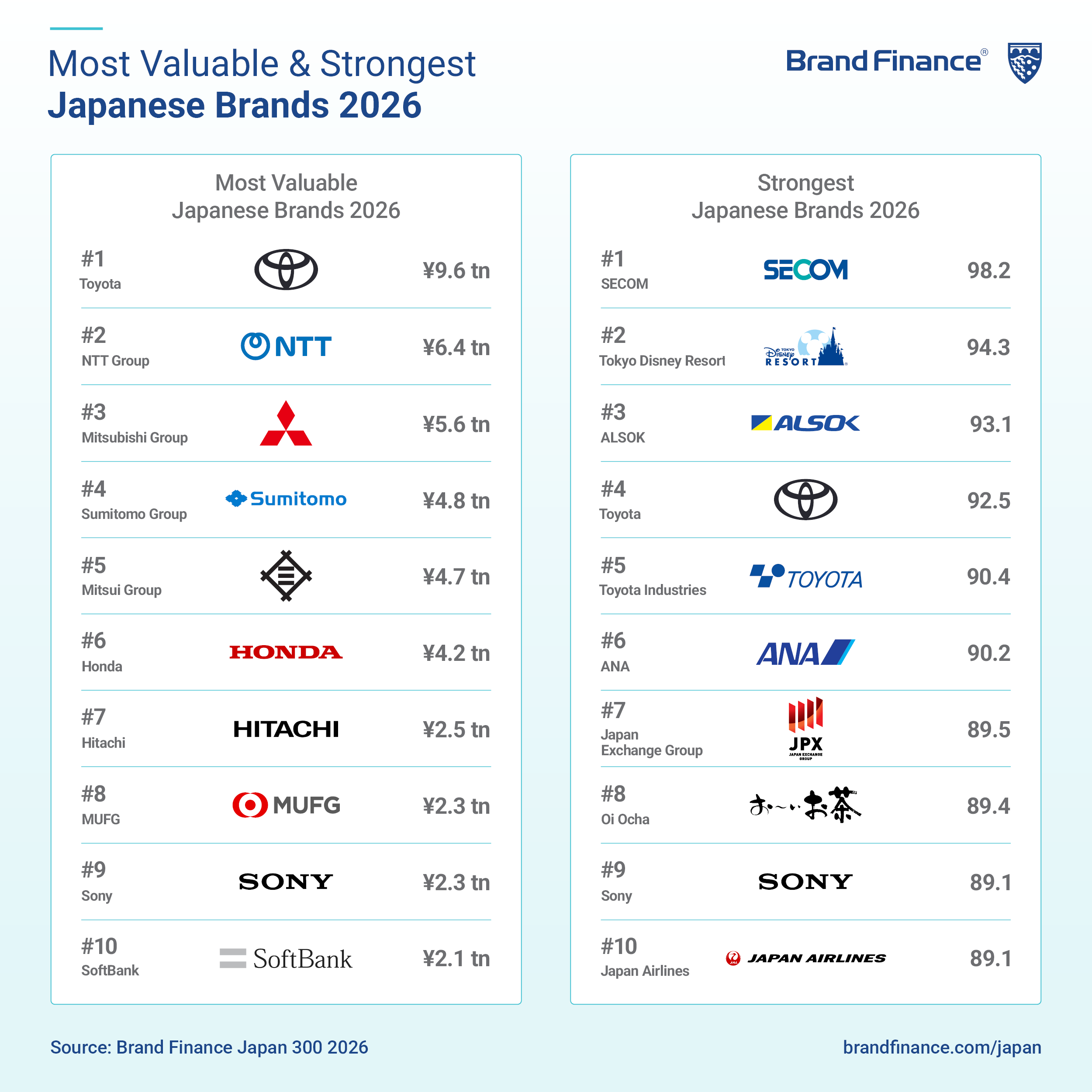
TOKYO, 17 July 2026 – Japan enters 2026 with a stable but moderating economic backdrop as the country continues to transition towards monetary normalisation with balanced and subdued domestic demand. According to the Japan 300 2026 report by Brand Finance, the world’s leading brand valuation consultancy, the collective brand value of Japan’s top brands demonstrates a 9% increase to JPY117.9 trillion this year, with 149 out of 300 brands featured posting double-digit growth.
The Japanese automotive industry remains an essential pillar of the country’s economy, representing the largest brand value share of 17% at JPY20.07 trillion across 13 brands in the ranking. Japan’s automobile sector is not only significant within the country as it also holds a prominent position globally, ranking as the second-largest contributor to the Brand Finance Automobiles 100 2026 ranking, accounting for 23% (JPY20.28 trillion) of the industry’s brand value share globally, with all 13 brands featured.
Toyota (brand value up 3% to JPY9.6 trillion) leads Japan’s business ecosystem, retaining its position as the country’s most valuable brand for the 11th consecutive year. The automotive brand continues to dominate on a global scale as it benefits from solid fundamentals built on scale, reliability, and innovation. The brand’s leadership is further supported by its multi-pathway electrification strategy, particularly through the strong positioning of its hybrid vehicles segment, which accounts for 42% of global sales.
NTT Group (brand value up 20% to JPY6.4 trillion) rises one spot to rank as the second most valuable Japanese brand this year, following a notable double-digit growth. The telecoms brand’s investment in digital infrastructure and AI capabilities has supported its financial performance, reporting higher annual revenue driven by growth across several segments, such as data, network, and enterprise solutions businesses. NTT Group’s performance this year is also supported by the expansion of its global data centre footprint and AI technology through the Innovative Optical and Wireless Network (IOWN) and the launch of its high-performance generative AI model, “tsuzumi 2”.
Mitsubishi Group (brand value down 4% to JPY5.58 trillion) slips by one spot to rank third this year, as it faced higher operating costs that resulted in weaker profit margins despite stabilising revenue for the 2025–2026 financial year. However, the conglomerate’s diversified portfolio, spanning infrastructure, industrial systems, energy, mobility, and financial services, has mitigated the impact of these headwinds and supported long-term brand resilience.
Hello Kitty emerges as the fastest-growing brand this year, with its brand value surging 217% to JPY212.2 billion and rising by 96 positions to 101st within the ranking. The toy brand’s performance this year was driven by its commercial prominence and solid brand equity across global markets, following the momentum of its 50th anniversary celebrations in 2024, which boosted awareness, engagement, and sales performance. Additionally, Hello Kitty’s brand visibility was further reinforced through extensive global collaborations and licensing partnerships with major apparel brands, such as Adidas, UNIQLO, H&M, and Forever 21.
SECOM (brand value up 12% to JPY465.3 billion) holds on to its position as Japan’s strongest brand for the second consecutive year, receiving a Brand Strength Index (BSI) score of 98.2/100 (up from 95.6/100 in 2025), and maintaining its AAA+ brand strength rating. According to Brand Finance’s market research data, the online security services brand exhibits strong performance in key metrics, such as familiarity, understanding, and appeal. SECOM’s reputation is further strengthened by its proactive sustainability contributions through ESG initiatives, including alignment with Task Force on Climate-related Financial Disclosures (TCFD) recommendations, renewable energy adoption, and long-term carbon neutrality commitments.
Alex Haigh, Managing Director Asia Pacific, Brand Finance, remarked:
"Japan’s brand landscape in 2026 reflects both deep resilience and bold reinvention. Toyota’s leadership for an 11th consecutive year underscores the enduring power of scale, reliability, and disciplined innovation. Yet the more striking story is breadth: nearly half of the nation’s top brands recorded double-digit growth. Hello Kitty’s extraordinary 217% surge shows how cultural icons can translate into formidable commercial value, while SECOM proves that trust and consistency remain among the most durable foundations of brand strength. Together, these brands demonstrate that Japan’s competitive edge rests on both heritage and the courage to evolve.”
The Japan 300 2026 report was launched at an exclusive event in Tokyo today, marking 10 years of Brand Finance’s research on Japan’s leading brands.
Other notable brands featured in the Brand Finance Japan 300 2026 ranking include:
Sustainability
The Sustainability Perceptions Index 2026 reveals which brands are perceived to have the strongest commitment to sustainability globally, the changing role of sustainability in driving demand, and the large amounts of value tied to sustainability for the world’s biggest brands.
Brand Finance’s research shows that, among Japanese brands, the automobile brand, Toyota, leads on perceptions of sustainability in the Environment pillar while ANA leads in the Social and Governance pillars.
The Toyota Environmental Challenge 2050 has been the main driver of Toyota’s sustainability initiatives, promoting measures to address global environmental issues such as climate change, water shortage, resource depletion, and loss of biodiversity. The automotive brand further solidifies its commitment by achieving its emission reduction targets of greenhouse gas emissions (GHG) from its operations by 68%.
ANA adheres to the framework set by its Group ESG Management Promotion Committee, a taskforce established to promote and ensure the implementation of sustainable practices throughout the entire Group. The brand also focuses on the dissemination of the Sustainable Development Goals (SDGs) through in-house training, seminars, and e-learning, which help to deepen its employees’ understanding and implementation of global sustainability goals.




Brand Finance is the world’s leading brand valuation consultancy. Bridging the gap between marketing and finance, Brand Finance evaluates the strength of brands and quantifies their financial value to help organisations make strategic decisions.
Headquartered in London, Brand Finance operates in over 25 countries. Every year, Brand Finance conducts more than 6,000 brand valuations, supported by original market research, and publishes over 100 reports which rank brands across all sectors and countries.
Brand Finance also operates the Global Brand Equity Monitor, conducting original market research annually on 6,000 brands, surveying more than 175,000 respondents across 41 countries and 31 industry sectors. By combining perceptual data from the Global Brand Equity Monitor with data from its valuation database — the largest brand value database in the world — Brand Finance equips ambitious brand leaders with the data, analytics, and the strategic guidance they need to enhance brand and business value.
In addition to calculating brand value, Brand Finance also determines the relative strength of brands through a balanced scorecard of metrics, compliant with ISO 20671.
Brand Finance is a regulated accountancy firm and a committed leader in the standardisation of the brand valuation industry. Brand Finance was the first to be certified by independent auditors as compliant with both ISO 10668 and ISO 20671 and has received the official endorsement of the Marketing Accountability Standards Board (MASB) in the United States.
Brand is defined as a marketing-related intangible asset including, but not limited to, names, terms, signs, symbols, logos, and designs, intended to identify goods, services, or entities, creating distinctive images and associations in the minds of stakeholders, thereby generating economic benefits.
Brand strength is the efficacy of a brand’s performance on intangible measures relative to its competitors. Brand Finance evaluates brand strength in a process compliant with ISO 20671, looking at Marketing Investment, Stakeholder Equity, and the impact of those on Business Performance. The data used is derived from Brand Finance’s proprietary market research programme and from publicly available sources.
Each brand is assigned a Brand Strength Index (BSI) score out of 100, which feeds into the brand value calculation. Based on the score, each brand is assigned a corresponding Brand Rating up to AAA+ in a format similar to a credit rating.
Brand Finance calculates the values of brands in its rankings using the Royalty Relief approach – a brand valuation method compliant with the industry standards set in ISO 10668. It involves estimating the likely future revenues that are attributable to a brand by calculating a royalty rate that would be charged for its use, to arrive at a ‘brand value’ understood as a net economic benefit that a brand owner would achieve by licensing the brand in the open market.
The steps in this process are as follows:
1 Calculate brand strength using a balanced scorecard of metrics assessing Marketing Investment, Stakeholder Equity, and Business Performance. Brand strength is expressed as a Brand Strength Index (BSI) score on a scale of 0 to 100.
2 Determine royalty range for each industry, reflecting the importance of brand to purchasing decisions. In luxury, the maximum percentage is high, while in extractive industry, where goods are often commoditised, it is lower. This is done by reviewing comparable licensing agreements sourced from Brand Finance’s extensive database.
3 Calculate royalty rate. The BSI score is applied to the royalty range to arrive at a royalty rate. For example, if the royalty range in a sector is 0-5% and a brand has a BSI score of 80 out of 100, then an appropriate royalty rate for the use of this brand in the given sector will be 4%.
4 Determine brand-specific revenues by estimating a proportion of parent company revenues attributable to a brand.
5 Determine forecast revenues using a function of historic revenues, equity analyst forecasts, and economic growth rates.
6 Apply the royalty rate to the forecast revenues to derive brand revenues.
7 Discount post-tax brand revenues to a net present value which equals the brand value.
Brand Finance has produced this study with an independent and unbiased analysis. The values derived and opinions presented in this study are based on publicly available information and certain assumptions that Brand Finance used where such data was deficient or unclear. Brand Finance accepts no responsibility and will not be liable in the event that the publicly available information relied upon is subsequently found to be inaccurate. The opinions and financial analysis expressed in the study are not to be construed as providing investment or business advice. Brand Finance does not intend the study to be relied upon for any reason and excludes all liability to any body, government, or organisation.
The data presented in this study form part of Brand Finance's proprietary database, are provided for the benefit of the media, and are not to be used in part or in full for any commercial or technical purpose without written permission from Brand Finance.