BrandFinanceのJapan 300 2026が広範なブランド価値成長を明らかに、ランク入りブランドの約半数が二桁成長を達成
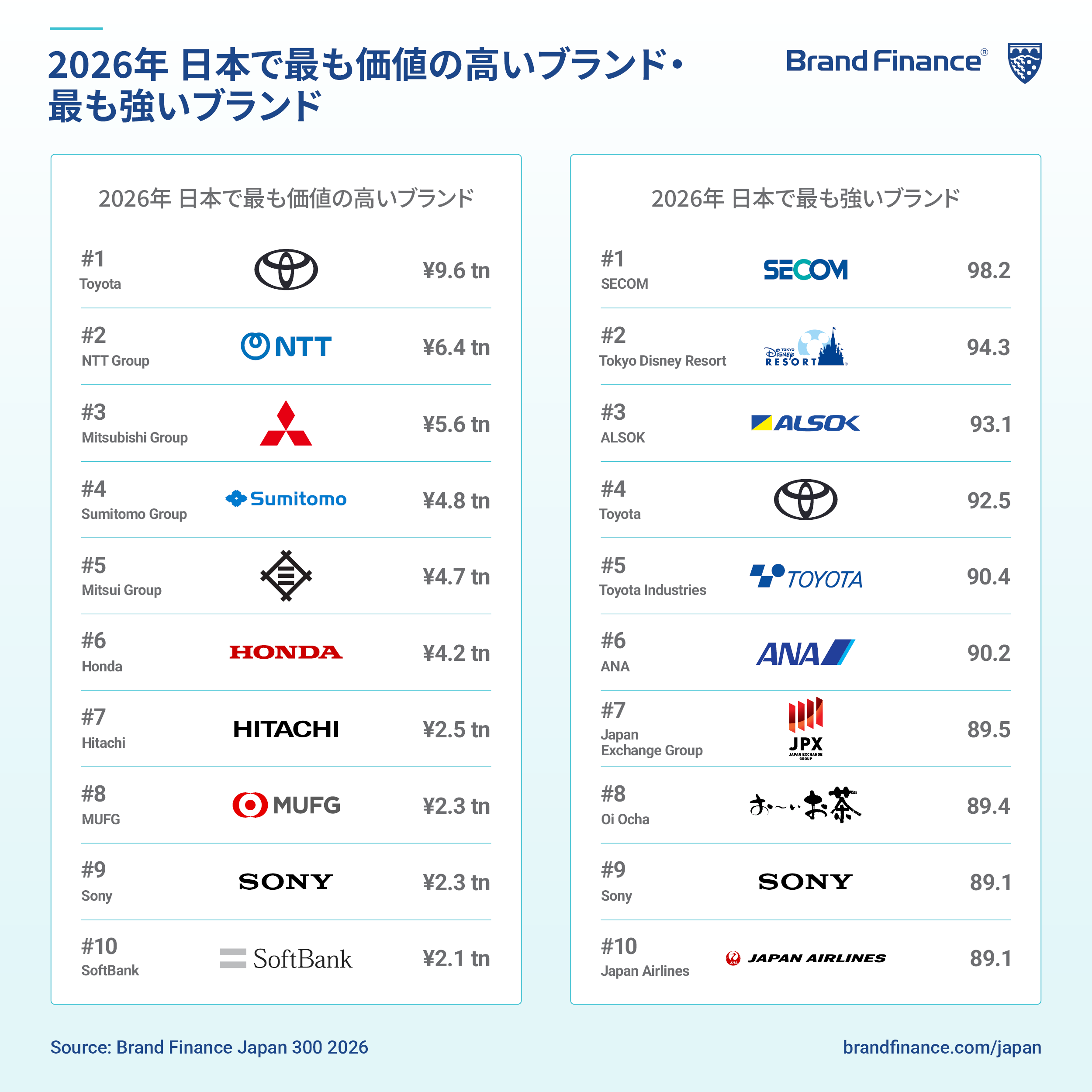
東京、2026年7月17日 — 日本は、金融正常化への移行を継続するとともに、均衡のとれた低調な国内需要を背景に、安定しながらも緩やかな経済状況のもとで2026年を迎えた。世界有数のブランド評価コンサルティング会社Brand FinanceによるJapan 300 2026レポートによると、日本トップブランドの総ブランド価値は今年9%増の117.9兆円となり、ランク入りした300ブランドのうち149ブランドが二桁成長を記録した。
日本の自動車産業は引き続き同国経済の重要な柱であり、ランキングに名を連ねる13ブランドで17%のブランド価値シェア(20.07兆円)を占め、最大のブランド価値貢献セクターの地位を維持している。日本の自動車セクターは国内においても重要な存在であるだけでなく、グローバルにも際立った地位を占めており、Brand Finance Automobiles 100 2026ランキングにおける第2位の貢献国として、13ブランドすべてがランク入りし、業界の世界ブランド価値シェアの23%(20.28兆円)を占めている。
トヨタ(ブランド価値3%増の9.6兆円)は、11年連続で日本で最も価値のあるブランドとしての地位を維持し、日本のビジネスエコシステムをリードしている。この自動車ブランドは、規模、信頼性、革新性に基づく強固なファンダメンタルズを背景に、グローバルな規模での優位性を維持し続けている。同ブランドのリーダーシップは、グローバル販売の42%を占めるハイブリッド車セグメントの強力なポジションを軸としたマルチパスウェイ電動化戦略によってさらに支えられている。
NTTグループ(ブランド価値20%増の6.4兆円)は、顕著な二桁成長を背景に1ランク上昇し、今年は日本で2番目に価値のあるブランドとしてランクインしている。この通信ブランドのデジタルインフラおよびAI活用への投資は財務パフォーマンスを支え、データ、ネットワーク、エンタープライズソリューションビジネスなど複数のセグメントでの成長により年間収益の増加が報告されている。NTTグループの今年のパフォーマンスはまた、グローバルなデータセンター網の拡大、IOWN(Innovative Optical and Wireless Network)を通じたAI技術の推進、および高性能生成AIモデル「tsuzumi 2」のローンチによっても支えられている。
三菱グループ(ブランド価値4%減の5.58兆円)は、2025〜2026年度において収益が安定したものの、営業コストの上昇による利益率の低下に直面し、今年は1ランク下落して3位となった。しかし、インフラ、産業システム、エネルギー、モビリティ、金融サービスにわたる同コングロマリットの多角化されたポートフォリオは、これらの逆風の影響を緩和し、長期的なブランドの強靱性を支えている。
ハローキティは今年最も急成長したブランドとして台頭し、ブランド価値が217%急増して2,122億円となり、ランキング内で96位上昇して101位となった。このトイブランドの今年のパフォーマンスは、2024年の50周年記念イベントの勢いを受けて認知度、エンゲージメント、販売実績が向上し、グローバル市場における商業的存在感と強固なブランドエクイティによって牽引された。さらに、アディダス、ユニクロ、H&M、フォーエバー21などの主要アパレルブランドとの広範なグローバルコラボレーションおよびライセンスパートナーシップを通じて、ハローキティのブランド可視性がさらに強化された。
SECOM(ブランド価値12%増の4,653億円)は、ブランド強度指数(BSI)スコア98.2/100(2025年の95.6/100から上昇)を獲得し、AAA+のブランド強度評価を維持して、2年連続で日本で最も強いブランドの座を守った。Brand Financeの市場調査データによると、このオンラインセキュリティサービスブランドは、親しみやすさ、理解度、魅力といった主要指標で高いパフォーマンスを示している。SECOMの評判は、気候関連財務情報開示タスクフォース(TCFD)提言への準拠、再生可能エネルギーの採用、長期的なカーボンニュートラルへのコミットメントを含むESGイニシアチブを通じた積極的なサステナビリティへの貢献によっても一層強化されている。
Brand Finance アジア太平洋地域マネージングディレクターのアレックス・ヘイグ氏は次のようにコメントしている:
「2026年の日本のブランド情勢は、深い強靱性と大胆な自己変革の両方を映し出しています。トヨタが11年連続でリーダーシップを維持していることは、規模、信頼性、規律ある革新の永続的な力を示しています。しかし、より印象的なのはその広がりです。国内トップブランドの約半数が二桁成長を記録しました。ハローキティの驚異的な217%の急成長は、文化的アイコンがいかに強力な商業価値に転換できるかを示しており、SECOMは信頼と一貫性がブランド強度の最も揺るぎない基盤であり続けることを証明しています。これらのブランドは総じて、日本の競争力が伝統と進化する勇気の両方に基づいていることを示しています。」
Japan 300 2026レポートは本日、東京で開催された特別イベントで発表された。同イベントは、Brand Financeによる日本の主要ブランドに関する調査の10周年を記念するものとなった。
Brand Finance Japan 300 2026ランキングに掲載されているその他の注目すべきブランド:
サステナビリティ
サステナビリティ・パーセプション・インデックス2026は、世界で最も強いサステナビリティへのコミットメントを持つと認識されているブランド、需要を牽引する要因としてのサステナビリティの役割の変化、そして世界最大級のブランドにおいてサステナビリティに結びつく大きな価値を明らかにしている。
Brand Financeの調査によると、日本ブランドの中では、自動車ブランドのトヨタが環境の柱におけるサステナビリティ認知をリードしており、ANAは社会とガバナンスの柱でリードしている。
トヨタ環境チャレンジ2050は、気候変動、水不足、資源枯渇、生物多様性の喪失など地球規模の環境問題への対応を促進するため、トヨタのサステナビリティイニシアチブの主要な推進力となっている。この自動車ブランドは、自社業務における温室効果ガス(GHG)排出量を68%削減するという目標を達成し、コミットメントをさらに確固たるものとしている。
ANAは、グループ全体にわたる持続可能な実践の推進と実施を確保するために設立されたタスクフォース、グループESG経営推進委員会が定めるフレームワークに準拠している。また同ブランドは、社内研修、セミナー、eラーニングを通じたSDGs(持続可能な開発目標)の普及にも注力しており、従業員のグローバルなサステナビリティ目標に対する理解と実践を深めている。





Brand Finance is the world’s leading brand valuation consultancy. Bridging the gap between marketing and finance, Brand Finance evaluates the strength of brands and quantifies their financial value to help organisations make strategic decisions.
Headquartered in London, Brand Finance operates in over 25 countries. Every year, Brand Finance conducts more than 6,000 brand valuations, supported by original market research, and publishes over 100 reports which rank brands across all sectors and countries.
Brand Finance also operates the Global Brand Equity Monitor, conducting original market research annually on 6,000 brands, surveying more than 175,000 respondents across 41 countries and 31 industry sectors. By combining perceptual data from the Global Brand Equity Monitor with data from its valuation database — the largest brand value database in the world — Brand Finance equips ambitious brand leaders with the data, analytics, and the strategic guidance they need to enhance brand and business value.
In addition to calculating brand value, Brand Finance also determines the relative strength of brands through a balanced scorecard of metrics, compliant with ISO 20671.
Brand Finance is a regulated accountancy firm and a committed leader in the standardisation of the brand valuation industry. Brand Finance was the first to be certified by independent auditors as compliant with both ISO 10668 and ISO 20671 and has received the official endorsement of the Marketing Accountability Standards Board (MASB) in the United States.
Brand is defined as a marketing-related intangible asset including, but not limited to, names, terms, signs, symbols, logos, and designs, intended to identify goods, services, or entities, creating distinctive images and associations in the minds of stakeholders, thereby generating economic benefits.
Brand strength is the efficacy of a brand’s performance on intangible measures relative to its competitors. Brand Finance evaluates brand strength in a process compliant with ISO 20671, looking at Marketing Investment, Stakeholder Equity, and the impact of those on Business Performance. The data used is derived from Brand Finance’s proprietary market research programme and from publicly available sources.
Each brand is assigned a Brand Strength Index (BSI) score out of 100, which feeds into the brand value calculation. Based on the score, each brand is assigned a corresponding Brand Rating up to AAA+ in a format similar to a credit rating.
Brand Finance calculates the values of brands in its rankings using the Royalty Relief approach – a brand valuation method compliant with the industry standards set in ISO 10668. It involves estimating the likely future revenues that are attributable to a brand by calculating a royalty rate that would be charged for its use, to arrive at a ‘brand value’ understood as a net economic benefit that a brand owner would achieve by licensing the brand in the open market.
The steps in this process are as follows:
1 Calculate brand strength using a balanced scorecard of metrics assessing Marketing Investment, Stakeholder Equity, and Business Performance. Brand strength is expressed as a Brand Strength Index (BSI) score on a scale of 0 to 100.
2 Determine royalty range for each industry, reflecting the importance of brand to purchasing decisions. In luxury, the maximum percentage is high, while in extractive industry, where goods are often commoditised, it is lower. This is done by reviewing comparable licensing agreements sourced from Brand Finance’s extensive database.
3 Calculate royalty rate. The BSI score is applied to the royalty range to arrive at a royalty rate. For example, if the royalty range in a sector is 0-5% and a brand has a BSI score of 80 out of 100, then an appropriate royalty rate for the use of this brand in the given sector will be 4%.
4 Determine brand-specific revenues by estimating a proportion of parent company revenues attributable to a brand.
5 Determine forecast revenues using a function of historic revenues, equity analyst forecasts, and economic growth rates.
6 Apply the royalty rate to the forecast revenues to derive brand revenues.
7 Discount post-tax brand revenues to a net present value which equals the brand value.
Brand Finance has produced this study with an independent and unbiased analysis. The values derived and opinions presented in this study are based on publicly available information and certain assumptions that Brand Finance used where such data was deficient or unclear. Brand Finance accepts no responsibility and will not be liable in the event that the publicly available information relied upon is subsequently found to be inaccurate. The opinions and financial analysis expressed in the study are not to be construed as providing investment or business advice. Brand Finance does not intend the study to be relied upon for any reason and excludes all liability to any body, government, or organisation.
The data presented in this study form part of Brand Finance's proprietary database, are provided for the benefit of the media, and are not to be used in part or in full for any commercial or technical purpose without written permission from Brand Finance.