





New Brand Finance data reveals trading activity remained elevated during a year of geopolitical uncertainty, while exchanges with diversified technology and data businesses outperformed peers
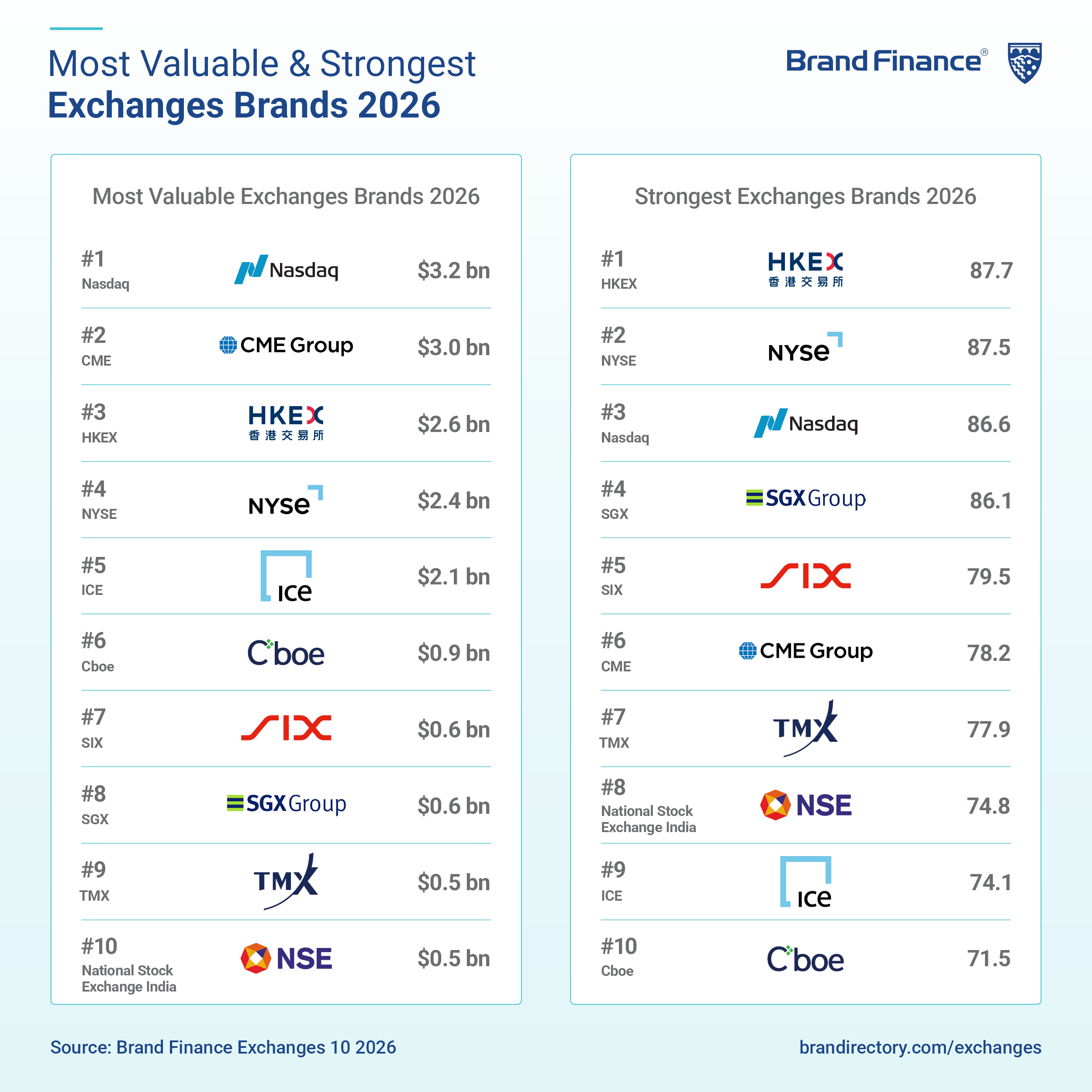
LONDON, 18 August 2026 – Nasdaq has retained its position as the world's most valuable exchanges brand for the second consecutive year, according to the Exchanges 10 2026 ranking from Brand Finance, the world's leading brand valuation consultancy. Nasdaq's brand value grew 2% to USD3.2 billion this year, driven by increased revenue forecasts, continued benefits from the Adenza acquisition, strong demand for market services, and growing contributions from its data, analytics and technology businesses.
Nasdaq's performance reflects broader trends reshaping the global exchanges sector. Trading activity remained elevated throughout 2025 as geopolitical uncertainty, tariff-related concerns and interest-rate expectations increased market volatility and demand for hedging products. At the same time, IPO activity recovered significantly, with global IPO proceeds rising nearly 43% and the number of IPOs increasing 8.7% year-on-year. Global equity market capitalisation also increased to nearly 19% to USD151.94 trillion.
CME (brand value at USD3 billion) and HKEX (brand value up 6% to USD2.6 billion) retain their positions as the second and third most valuable exchanges brands, respectively. CME's position is underpinned by its leadership in global derivatives markets despite facing increased global competition.
Meanwhile, HKEX also retains its position as the strongest exchanges brand globally, with a Brand Strength Index (BSI) score of 87.7/100 and an AAA brand strength rating. The exchange continued to benefit from renewed momentum in Hong Kong's capital markets, welcoming 44 new listings in the first half of 2025 and maintaining a pipeline of approximately 120 active IPO applications at the end of June. Supported by stronger cash-market performance, robust commodities and derivatives trading, and continued investment in market infrastructure, HKEX reinforces its position as one of the world's leading exchange brands.
Oliver Schmitz, Global Sector Head of Exchanges, Brand Finance, commented:
"The world's leading exchange brands benefited from a year of stronger trading activity, recovering IPO markets and increased demand for financial-market infrastructure. The exchanges delivering the strongest growth are those successfully diversifying beyond traditional trading revenues through technology, data, analytics and post-trade services. At the same time, brand strength is becoming increasingly linked to market confidence, trust, transparency and perceptions of economic stability."
NYSE (brand value up 6% to USD2.4 billion) remains the second strongest exchanges brand, earning a BSI score of 87.5/100 and an AAA brand strength rating. Brand Finance market research data indicates that NYSE strengthened its performance across key brand metrics, with improvements in familiarity, understanding and reputation in its home market. The exchange also benefited from strategic initiatives aimed at expanding its reach and accessibility, including the launch of NYSE Texas and efforts to support extended trading hours.
Nasdaq (brand value up 2% to USD3.2 billion) ranks as third strongest, with a BSI score of 86.6/100 and an AAA brand strength rating. According to Brand Finance’s market research data, Nasdaq continued to benefit from strong business fundamentals, supported by growing revenues across its technology, data and market services businesses. The exchange also maintained momentum in capital markets activity, with companies listing on Nasdaq raising approximately USD46.7 billion by December 2025, more than double the comparable prior-year amount, while 22 companies with a combined market value of around USD1.20 trillion transferred their listings to Nasdaq during the year.
TMX (brand value up 18% to USD542 million) emerges as the fastest-growing exchanges brand in 2026, supported by stronger revenue forecasts and improved brand strength. Growth was underpinned by the successful launch of AlphaX US, rising Canadian trading volumes, strong derivatives activity and increasing confidence in Canada's economic outlook. Canadian derivatives volumes increased by 41% during the period, while overall Canadian equity trading volumes rose 21%. According to Brand Finance’s market research data, TMX also benefited from improved familiarity, understanding and reputation metrics in its home market.
The Exchanges 10 2026 ranking highlights the continued evolution of exchanges into diversified technology and financial infrastructure businesses, with growing revenues from data, analytics, software and post-trade services reducing reliance on traditional trading and listings. While the sector benefited from a strong recovery in trading activity and IPO markets, performance varied across operators, with exchanges offering diversified revenue streams, advanced technology and strong international connectivity generally outperforming their peers.
Asia-Pacific remains a key driver of listings activity, accounting for 43% of global IPO proceeds, while Hong Kong re-emerges as a leading fundraising hub and the US continues to attract issuers through its scale, liquidity and access to capital.




Brand Finance is the world’s leading brand valuation consultancy. Bridging the gap between marketing and finance, Brand Finance evaluates the strength of brands and quantifies their financial value to help organisations make strategic decisions.
Headquartered in London, Brand Finance operates in over 25 countries. Every year, Brand Finance conducts more than 6,000 brand valuations, supported by original market research, and publishes over 100 reports which rank brands across all sectors and countries.
Brand Finance also operates the Global Brand Equity Monitor, conducting original market research annually on 6,000 brands, surveying more than 175,000 respondents across 41 countries and 31 industry sectors. By combining perceptual data from the Global Brand Equity Monitor with data from its valuation database — the largest brand value database in the world — Brand Finance equips ambitious brand leaders with the data, analytics, and the strategic guidance they need to enhance brand and business value.
In addition to calculating brand value, Brand Finance also determines the relative strength of brands through a balanced scorecard of metrics, compliant with ISO 20671.
Brand Finance is a regulated accountancy firm and a committed leader in the standardisation of the brand valuation industry. Brand Finance was the first to be certified by independent auditors as compliant with both ISO 10668 and ISO 20671 and has received the official endorsement of the Marketing Accountability Standards Board (MASB) in the United States.
Brand is defined as a marketing-related intangible asset including, but not limited to, names, terms, signs, symbols, logos, and designs, intended to identify goods, services, or entities, creating distinctive images and associations in the minds of stakeholders, thereby generating economic benefits.
Brand strength is the efficacy of a brand’s performance on intangible measures relative to its competitors. Brand Finance evaluates brand strength in a process compliant with ISO 20671, looking at Marketing Investment, Stakeholder Equity, and the impact of those on Business Performance. The data used is derived from Brand Finance’s proprietary market research programme and from publicly available sources.
Each brand is assigned a Brand Strength Index (BSI) score out of 100, which feeds into the brand value calculation. Based on the score, each brand is assigned a corresponding Brand Rating up to AAA+ in a format similar to a credit rating.
Brand Finance calculates the values of brands in its rankings using the Royalty Relief approach – a brand valuation method compliant with the industry standards set in ISO 10668. It involves estimating the likely future revenues that are attributable to a brand by calculating a royalty rate that would be charged for its use, to arrive at a ‘brand value’ understood as a net economic benefit that a brand owner would achieve by licensing the brand in the open market.
The steps in this process are as follows:
1 Calculate brand strength using a balanced scorecard of metrics assessing Marketing Investment, Stakeholder Equity, and Business Performance. Brand strength is expressed as a Brand Strength Index (BSI) score on a scale of 0 to 100.
2 Determine royalty range for each industry, reflecting the importance of brand to purchasing decisions. In luxury, the maximum percentage is high, while in extractive industry, where goods are often commoditised, it is lower. This is done by reviewing comparable licensing agreements sourced from Brand Finance’s extensive database.
3 Calculate royalty rate. The BSI score is applied to the royalty range to arrive at a royalty rate. For example, if the royalty range in a sector is 0-5% and a brand has a BSI score of 80 out of 100, then an appropriate royalty rate for the use of this brand in the given sector will be 4%.
4 Determine brand-specific revenues by estimating a proportion of parent company revenues attributable to a brand.
5 Determine forecast revenues using a function of historic revenues, equity analyst forecasts, and economic growth rates.
6 Apply the royalty rate to the forecast revenues to derive brand revenues.
7 Discount post-tax brand revenues to a net present value which equals the brand value.
Brand Finance has produced this study with an independent and unbiased analysis. The values derived and opinions presented in this study are based on publicly available information and certain assumptions that Brand Finance used where such data was deficient or unclear. Brand Finance accepts no responsibility and will not be liable in the event that the publicly available information relied upon is subsequently found to be inaccurate. The opinions and financial analysis expressed in the study are not to be construed as providing investment or business advice. Brand Finance does not intend the study to be relied upon for any reason and excludes all liability to any body, government, or organisation.
The data presented in this study form part of Brand Finance's proprietary database, are provided for the benefit of the media, and are not to be used in part or in full for any commercial or technical purpose without written permission from Brand Finance.