





Brand Finance's Football 50 2026 report reveals record brand value growth for the world's top clubs
LONDON, 20 August 2026 – The combined brand value of the world's 50 most valuable football club brands has reached EUR23.9 billion, the strongest annual growth in the 15-year history of the Football 50, according to a new report from Brand Finance, the world's leading brand valuation consultancy.
The world's leading football clubs are not only becoming more valuable – they are pulling away from the rest of the field. The 10 most valuable football club brands now account for EUR14.9 billion, more than 60% of the Football 50's total brand value. Since 2012, their combined brand value has grown by 250%, compared with 220% for the top 50 overall.
Yet beneath that concentration, European football hierarchy is beginning to shift. The emergence of Arsenal among the world's three most valuable football brands, alongside the rapid growth of Aston Villa FC and VfB Stuttgart, shows that sustained sporting success can translate into significant commercial momentum – potentially allowing ambitious clubs to challenge an established order historically dominated by a small group of European superclubs.
Real Madrid completes brand hat-trick to retain global crown
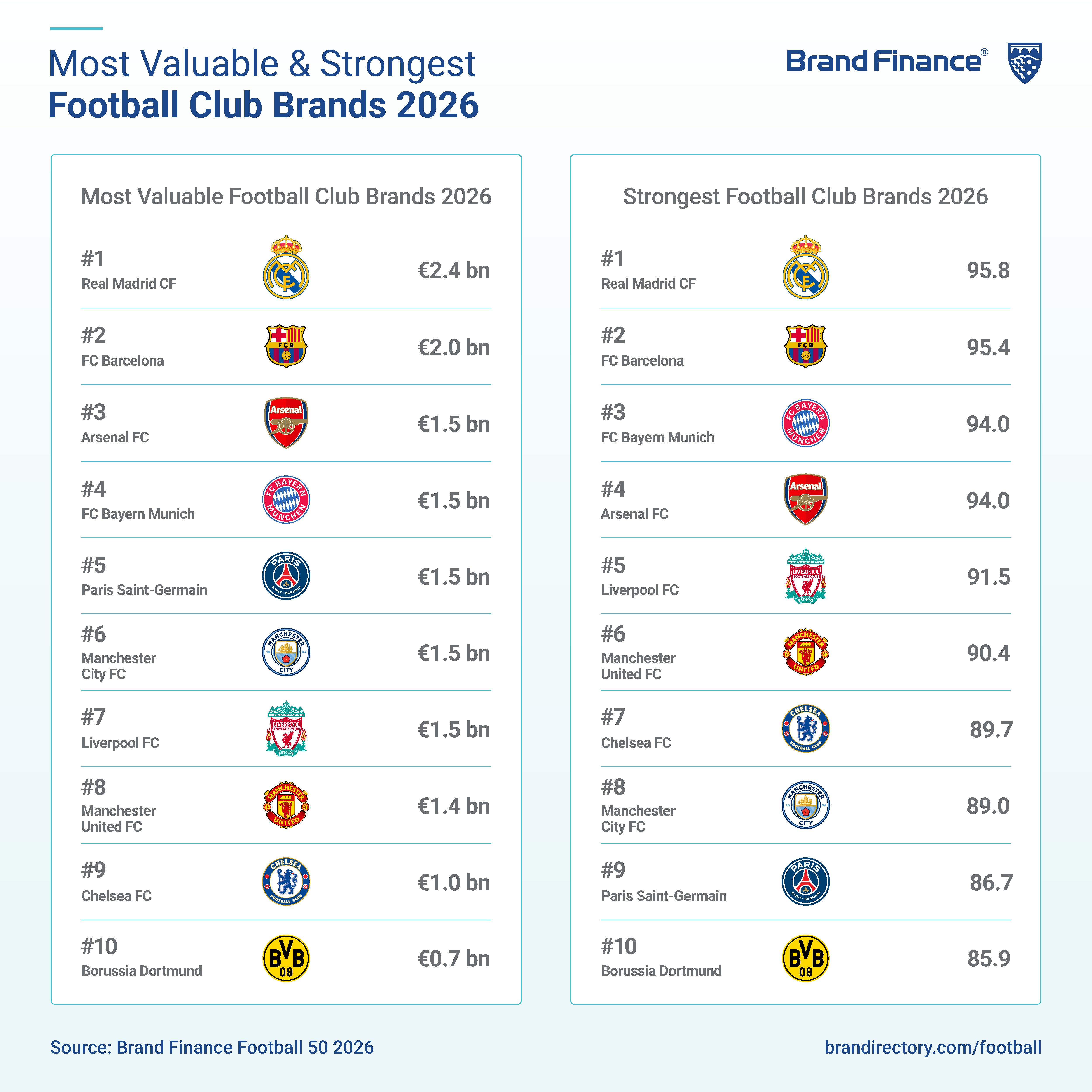
Real Madrid CF retains its position as the world's most valuable football club brand for the third consecutive year, with brand value rising 25% to EUR2.4 billion. It also remains the world's strongest football club brand, with a Brand Strength Index (BSI) score of 95.8 out of 100, the highest of all 281 clubs analysed by Brand Finance. The club’s strength reflects its strong global reputation, passionate fanbase, star players, heritage and prestige, and association with elite-level football, as highlighted by Brand Finance’s sports fan research.
FC Barcelona retains second place, with brand value increasing 15% to EUR2 billion. Its growth has been supported by a return to Spotify Camp Nou after more than two years away, alongside back-to-back LALIGA titles under Hansi Flick.
The continued dominance of Real Madrid and Barcelona highlights the extraordinary durability of football's two most globally recognised club brands.
Arsenal breaks into global top three
Arsenal FC is one of the standout performers of the 2026 ranking, climbing five places to third – its highest-ever position in the Football 50. The club's brand value rose 28% to EUR1.5 billion, following its first Premier League title in 22 years and a Champions League final appearance. Arsenal has also overtaken Manchester United to become the UK's strongest football club brand, with a BSI score of 94.0/100, ranking fourth globally.
With the Premier League continuing to dominate as the world's strongest domestic football league brand, Arsenal's rise demonstrates the commercial advantage available to clubs competing within the world's deepest portfolio of globally recognised football brands.
Competition intensifies across global top 10
Elsewhere in the top 10, the competitive order continues to shift. FC Bayern Munich (+21% to EUR1.5 billion) climbed to fourth, while Paris Saint-Germain FC (+10% to EUR1.5 billion) retained fifth place. Manchester City FC (+3% to EUR1.5 billion), Liverpool FC (+5% to EUR1.5 billion) and Manchester United FC (+15% to EUR1.4 billion) all recorded strong brand value growth, despite each slipping one place to sixth, seventh and eighth respectively as faster-growing clubs moved ahead. Chelsea FC (-1% to EUR955 million) held firm in ninth, while Borussia Dortmund (+8% to EUR664 million) returned to the global top 10 for the first time in a decade.
The next commercial battle: from established giants to emerging challengers
The 2026 results point to a football landscape in which the biggest clubs continue to accumulate enormous brand value, while a second group of ambitious European clubs is beginning to convert sporting breakthroughs into lasting commercial momentum.
Aston Villa FC is this year's Brand to Watch. Its brand value increased by more than 60% to EUR483.5 million, the second-fastest growth among clubs in the ranking. The rise follows three consecutive European qualifications, including the club's first Champions League appearance in more than four decades and a UEFA Europa League title in 2025/26.
VfB Stuttgart provides another striking example. The German club recorded the largest increase in brand value among the Football 50, almost doubling its value year-on-year by 99% to EUR183.5 million. Record revenues, multiple Champions League qualifications and a first major trophy since 2007 have helped transform its commercial profile.
Together, the results suggest that while football's financial and brand power remains heavily concentrated, the pathway to greater brand value is not closed to clubs outside the traditional elite.
Scott Moore, Head of Sports Services, Brand Finance commented:
“This year’s Football 50 shows just how far the gap has widened between football’s elite and the rest of the pack. A €23.9 billion combined brand value, with the strongest growth we've seen in fifteen years of tracking this ranking, tells you that success on the pitch is translating directly into commercial power off it. Real Madrid's third straight year at the top reflects sustained excellence, but the real story is depth – clubs like Arsenal and Aston Villa show that sporting breakthroughs, when paired with smart brand-building, can move the needle fast.
The European football hierarchy is not standing still. The biggest brands continue to pull further ahead, but ambitious clubs are proving that sustained sporting success can accelerate their journey towards global relevance. Football's biggest clubs aren't just competing with each other; they're competing for attention, loyalty and commercial growth on a truly global scale and, as this year's numbers show, outpacing entire leagues in other sports."




Brand Finance is the world’s leading brand valuation consultancy. Bridging the gap between marketing and finance, Brand Finance evaluates the strength of brands and quantifies their financial value to help organisations make strategic decisions.
Headquartered in London, Brand Finance operates in over 25 countries. Every year, Brand Finance conducts more than 6,000 brand valuations, supported by original market research, and publishes over 100 reports which rank brands across all sectors and countries.
Brand Finance also operates the Global Brand Equity Monitor, conducting original market research annually on 6,000 brands, surveying more than 175,000 respondents across 41 countries and 31 industry sectors. By combining perceptual data from the Global Brand Equity Monitor with data from its valuation database — the largest brand value database in the world — Brand Finance equips ambitious brand leaders with the data, analytics, and the strategic guidance they need to enhance brand and business value.
In addition to calculating brand value, Brand Finance also determines the relative strength of brands through a balanced scorecard of metrics, compliant with ISO 20671.
Brand Finance is a regulated accountancy firm and a committed leader in the standardisation of the brand valuation industry. Brand Finance was the first to be certified by independent auditors as compliant with both ISO 10668 and ISO 20671 and has received the official endorsement of the Marketing Accountability Standards Board (MASB) in the United States.
Brand is defined as a marketing-related intangible asset including, but not limited to, names, terms, signs, symbols, logos, and designs, intended to identify goods, services, or entities, creating distinctive images and associations in the minds of stakeholders, thereby generating economic benefits.
Brand strength is the efficacy of a brand’s performance on intangible measures relative to its competitors. Brand Finance evaluates brand strength in a process compliant with ISO 20671, looking at Marketing Investment, Stakeholder Equity, and the impact of those on Business Performance. The data used is derived from Brand Finance’s proprietary market research programme and from publicly available sources.
Each brand is assigned a Brand Strength Index (BSI) score out of 100, which feeds into the brand value calculation. Based on the score, each brand is assigned a corresponding Brand Rating up to AAA+ in a format similar to a credit rating.
Brand Finance calculates the values of brands in its rankings using the Royalty Relief approach – a brand valuation method compliant with the industry standards set in ISO 10668. It involves estimating the likely future revenues that are attributable to a brand by calculating a royalty rate that would be charged for its use, to arrive at a ‘brand value’ understood as a net economic benefit that a brand owner would achieve by licensing the brand in the open market.
The steps in this process are as follows:
1 Calculate brand strength using a balanced scorecard of metrics assessing Marketing Investment, Stakeholder Equity, and Business Performance. Brand strength is expressed as a Brand Strength Index (BSI) score on a scale of 0 to 100.
2 Determine royalty range for each industry, reflecting the importance of brand to purchasing decisions. In luxury, the maximum percentage is high, while in extractive industry, where goods are often commoditised, it is lower. This is done by reviewing comparable licensing agreements sourced from Brand Finance’s extensive database.
3 Calculate royalty rate. The BSI score is applied to the royalty range to arrive at a royalty rate. For example, if the royalty range in a sector is 0-5% and a brand has a BSI score of 80 out of 100, then an appropriate royalty rate for the use of this brand in the given sector will be 4%.
4 Determine brand-specific revenues by estimating a proportion of parent company revenues attributable to a brand.
5 Determine forecast revenues using a function of historic revenues, equity analyst forecasts, and economic growth rates.
6 Apply the royalty rate to the forecast revenues to derive brand revenues.
7 Discount post-tax brand revenues to a net present value which equals the brand value.
Brand Finance has produced this study with an independent and unbiased analysis. The values derived and opinions presented in this study are based on publicly available information and certain assumptions that Brand Finance used where such data was deficient or unclear. Brand Finance accepts no responsibility and will not be liable in the event that the publicly available information relied upon is subsequently found to be inaccurate. The opinions and financial analysis expressed in the study are not to be construed as providing investment or business advice. Brand Finance does not intend the study to be relied upon for any reason and excludes all liability to any body, government, or organisation.
The data presented in this study form part of Brand Finance's proprietary database, are provided for the benefit of the media, and are not to be used in part or in full for any commercial or technical purpose without written permission from Brand Finance.