





Der Football 50 2026-Bericht von Brand Finance zeigt Rekordwachstum beim Markenwert der wertvollsten Fußballclubs der Welt
LONDON, 20. August 2026 – Der kombinierte Markenwert der 50 wertvollsten Fußballclub-Marken der Welt hat 23,9 Mrd. EUR erreicht – das stärkste jährliche Wachstum in der 15-jährigen Geschichte des Football 50, wie ein neuer Bericht von Brand Finance, der weltweit führenden Markenberatung, zeigt. Die Top 50 der wertvollsten Clubs verfügen zudem über einen kombinierten Unternehmenswert von 79,7 Mrd. EUR, was die erhebliche finanzielle Größenordnung und kommerzielle Bedeutung der weltweit führenden Fußballinstitutionen unterstreicht.
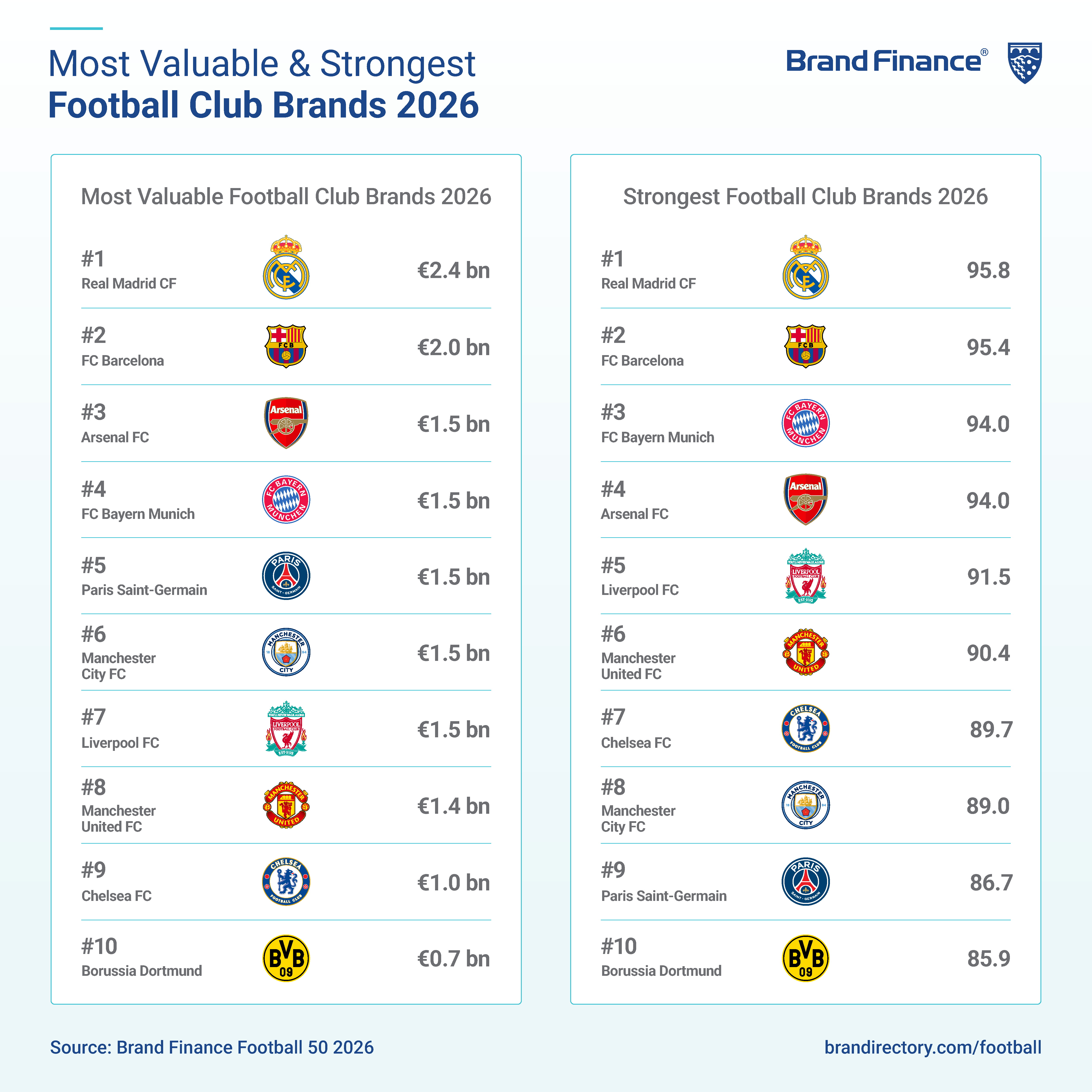
Deutschlands zehn wertvollste Fußballclub-Marken sind 2026 zusammen 3,7 Mrd. EUR wert. Bayern München bleibt weiterhin Deutschlands wertvollste und stärkste Clubmarke, der Markenwert wächst um 21 % auf 1,5 Mrd. EUR. Diese Dominanz wird durch die Verlängerung des Haupttrikotsponsorings mit der Deutschen Telekom bis 2032 – Berichten zufolge 65 Mio. EUR pro Jahr wert – sowie durch die anhaltende globale Anziehungskraft von Harry Kane‘s Torform getragen. Borussia Dortmund (Markenwert plus 8 % auf 664,1 Mio. EUR) behauptet seine Position als Deutschlands zweitwertvollste und zweitstärkste Fußballclub-Marke und kehrt erstmals seit einem Jahrzehnt in die globale Top 10 zurück. Neben gestärkten kommerziellen Einnahmen und Übertragungserlösen wurzelt die Markenstärke ungewöhnlich stark in der Stadionkultur: Die „Gelbe Wand" im Signal Iduna Park sorgt weiterhin für globale Reichweite bei Inhalten und Auswärtsspiel-Tourismus, den nur wenige Clubs mit vergleichbarer Titelbilanz erreichen.
VfB Stuttgart ist die am schnellsten wachsende Marke im gesamten Football 50 und verdoppelt seinen Markenwert nahezu auf 183,5 Mio. EUR. Das umgebaute MHP Arena mit seinem Mehrzweckkonzept – ganzjährig Austragungsort für Konzerte und Community-Events – verschafft Stuttgart eine Einnahmebasis, die nicht allein von Spieltagen abhängt, ein struktureller Vorteil, der sich in den Ergebnissen widerspiegelt.
Bei anderen deutschen Clubs zeigt sich ein deutlich anderes Bild. Bayer 04 Leverkusen (minus 3 % auf 400 Mio. EUR) verlor den Kern seines ungeschlagenen Meisterkaders aus der Saison 2023/24, während Trainerinstabilität den jüngsten Schwung störte, und RB Leipzig (minus 4 % auf 246 Mio. EUR) kühlte ab, nachdem der Club erstmals seit dem Aufstieg 2016 den Europapokal verpasste. Eintracht Frankfurt verzeichnete den größten Rückgang aller Clubs im Ranking, der Markenwert fiel um 32 % auf 185 Mio. EUR, da ein frühes Ausscheiden aus dem europäischen Wettbewerb, der Abfall vom dritten auf den achten Bundesliga-Platz, wichtige Abgänge und ein Trainerwechsel den kommerziellen Schub durch die erstmalige Champions-League-Qualifikation über die Ligaplatzierung des Clubs überwogen.
Scott Moore, Head of Sports Services bei Brand Finance, kommentiert:
„Mit zwei Clubs in der globalen Top 10 und einem weiteren mit dem am schnellsten wachsenden Markenwert im gesamten Top-50-Ranking beweisen deutsche Clubs, dass sich nachhaltige Investitionen in kommerzielle Infrastruktur und globale Sichtbarkeit auszahlen. Die Bundesliga insgesamt erzählt jedoch eine mahnendere Geschichte. Talentierte Kader werden fast so schnell auseinandergerissen, wie sie aufgebaut werden, und ohne das tiefere kommerzielle Polster, das Clubs in England oder Spanien genießen, schlägt sich diese Fluktuation direkt im Markenwert nieder. Stuttgarts Aufstieg zeigt, dass es einen Weg heraus gibt: den Aufbau von Einnahmequellen, die nicht vollständig davon abhängen, wer an einem bestimmten Spieltag auf dem Platz steht."
Real Madrid CF verteidigt seinen Titel als wertvollste und stärkste Fußballclub-Marke der Welt, der Markenwert steigt um 25 % auf 2,4 Mrd. EUR, während der FC Barcelona den zweiten Platz behauptet, Markenwert plus 15 % auf 2 Mrd. EUR. Arsenal FC (Markenwert plus 28 % auf 1,5 Mrd. EUR) ist einer der herausragenden Performer des Jahres 2026 und klettert fünf Plätze in die globale Top drei – zum ersten Mal in der Geschichte des Rankings – nachdem der Club eine 22-jährige Wartezeit auf den Premier-League-Titel beendet und das Champions-League-Finale erreicht hat.




Brand Finance is the world’s leading brand valuation consultancy. Bridging the gap between marketing and finance, Brand Finance evaluates the strength of brands and quantifies their financial value to help organisations make strategic decisions.
Headquartered in London, Brand Finance operates in over 25 countries. Every year, Brand Finance conducts more than 6,000 brand valuations, supported by original market research, and publishes over 100 reports which rank brands across all sectors and countries.
Brand Finance also operates the Global Brand Equity Monitor, conducting original market research annually on 6,000 brands, surveying more than 175,000 respondents across 41 countries and 31 industry sectors. By combining perceptual data from the Global Brand Equity Monitor with data from its valuation database — the largest brand value database in the world — Brand Finance equips ambitious brand leaders with the data, analytics, and the strategic guidance they need to enhance brand and business value.
In addition to calculating brand value, Brand Finance also determines the relative strength of brands through a balanced scorecard of metrics, compliant with ISO 20671.
Brand Finance is a regulated accountancy firm and a committed leader in the standardisation of the brand valuation industry. Brand Finance was the first to be certified by independent auditors as compliant with both ISO 10668 and ISO 20671 and has received the official endorsement of the Marketing Accountability Standards Board (MASB) in the United States.
Brand is defined as a marketing-related intangible asset including, but not limited to, names, terms, signs, symbols, logos, and designs, intended to identify goods, services, or entities, creating distinctive images and associations in the minds of stakeholders, thereby generating economic benefits.
Brand strength is the efficacy of a brand’s performance on intangible measures relative to its competitors. Brand Finance evaluates brand strength in a process compliant with ISO 20671, looking at Marketing Investment, Stakeholder Equity, and the impact of those on Business Performance. The data used is derived from Brand Finance’s proprietary market research programme and from publicly available sources.
Each brand is assigned a Brand Strength Index (BSI) score out of 100, which feeds into the brand value calculation. Based on the score, each brand is assigned a corresponding Brand Rating up to AAA+ in a format similar to a credit rating.
Brand Finance calculates the values of brands in its rankings using the Royalty Relief approach – a brand valuation method compliant with the industry standards set in ISO 10668. It involves estimating the likely future revenues that are attributable to a brand by calculating a royalty rate that would be charged for its use, to arrive at a ‘brand value’ understood as a net economic benefit that a brand owner would achieve by licensing the brand in the open market.
The steps in this process are as follows:
1 Calculate brand strength using a balanced scorecard of metrics assessing Marketing Investment, Stakeholder Equity, and Business Performance. Brand strength is expressed as a Brand Strength Index (BSI) score on a scale of 0 to 100.
2 Determine royalty range for each industry, reflecting the importance of brand to purchasing decisions. In luxury, the maximum percentage is high, while in extractive industry, where goods are often commoditised, it is lower. This is done by reviewing comparable licensing agreements sourced from Brand Finance’s extensive database.
3 Calculate royalty rate. The BSI score is applied to the royalty range to arrive at a royalty rate. For example, if the royalty range in a sector is 0-5% and a brand has a BSI score of 80 out of 100, then an appropriate royalty rate for the use of this brand in the given sector will be 4%.
4 Determine brand-specific revenues by estimating a proportion of parent company revenues attributable to a brand.
5 Determine forecast revenues using a function of historic revenues, equity analyst forecasts, and economic growth rates.
6 Apply the royalty rate to the forecast revenues to derive brand revenues.
7 Discount post-tax brand revenues to a net present value which equals the brand value.
Brand Finance has produced this study with an independent and unbiased analysis. The values derived and opinions presented in this study are based on publicly available information and certain assumptions that Brand Finance used where such data was deficient or unclear. Brand Finance accepts no responsibility and will not be liable in the event that the publicly available information relied upon is subsequently found to be inaccurate. The opinions and financial analysis expressed in the study are not to be construed as providing investment or business advice. Brand Finance does not intend the study to be relied upon for any reason and excludes all liability to any body, government, or organisation.
The data presented in this study form part of Brand Finance's proprietary database, are provided for the benefit of the media, and are not to be used in part or in full for any commercial or technical purpose without written permission from Brand Finance.