




This article was originally published in the Brand Finance Football 50 2026 report.
Every FIFA World Cup sparks the same post-tournament debate. Which sponsor produced the best ad? Which activation created the most buzz? Which brand “won” the World Cup? While these questions tend to dominate marketing headlines, they often miss a crucial one: was it worth it? Did the deal create real financial value for the sponsor?
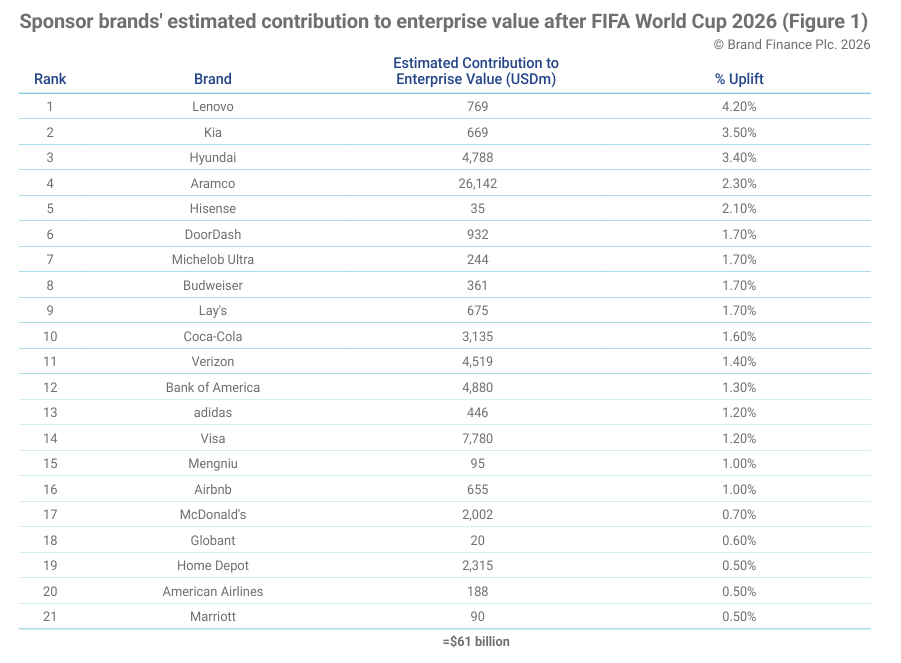
Brand Finance values the 2026 FIFA World Cup brand at USD5.2 billion, more than triple what it was worth in 2010. At the same time, Brand Finance's analysis of sponsorship activity at the 2026 FIFA World Cup across 21 official partners puts a number on that impact. Approximately USD2.8 billion in sponsorship investment generated an estimated USD61 billion contribution to enterprise value – a 22-fold return. Separately, the 21 sponsors analysed recorded a combined projected uplift of USD7.2 billion in brand value.
Beyond football, these figures illustrate how brands create tangible commercial value from the world's biggest sporting event, why some sponsors outperform others, and how sponsorship can become a long-term investment rather than simply a marketing expense.
Measuring sponsorship as a strategic investment
For many organisations, sponsorship is still measured by visibility. Reach, social engagement and impressions and media value are useful indicators of attention, but they do not reveal whether a partnership has strengthened awareness, familiarity, consideration or reputation in ways that ultimately drive brand value. In other words, these metrics show how visible a sponsorship was, not how valuable it became.
The most effective sponsorships are those that strengthen the intangible drivers of commercial performance, rather than simply generating short-term visibility.
How the analysis works
The analysis measures two distinct forms of financial impact. The published 22-fold figure compares approximately USD2.8 billion in sponsorship investment with an estimated USD61 billion contribution to enterprise value (Figure 1). It should not be read as a conventional cash return: it estimates the wider value created for the businesses that own the sponsoring brands.
Because this calculation requires public market and enterprise value data, its scope covers 21 official sponsors with publicly listed parent companies that were already tracked by Brand Finance. A small number of other sponsors could not be assessed because they were not covered by Brand Finance’s proprietary market research programme. Conversely, some brands for which Brand Finance holds brand valuations were excluded from the published analysis where corresponding enterprise value data was unavailable.
The sponsors excluded under these criteria were PIF, Qatar Airways, Unilever, Diageo, Mercado Livre, ADI Predictstreet, Betano, Boggi Milano, ExpressVPN, Fanatics, Inter Rapidísimo, Rock-it Cargo and Valvoline.
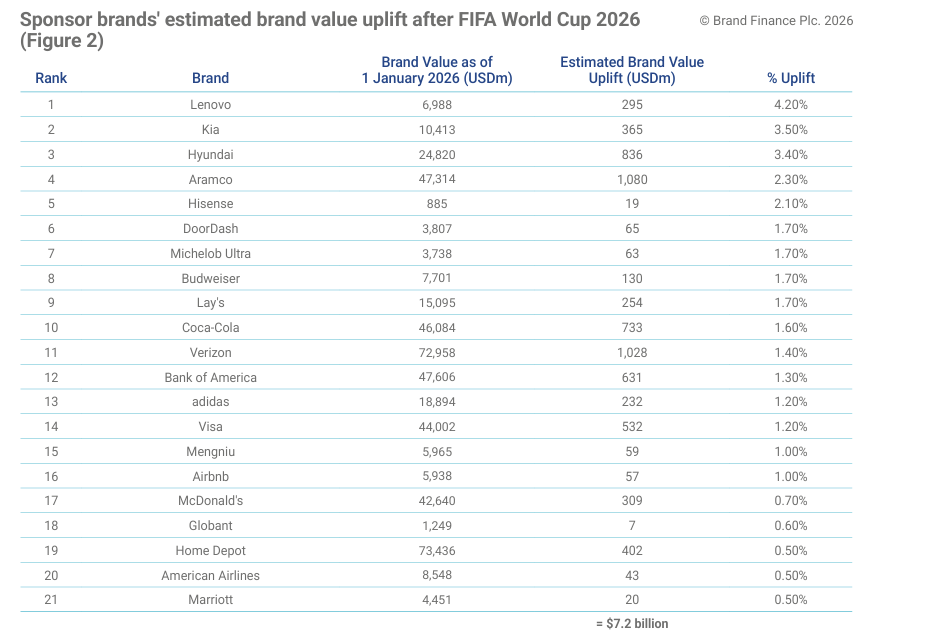
Brand value uplift was modelled separately. Across the 21 sponsors analysed, Brand Finance estimated a combined USD7.2 billion increase in brand value over the tournament, equivalent to an average uplift of 1.6%. This captures the long-term brand-building component of sponsorship impact and should not be added to, or treated as interchangeable with, the estimated enterprise value contribution.
Under Brand Finance’s Royalty Relief methodology, sponsorship exposure can strengthen the consumer perception measures that feed into a brand’s Brand Strength Index (BSI), including awareness, familiarity, consideration and reputation.
The BSI determines where a brand sits within the applicable royalty-rate range for its sector. A stronger brand supports a higher royalty rate on the same revenues and, consequently, a higher brand value.
This provides the link between changes in consumer perception and financial value. To understand why outcomes differed between sponsors, our analysis examined five key drivers: brand strength headroom, existing brand scale, the host market effect, tier of rights and activation quality.
The World Cup creates the greatest value for brands with room to grow
Among the partners analysed, Lenovo (+4.2%), Kia (+3.5%), Hyundai (+3.4%) and Aramco (+2.3%) recorded the highest projected uplifts in brand value, outperforming the tournament average. This suggests that the greatest commercial gains often belong to brands with the greatest scope to strengthen global perceptions through sponsorship (Figure 2).
This aligns with a broader pattern Brand Finance identified: Middle Eastern brands have outpaced the rest of the Global 500 in recent years, while Chinese and Asian brands continue to build their international footprint. For brands at this stage of their development, the World Cup can function as an accelerant, compressing years of international brand building efforts into a few weeks of guaranteed global attention. With lower levels of awareness in many markets, these brands have greater headroom to strengthen familiarity, consideration and preference, creating proportionately larger gains in brand value.
For market leaders, sponsorship is about protecting value rather than creating it
Visa’s projected brand value uplift was the lowest of any Tier 1 sponsor (+1.2%), closely followed by Adidas. Judged purely on projected uplift, both appear to underperform brands such as Lenovo or Kia. In reality, however, they are pursuing a fundamentally different objective.
Brands that already enjoy exceptionally high global awareness, familiarity, and consideration have less headroom for perceptual gains. Rather than using sponsorship to build their brand, they use it to reinforce existing leadership, maintain salience and protect hard-earned competitive advantage.
Visa's long-standing relationship with FIFA has ensured that Mastercard remains absent from one of the world's most valuable sporting properties. Adidas' decades-long association with football has reinforced its leadership in the sport while limiting Nike's ability to establish the same level of official presence. Coca Cola's sponsorship portfolio has served a similar purpose within the global beverages market.
For brands in this position, the commercial question is different. Rather than asking, “how much additional value will this sponsorship generate?” they ask, “what is the value of maintaining our leadership and preventing competitors from occupying this space?”
Viewed this way, a lower projected uplift does not necessarily imply a weaker investment. It reflects the fact that, for category leaders, sponsorship is often less about building new brand value than preserving the brand equity they have spent years building.
Geography shapes the opportunity
The markets in which a sponsor begins with the strongest commercial presence also influence the value it can generate. For example, sponsors with concentrated North American exposure, including domestic sponsors, benefited from activating where tournament engagement was most intense. Existing market presence gives brands more opportunities to activate through retail, media, hospitality, and local partnerships.
That said, the host-market effect does not benefit every sponsor equally. American Airlines and Marriott (+0.5% each) recorded the lowest uplifts of any sponsor – a finding that echoed wider reports of softer-than expected hotel and travel demand across host cities despite the influx of fans.
Rights create access but activation creates brand value
Hisense (+2.1%), DoorDash (+1.7%) and Michelob Ultra (+1.7%), all Tier 2 sponsors paying substantially less than Tier 1 partners for tournament only rights, beat the 1.6% average uplift that several Tier 1 partners fell short of.
This suggests that sponsorship success depends not only on the size of the investment, but on how effectively that investment is activated through advertising, digital content, retail, customer experiences, employee engagement and local market execution.
As sponsorship rights become more expensive and portfolios continue to expand, competitive advantage will increasingly belong to brands that maximise the value of their investment, not simply the scale of it. The strongest performers will be those most capable of translating association into stronger consumer perceptions and, ultimately, measurable commercial outcomes.
The ceiling ahead
The expansion of the World Cup to 48 teams prompted concerns that a larger tournament might dilute its commercial appeal. So far, FIFA has achieved the opposite.
The 2026 FIFA World Cup reached a record brand value of USD5.2 billion, with sponsorship remaining its largest single contributor to brand value, accounting for USD1.9 billion. Official partners collectively generated substantial commercial returns, demonstrating that the tournament's commercial proposition has strengthened rather than weakened despite its expansion.
Discussions around a 64-team format are already underway. While FIFA has successfully grown the competition without diminishing its commercial value in both the 2018-22 cycle and again in 2026, further expansion raises a different question - at what point does greater scale begin to erode the exclusivity that makes sponsorship valuable in the first place?
The value of sponsorship is built not only on audience size, but on scarcity. Official partners pay a premium because access remains limited. As FIFA considers future expansion, maintaining that balance between growth with the exclusivity will be critical to preserving the value of its commercial partnerships.
What this means for sponsorship strategy
The 2026 FIFA World Cup reinforced football's position as one of the world's most powerful commercial platforms. More importantly, it demonstrated that sponsorship should be evaluated not by the visibility it generates, but by the commercial value it creates. For challenger brands, sponsorship can accelerate international growth by strengthening awareness, familiarity and consideration among new audiences.
For established brands, it often plays a different role: reinforcing leadership, protecting market position and preserving the brand equity built over decades. The lesson for all brands, however, is clear: sponsorship should be treated as a strategic investment in brand value, not simply a communications expense. The organisations that outperform will be those that move beyond measuring attention and instead measure how effectively sponsorship strengthens the consumer perceptions that drive long-term commercial success.