




This article was originally published in the Brand Finance Football 50 2026 report.
Sports as an asset class: What is a club really worth?

Global Managing Director,
Brand Finance
What would it take to acquire Real Madrid? The question is deliberately provocative, but it points to a much bigger issue for sports businesses: what is a club, league or sports property actually worth as an investable asset?
As sport increasingly attracts institutional capital, private equity, strategic investors and global sponsors, enterprise valuation is becoming more than an exercise in putting a number on a club. It provides a framework for understanding where value comes from, what drives it, and how that value could change under different ownership or commercial strategies.
Brand Finance estimates Real Madrid’s enterprise value at EUR8.1 billion, making it the most valuable football asset globally. Barcelona follows at EUR6.7 billion, with Liverpool, Bayern Munich, Arsenal and PSG also exceeding EUR5 billion (Figure 1). The precise figures matter less than what the valuations reveal: clubs with similar revenues can command materially different values because investors are buying more than current financial performance.
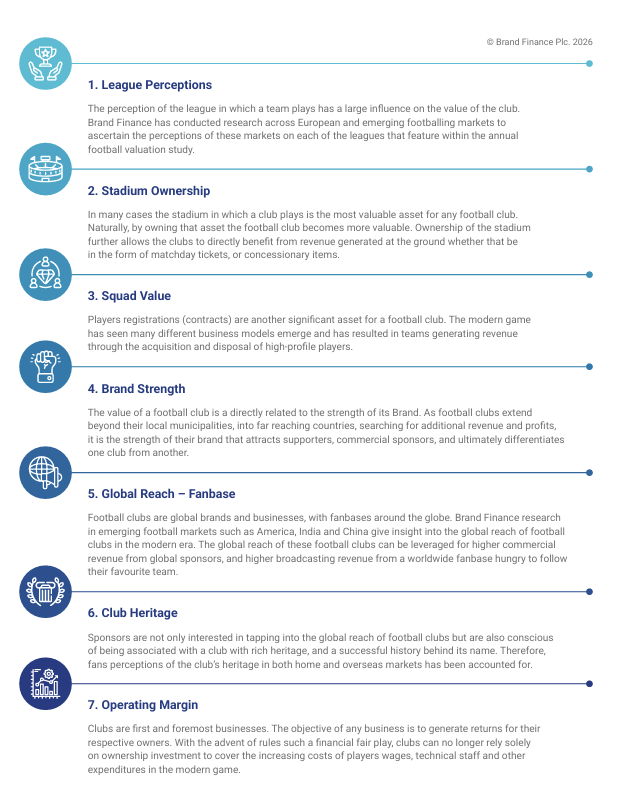
That distinction is critical for rights holders, sponsors and club executives. A club’s value reflects its ability to generate future commercial opportunities, its competitive position, the strength of its brand and global following, the quality and value of its playing squad, its heritage, ownership of key assets such as a stadium, and the degree of strategic freedom available to an owner.
This is why sports valuation cannot simply be approached as a conventional corporate valuation based on forecast cash flows. European top-flight clubs collectively recorded an aggregate loss of around EUR0.3 billion in 2023, yet transactions continue to value leading clubs at levels that would be difficult to justify on near-term earnings alone. Sport has characteristics of a trophy asset: scarcity, emotional attachment, global reach and the potential for a future owner to unlock value that is not reflected in today's profits.
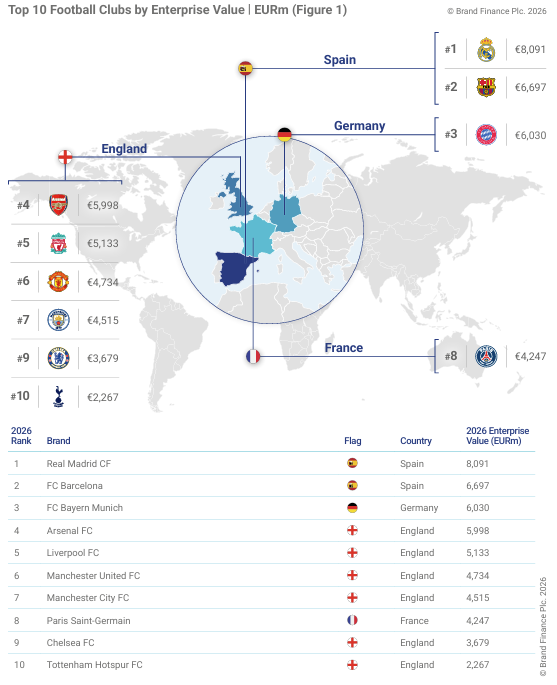
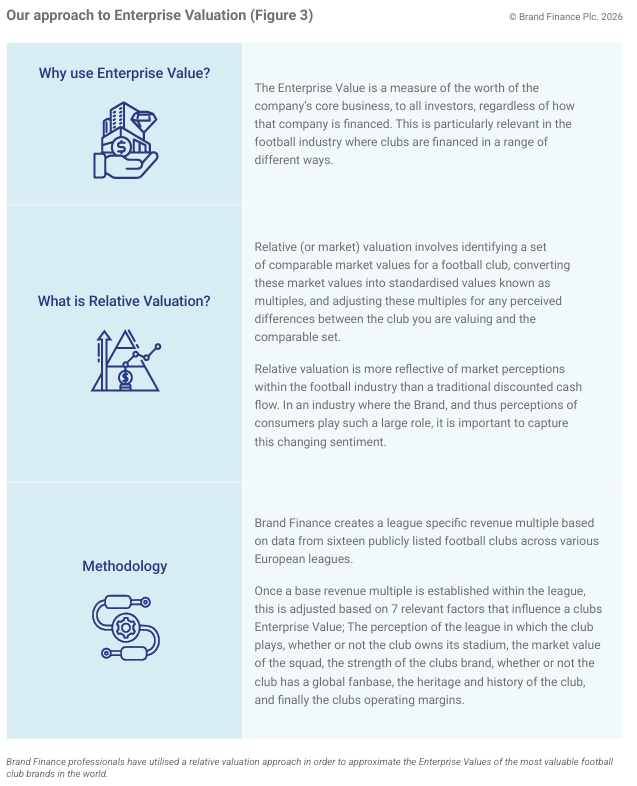
Enterprise value therefore provides a particularly useful lens. Brand Finance benchmarks clubs against publicly listed sports businesses, using enterprise value-to-revenue multiples as observable market evidence. We then adjust the appropriate multiple to reflect the relative characteristics of each club, including brand strength, squad value, global following, heritage and stadium ownership.
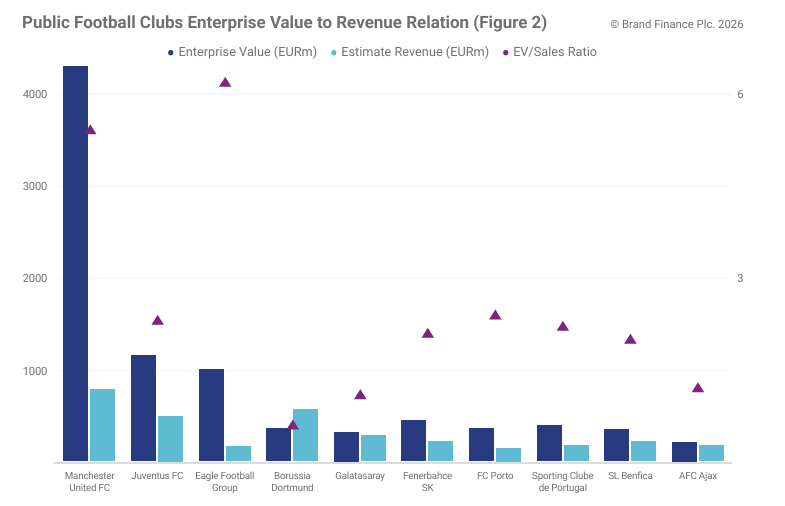
The result is not simply a valuation; it is a diagnostic of the asset. Consider Borussia Dortmund. Despite strong revenues, sporting success and regular Champions League participation, its market-derived EV/revenue multiple is substantially below some European peers.
Germany's 50+1 ownership structure limits the ability of external investors to obtain control, reducing the strategic and financial flexibility that can underpin higher valuations elsewhere. The implication for a club leader or investor is clear: enterprise value captures not only what a business earns, but the control, growth and value-creation opportunities available to its owner.
For rights holders, this creates a powerful benchmark for understanding the value of their underlying asset and the commercial upside available from stronger brands, audiences or assets. For sponsors, it helps identify which properties possess the underlying strength and future potential to justify long-term investment. For club executives and finance leaders, it provides a market-based perspective on strategic priorities: which investments are most likely to increase the value of the enterprise, rather than simply increase this year's revenue?
As sport matures into an asset class, that distinction becomes increasingly important. The question is no longer simply what is a club worth today? It is what characteristics make a sports asset valuable, what constrains that value, and where can management create the next billion in enterprise value?