





New Brand Finance data reveals that 75% of Australian retail brands featured record brand value growth
SYDNEY, 29 September 2026 – Woolworths maintains its position among the top 30 most valuable retail brands globally, ranking at 28th place with a noteworthy 12% brand value increase to USD9.8 billion. According to the Brand Finance Retail 100 2026 ranking by Brand Finance, the world’s leading brand valuation consultancy, three out of the four featured Australian brands demonstrate brand value growth amid efforts to improve shopping experience and value. Collectively, the four featured Australian brands post a 7% brand value increase to USD23 billion, which represents a 2% share of the ranking’s collective brand value.
Woolworths’s performance can be attributed to increased revenue thanks to its proactive measures towards affordability, supported by initiatives such as expanding Lower Shelf Price to nearly 700 essential goods, helping consumers save up on spending for their necessities. Additionally, the brand’s performance can also be attributed to its investment in supply chain resilience and customer experience, opening new distribution centres that improved product availability and restocking speed.
Coles (brand value down 3% to USD5.7 billion) ranks as the 44th most valuable retail brand globally, slipping four places from 2025. Despite the contraction in brand value, Coles reported higher sales and improved earnings in the 2025 financial year, driven by growth in its core supermarkets division and continued momentum in e-commerce, reflected in a 20% increase in its online sales. Coles’s performance can also be attributed to its value-focused strategy amid increased price sensitivity, with strong demand for own-brand and private-label ranges such as Coles Finest and Coles Simply.
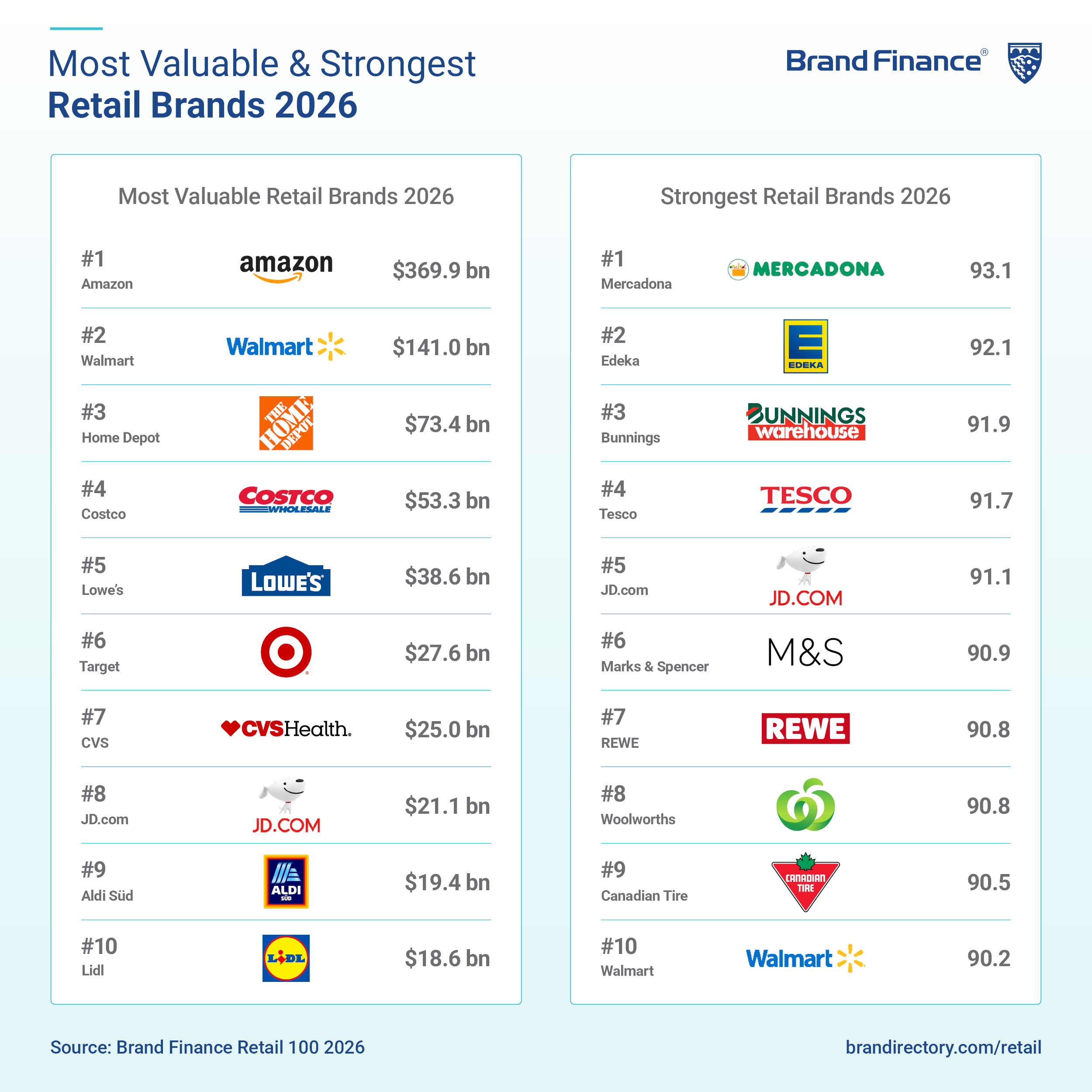
Bunnings rises three spots to become the 50th most valuable retail brand globally, posting a 9% brand value increase to USD5.1 billion. The brand also rises eight positions to rank as the third strongest retail brand globally, receiving a Brand Strength Index (BSI) score of 91.9/100 and an AAA brand strength rating. In April 2025, Bunnings launched a high-impact campaign called the “Legend of the Tongs”, which ran across the 18 weeks of the national Australian Football League (AFL) 2025 season and celebrated grassroots volunteers who contribute to running iconic match-day BBQs. This initiative generated substantial media coverage and engagement, lending to Bunnings’s brand strength performance this year.
Kmart demonstrates noteworthy double-digit growth, experiencing a 10% brand value increase to USD2.4 billion, rising two spots to become the 88th most valuable retail brand this year. The department store chain’s brand value growth can be attributed to its solid trading performance, effective cost control, and a focus on productivity, driven by the digitalisation of operations across its stores, sourcing, and supply chains. This effort in improving productivity mitigated the impact of business inflation, supporting revenue growth of almost 3% to AUD11.4 billion (approximately USD8.1 billion). Moreover, enhancements to Kmart Group’s digital platforms helped improve engagement and fostered a growing customer base, reaching 1.3 million monthly active users (MAU), supporting its brand performance over the past year.
Andy Kan, Managing Director, Brand Finance Australia, commented:
“Bunnings has achieved a place in the industry that extends well beyond transactions. It is a strength built through community presence rather than advertising weight, which is why the brand now ranks among the strongest retail brands globally. Woolworths and Coles are showing similar intent, investing in affordability and service in a category where shoppers reward consistency, as they rebound and reinforce long-term brand performance. Meanwhile, Kmart has turned operational discipline and a growing digital platform into double-digit brand value growth, proving that low prices and a strong brand are not mutually exclusive.”
Global Insights
Growing macroeconomic pressures have influenced consumer spending habits and provided discount and value retailers with a conducive environment to expand within the market since 2023, reflected in solid performances by brands such as Aldi Süd (brand value up 15% to USD19.4 billion) and Lidl (brand value up 4% to USD18.6 billion), which have grown their combined brand value at around three times the rate of traditional full-service incumbents.
Established national brands have also continued to demonstrate solid performances on measures of consumer perception and loyalty. Mercadona is now the strongest retail brand globally, receiving a BSI score of 93.1/100 and an AAA+ brand strength rating.
Additionally, Amazon retains its position as the most valuable retail brand globally, recording a 4% brand value increase to USD369.9 billion, almost three times the brand value of Walmart (brand value up 3% to USD141 billion), ranked second globally.




Brand Finance is the world’s leading brand valuation consultancy. Bridging the gap between marketing and finance, Brand Finance evaluates the strength of brands and quantifies their financial value to help organisations make strategic decisions.
Headquartered in London, Brand Finance operates in over 25 countries. Every year, Brand Finance conducts more than 6,000 brand valuations, supported by original market research, and publishes over 100 reports which rank brands across all sectors and countries.
Brand Finance also operates the Global Brand Equity Monitor, conducting original market research annually on 6,000 brands, surveying more than 175,000 respondents across 41 countries and 31 industry sectors. By combining perceptual data from the Global Brand Equity Monitor with data from its valuation database — the largest brand value database in the world — Brand Finance equips ambitious brand leaders with the data, analytics, and the strategic guidance they need to enhance brand and business value.
In addition to calculating brand value, Brand Finance also determines the relative strength of brands through a balanced scorecard of metrics, compliant with ISO 20671.
Brand Finance is a regulated accountancy firm and a committed leader in the standardisation of the brand valuation industry. Brand Finance was the first to be certified by independent auditors as compliant with both ISO 10668 and ISO 20671 and has received the official endorsement of the Marketing Accountability Standards Board (MASB) in the United States.
Brand is defined as a marketing-related intangible asset including, but not limited to, names, terms, signs, symbols, logos, and designs, intended to identify goods, services, or entities, creating distinctive images and associations in the minds of stakeholders, thereby generating economic benefits.
Brand strength is the efficacy of a brand’s performance on intangible measures relative to its competitors. Brand Finance evaluates brand strength in a process compliant with ISO 20671, looking at Marketing Investment, Stakeholder Equity, and the impact of those on Business Performance. The data used is derived from Brand Finance’s proprietary market research programme and from publicly available sources.
Each brand is assigned a Brand Strength Index (BSI) score out of 100, which feeds into the brand value calculation. Based on the score, each brand is assigned a corresponding Brand Rating up to AAA+ in a format similar to a credit rating.
Brand Finance calculates the values of brands in its rankings using the Royalty Relief approach – a brand valuation method compliant with the industry standards set in ISO 10668. It involves estimating the likely future revenues that are attributable to a brand by calculating a royalty rate that would be charged for its use, to arrive at a ‘brand value’ understood as a net economic benefit that a brand owner would achieve by licensing the brand in the open market.
The steps in this process are as follows:
1 Calculate brand strength using a balanced scorecard of metrics assessing Marketing Investment, Stakeholder Equity, and Business Performance. Brand strength is expressed as a Brand Strength Index (BSI) score on a scale of 0 to 100.
2 Determine royalty range for each industry, reflecting the importance of brand to purchasing decisions. In luxury, the maximum percentage is high, while in extractive industry, where goods are often commoditised, it is lower. This is done by reviewing comparable licensing agreements sourced from Brand Finance’s extensive database.
3 Calculate royalty rate. The BSI score is applied to the royalty range to arrive at a royalty rate. For example, if the royalty range in a sector is 0-5% and a brand has a BSI score of 80 out of 100, then an appropriate royalty rate for the use of this brand in the given sector will be 4%.
4 Determine brand-specific revenues by estimating a proportion of parent company revenues attributable to a brand.
5 Determine forecast revenues using a function of historic revenues, equity analyst forecasts, and economic growth rates.
6 Apply the royalty rate to the forecast revenues to derive brand revenues.
7 Discount post-tax brand revenues to a net present value which equals the brand value.
Brand Finance has produced this study with an independent and unbiased analysis. The values derived and opinions presented in this study are based on publicly available information and certain assumptions that Brand Finance used where such data was deficient or unclear. Brand Finance accepts no responsibility and will not be liable in the event that the publicly available information relied upon is subsequently found to be inaccurate. The opinions and financial analysis expressed in the study are not to be construed as providing investment or business advice. Brand Finance does not intend the study to be relied upon for any reason and excludes all liability to any body, government, or organisation.
The data presented in this study form part of Brand Finance's proprietary database, are provided for the benefit of the media, and are not to be used in part or in full for any commercial or technical purpose without written permission from Brand Finance.