





Brand Finance Retail 100 2026 ranking reveals resilient brand value performance across all five Chinese brands, despite declining brand strength
BEIJING, 29 September 2026 – China’s leading retail brands continue to grow in value despite a challenging consumer environment, but signs of mounting competitive pressure are emerging. According to the Brand Finance Retail 100 2026 ranking by Brand Finance, the world’s leading brand valuation consultancy, the five Chinese brands featured in the ranking recorded a combined brand value of USD68.4 billion, up 3% year-on-year. However, all five brands saw declines in their Brand Strength Index (BSI) scores as differentiation becomes harder to sustain in an increasingly price-driven market.
China accounts for 5% of the total brand value of this year's Retail 100 ranking, maintaining its position as one of the world's most influential retail markets despite more subdued growth than that of many international peers.
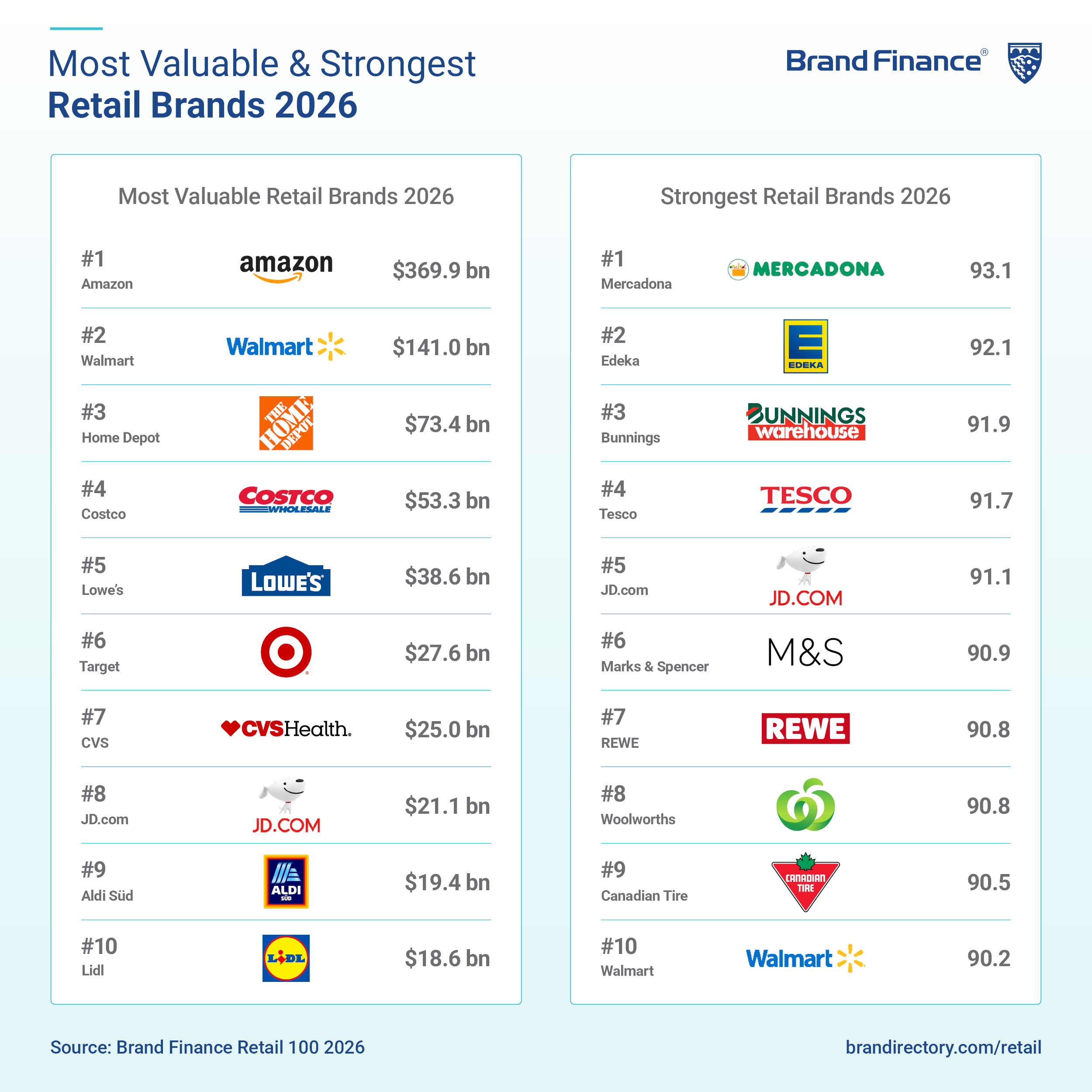
JD.com ranks as the eighth most valuable retail brand globally, recording 12% brand value growth to USD21.1 billion this year. Over the past year, the brand faced several headwinds, such as a high base effect from government trade-in subsidies in the prior year and rising raw material costs for electronics. Despite posting a dip in its Q2 2026 revenue, the online retail platform records an adjusted net profit growth of 21% to USD1.3 billion (approximately CNY8.9 billion), thanks to its disciplined cost management, demonstrating the brand’s resilience amid macroeconomic pressures.
However, even JD.com is not immune to the pressures facing China's retail sector. Despite retaining its AAA+ brand strength rating, its BSI score slipped from 92.3/100 in 2025 to 91.1/100 this year, mirroring a broader brand strength decline across all Chinese retail brands. The e-commerce platform ranks as the fifth strongest retail brand globally this year.
Pinduoduo (brand value up 6% to USD13.9 billion) remains the 17th most valuable retail brand globally. The brand’s performance can be attributed to solid revenue and operating profit growth, delivering an 11% revenue increase to USD15.4 billion (approximately CNY106.2 billion), mainly driven by its transaction services. The e-commerce brand is currently making notable investments to uplift its overall standing within the market, through initiatives such as the “100 Billion Yuan Support” programme, launched in April 2026, aiming to improve essential aspects of its retail ecosystem, as well as fee reductions for merchants, which is expected to enhance its long-term brand performance.
Pinduoduo also recorded a dip in its BSI score, dropping from 74.8/100 in 2025 to 71.7/100 this year. Its brand strength rating also declined to AA this year from AA+ last year. According to Brand Finance market research in China, Pinduoduo lags in terms of price acceptance, reflecting macroeconomic pressures faced by the country.
Taobao (brand value up 3% to USD12.2 billion) ranks as the 20th most valuable retail brand globally. Taobao remains one of the country's largest online marketplaces by gross merchandise value (GMV), which provides the brand with a larger pool of merchants, buyers, data, and logistics. In April 2025, the brand launched an on-demand delivery service, Taobao Instant Commerce, which focuses on quick delivery across various product categories on its platform, such as food, beverages, electronics, and apparel.
By August 2025, the service drove 25% year-on-year growth in Taobao’s monthly active users (MAU), reflecting the effectiveness of its strategic response to growing consumer needs. Taobao’s scale lends resilience its brand strength, resulting in only a slight dip in its BSI score from 89.3/100 last year to 88.8/100 this year, maintaining its AAA brand strength rating.
Tmall’s brand value sees a 3% drop to USD11 billion as customer complaints regarding the merchants on the platform surged in 2025. According to recent consumer-protection reports from China, a large share of complaints was related to the quality of the goods sold, counterfeit items, misleading advertisements, and difficulty in obtaining refunds for purchased items. These pressures are also reflected in the brand’s notable drop in BSI score from 89.2/100 in 2025 to 80.8/100 this year, with a brand strength rating decline from AAA to AAA-.
Meanwhile, Meituan records a 13% brand value decline to USD10.2 billion. In Q2 2025, the brand recorded a net profit drop of around 89% year-on-year amid intensifying competition within China’s food delivery market. Additionally, the local services platform faced regulatory pressures over its late delivery penalties as the algorithm that enforced the policy was linked with unsafe working conditions, traffic rule violations, and poor welfare outcomes for couriers. The brand phased out the penalties by the end of 2025; however, Meituan’s brand strength had already been affected. Meituan experiences a drop in its BSI score from 90.5/100 last year to 82.9/100 this year, with a brand strength rating decline from AAA+ to AAA- this year.
Despite declines in brand values, Tmall and Meituan rank as the 24th and 26th most valuable retail brands globally, respectively, rounding out the five featured Chinese brands among the top 30 most valuable retail brands globally. Their rankings reflect the scale of the Chinese retail sector even as its brands face financial headwinds, regulatory pressures, and intensifying competition.
Scott Chen, Managing Director China, Brand Finance, commented:
“China's retail sector has reached a turning point. For more than a decade, platforms grew by scale, and scale alone was enough to build formidable brands. With consumers more cautious and relentless price competition squeezing the whole value chain, the next phase of growth will be won on trust. JD.com has shown that reliability and service quality can hold up even in a tough market, while the pressures faced by Tmall and Meituan show how trust impacts brand performance. As competition intensifies, Chinese retail brands that tighten merchant quality control, deliver dependable fulfilment, and invest in customer loyalty are best positioned to build long-term brand performance.”
Global Insights
Growing macroeconomic pressures have influenced consumer spending habits and provided discount and value retailers with a conducive environment to expand within the market since 2023, reflected in solid performances by brands such as Aldi Süd (brand value up 15% to USD19.4 billion) and Lidl (brand value up 4% to USD18.6 billion), which have grown their combined brand value at around three times the rate of traditional full-service incumbents.
Established national brands have also continued to demonstrate solid performances on measures of consumer perception and loyalty. Mercadona is now the strongest retail brand globally, receiving a BSI score of 93.1/100 and an AAA+ brand strength rating.
Additionally, Amazon retains its position as the most valuable retail brand globally, recording a 4% brand value increase to USD369.9 billion, almost three times the brand value of Walmart (brand value up 3% to USD141 billion), ranked second globally.




Brand Finance is the world’s leading brand valuation consultancy. Bridging the gap between marketing and finance, Brand Finance evaluates the strength of brands and quantifies their financial value to help organisations make strategic decisions.
Headquartered in London, Brand Finance operates in over 25 countries. Every year, Brand Finance conducts more than 6,000 brand valuations, supported by original market research, and publishes over 100 reports which rank brands across all sectors and countries.
Brand Finance also operates the Global Brand Equity Monitor, conducting original market research annually on 6,000 brands, surveying more than 175,000 respondents across 41 countries and 31 industry sectors. By combining perceptual data from the Global Brand Equity Monitor with data from its valuation database — the largest brand value database in the world — Brand Finance equips ambitious brand leaders with the data, analytics, and the strategic guidance they need to enhance brand and business value.
In addition to calculating brand value, Brand Finance also determines the relative strength of brands through a balanced scorecard of metrics, compliant with ISO 20671.
Brand Finance is a regulated accountancy firm and a committed leader in the standardisation of the brand valuation industry. Brand Finance was the first to be certified by independent auditors as compliant with both ISO 10668 and ISO 20671 and has received the official endorsement of the Marketing Accountability Standards Board (MASB) in the United States.
Brand is defined as a marketing-related intangible asset including, but not limited to, names, terms, signs, symbols, logos, and designs, intended to identify goods, services, or entities, creating distinctive images and associations in the minds of stakeholders, thereby generating economic benefits.
Brand strength is the efficacy of a brand’s performance on intangible measures relative to its competitors. Brand Finance evaluates brand strength in a process compliant with ISO 20671, looking at Marketing Investment, Stakeholder Equity, and the impact of those on Business Performance. The data used is derived from Brand Finance’s proprietary market research programme and from publicly available sources.
Each brand is assigned a Brand Strength Index (BSI) score out of 100, which feeds into the brand value calculation. Based on the score, each brand is assigned a corresponding Brand Rating up to AAA+ in a format similar to a credit rating.
Brand Finance calculates the values of brands in its rankings using the Royalty Relief approach – a brand valuation method compliant with the industry standards set in ISO 10668. It involves estimating the likely future revenues that are attributable to a brand by calculating a royalty rate that would be charged for its use, to arrive at a ‘brand value’ understood as a net economic benefit that a brand owner would achieve by licensing the brand in the open market.
The steps in this process are as follows:
1 Calculate brand strength using a balanced scorecard of metrics assessing Marketing Investment, Stakeholder Equity, and Business Performance. Brand strength is expressed as a Brand Strength Index (BSI) score on a scale of 0 to 100.
2 Determine royalty range for each industry, reflecting the importance of brand to purchasing decisions. In luxury, the maximum percentage is high, while in extractive industry, where goods are often commoditised, it is lower. This is done by reviewing comparable licensing agreements sourced from Brand Finance’s extensive database.
3 Calculate royalty rate. The BSI score is applied to the royalty range to arrive at a royalty rate. For example, if the royalty range in a sector is 0-5% and a brand has a BSI score of 80 out of 100, then an appropriate royalty rate for the use of this brand in the given sector will be 4%.
4 Determine brand-specific revenues by estimating a proportion of parent company revenues attributable to a brand.
5 Determine forecast revenues using a function of historic revenues, equity analyst forecasts, and economic growth rates.
6 Apply the royalty rate to the forecast revenues to derive brand revenues.
7 Discount post-tax brand revenues to a net present value which equals the brand value.
Brand Finance has produced this study with an independent and unbiased analysis. The values derived and opinions presented in this study are based on publicly available information and certain assumptions that Brand Finance used where such data was deficient or unclear. Brand Finance accepts no responsibility and will not be liable in the event that the publicly available information relied upon is subsequently found to be inaccurate. The opinions and financial analysis expressed in the study are not to be construed as providing investment or business advice. Brand Finance does not intend the study to be relied upon for any reason and excludes all liability to any body, government, or organisation.
The data presented in this study form part of Brand Finance's proprietary database, are provided for the benefit of the media, and are not to be used in part or in full for any commercial or technical purpose without written permission from Brand Finance.