





A new Brand Finance study of 70 Chinese cities finds tourism, culture and liveability are reshaping urban competitiveness
LONDON, 14 October 2026 – Beijing is China's strongest city brand, according to Brand Finance, the world’s leading brand valuation consultancy, as the country's leading cities increasingly compete on culture, tourism and quality of life alongside economic strength.
The study finds that China's urban landscape is evolving beyond traditional measures of success. While economic performance, infrastructure and innovation remain fundamental, cities that offer compelling cultural experiences, attractive lifestyles and vibrant urban environments are strengthening their reputations and enhancing their appeal to residents, visitors, talent and investors alike.
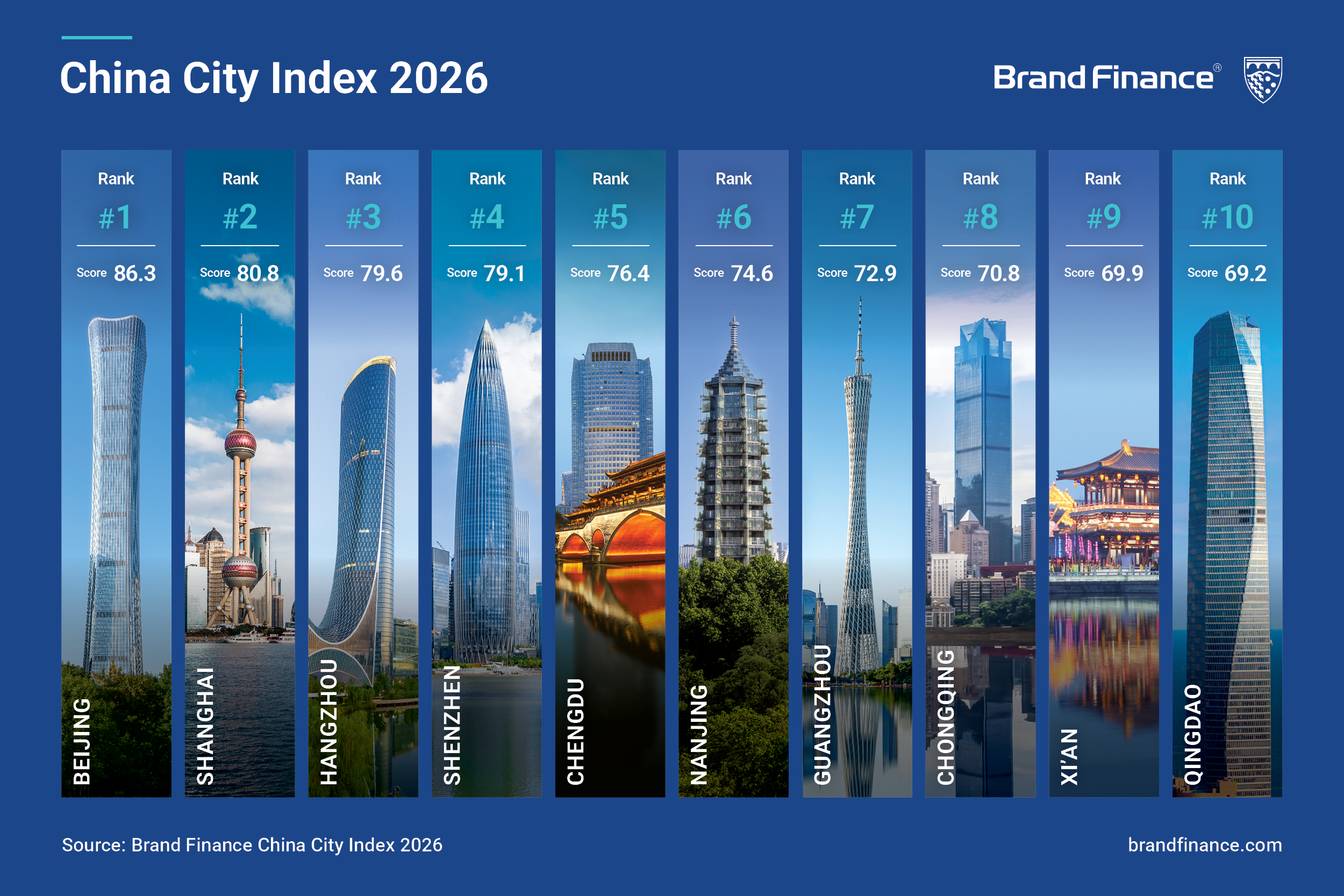
Beijing ranks as China's strongest city brand in the Brand Finance China City Index, followed by Shanghai in 2nd place and Hangzhou in 3rd. Shenzhen and Chengdu round out the top five, reflecting the growing strength of cities that combine economic dynamism with culture, tourism and quality of life.
As China's political, cultural and educational centre, Beijing continues to set the benchmark for comprehensive urban competitiveness. The city leads the nation in overall reputation, familiarity and visitation, while its strengths across governance, education, healthcare and cultural attractions reinforce its position as the country's most influential city brand.
Beyond Beijing, the Index shows there is no single blueprint for building a successful city brand.
Shanghai, ranks 2nd overall, reinforcing its position as China's commercial and financial powerhouse. The city ranks among the nation's strongest for national and international connectivity and employment opportunities, while also placing 2nd for familiarity and visitation. Its blend of global business influence, vibrant cultural scene and international appeal demonstrates how economic leadership remains a defining pillar of China's urban competitiveness. Hangzhou, ranks 3rd overall, has emerged as one of China's standout city brands by combining a thriving digital economy with rich cultural heritage, and scenic landscapes. The city ranks 2nd nationally for reputation and performs strongly for lifestyle appeal and green spaces, demonstrating how innovation and liveability can work hand in hand. Home to technology leaders such as Alibaba and NetEase, while also renowned for landmarks including West Lake and Longjing tea, Hangzhou exemplifies how cities can successfully balance economic dynamism with quality of life.
The research also highlights the increasingly distinctive identities emerging across China's leading cities. Shenzhen continues to strengthen its position as China's innovation and entrepreneurship hub. Ranking 4th overall, the city leads the nation for entrepreneurship, technological leadership and entrepreneurial spirit, underpinned by its world-leading concentration of high-tech enterprises and sustained leadership in international patent applications. While best known as China's Silicon Valley, Shenzhen is also investing heavily in culture, public spaces and quality of life, signalling its ambition to evolve into a more rounded global city.
Chengdu, meanwhile, has transformed its renowned food culture, green spaces and relaxed way of life into a powerful competitive advantage. Ranking 5th overall and 1st for lifestyle attractiveness, the city illustrates how investments in quality of life can become a defining element of a successful city brand.
Rather than converging around a single model of development, China's leading cities are increasingly defining themselves through their individual strengths. Together, they demonstrate how diverse approaches to urban development are helping shape a more dynamic and competitive city landscape.
The Index also highlights opportunities for cities to build even stronger brands. Across all 70 cities surveyed, residents consistently rated their own cities more highly than people elsewhere did for attributes such as green spaces, public safety, healthcare and overall liveability. These findings suggest many cities possess strengths that can be further amplified by showcasing the experiences and qualities that residents value most, helping to deepen emotional connections with visitors, businesses and future residents
Commenting on the findings, Scott Chen, Managing Director, Brand Finance China, said:
"China's strongest cities such as Beijing, Shanghai, Hangzhou, Shenzhen and Chengdu show that long-term competitiveness is no longer built on economic strength alone. The highest-ranked cities combine strong economic fundamentals with distinctive identities, whether through innovation, culture, liveability or global connectivity. It is this ability to stand for something unique that increasingly sets the country's leading city brands apart.
For emerging cities like Suzhou, Kunming, Yangzhou and Weihai, the opportunity lies in building on the qualities that residents already value. Across many cities, locals rate liveability, safety and public spaces more highly than people elsewhere do. By communicating these authentic strengths more effectively, cities can strengthen their reputation, attract talent and investment, and unlock greater economic and social value."
Other notable cities in the Brand Finance China City Index 2026 include:
The Brand Finance China City Index is based on a nationwide survey of 12,000 respondents evaluating 70 major Chinese cities across seven dimensions: Business & Investment, Culture & Heritage, Education & Science, Governance, Liveability, People & Values, andSustainability & Transport. By assessing both residents' views of their own cities and perceptions from across the country, the Index provides a comprehensive picture of the factors shaping China's strongest city brands and the evolving nature of urban competitiveness.




Brand Finance is the world’s leading brand valuation consultancy. Bridging the gap between marketing and finance, Brand Finance evaluates the strength of brands and quantifies their financial value to help organisations make strategic decisions.
Headquartered in London, Brand Finance operates in over 25 countries. Every year, Brand Finance conducts more than 6,000 brand valuations, supported by original market research, and publishes over 100 reports which rank brands across all sectors and countries.
Brand Finance also operates the Global Brand Equity Monitor, conducting original market research annually on 6,000 brands, surveying more than 175,000 respondents across 41 countries and 31 industry sectors. By combining perceptual data from the Global Brand Equity Monitor with data from its valuation database — the largest brand value database in the world — Brand Finance equips ambitious brand leaders with the data, analytics, and the strategic guidance they need to enhance brand and business value.
In addition to calculating brand value, Brand Finance also determines the relative strength of brands through a balanced scorecard of metrics, compliant with ISO 20671.
Brand Finance is a regulated accountancy firm and a committed leader in the standardisation of the brand valuation industry. Brand Finance was the first to be certified by independent auditors as compliant with both ISO 10668 and ISO 20671 and has received the official endorsement of the Marketing Accountability Standards Board (MASB) in the United States.
Brand is defined as a marketing-related intangible asset including, but not limited to, names, terms, signs, symbols, logos, and designs, intended to identify goods, services, or entities, creating distinctive images and associations in the minds of stakeholders, thereby generating economic benefits.
Brand strength is the efficacy of a brand’s performance on intangible measures relative to its competitors. Brand Finance evaluates brand strength in a process compliant with ISO 20671, looking at Marketing Investment, Stakeholder Equity, and the impact of those on Business Performance. The data used is derived from Brand Finance’s proprietary market research programme and from publicly available sources.
Each brand is assigned a Brand Strength Index (BSI) score out of 100, which feeds into the brand value calculation. Based on the score, each brand is assigned a corresponding Brand Rating up to AAA+ in a format similar to a credit rating.
Brand Finance calculates the values of brands in its rankings using the Royalty Relief approach – a brand valuation method compliant with the industry standards set in ISO 10668. It involves estimating the likely future revenues that are attributable to a brand by calculating a royalty rate that would be charged for its use, to arrive at a ‘brand value’ understood as a net economic benefit that a brand owner would achieve by licensing the brand in the open market.
The steps in this process are as follows:
1 Calculate brand strength using a balanced scorecard of metrics assessing Marketing Investment, Stakeholder Equity, and Business Performance. Brand strength is expressed as a Brand Strength Index (BSI) score on a scale of 0 to 100.
2 Determine royalty range for each industry, reflecting the importance of brand to purchasing decisions. In luxury, the maximum percentage is high, while in extractive industry, where goods are often commoditised, it is lower. This is done by reviewing comparable licensing agreements sourced from Brand Finance’s extensive database.
3 Calculate royalty rate. The BSI score is applied to the royalty range to arrive at a royalty rate. For example, if the royalty range in a sector is 0-5% and a brand has a BSI score of 80 out of 100, then an appropriate royalty rate for the use of this brand in the given sector will be 4%.
4 Determine brand-specific revenues by estimating a proportion of parent company revenues attributable to a brand.
5 Determine forecast revenues using a function of historic revenues, equity analyst forecasts, and economic growth rates.
6 Apply the royalty rate to the forecast revenues to derive brand revenues.
7 Discount post-tax brand revenues to a net present value which equals the brand value.
Brand Finance has produced this study with an independent and unbiased analysis. The values derived and opinions presented in this study are based on publicly available information and certain assumptions that Brand Finance used where such data was deficient or unclear. Brand Finance accepts no responsibility and will not be liable in the event that the publicly available information relied upon is subsequently found to be inaccurate. The opinions and financial analysis expressed in the study are not to be construed as providing investment or business advice. Brand Finance does not intend the study to be relied upon for any reason and excludes all liability to any body, government, or organisation.
The data presented in this study form part of Brand Finance's proprietary database, are provided for the benefit of the media, and are not to be used in part or in full for any commercial or technical purpose without written permission from Brand Finance.