





New Brand Finance data shows consumers rate Chime and Ally highly for quality, while some of the region’s best-known banks rely more on scale than strong consumer conviction
LONDON, 15 October 2026 – As Dallas builds its case as a rival financial center to New York, new analysis from Brand Finance, the world’s leading brand valuation consultancy, examines how consumers across South Central U.S. perceive the banking brands competing for their business.
Capital One dominates the funnel
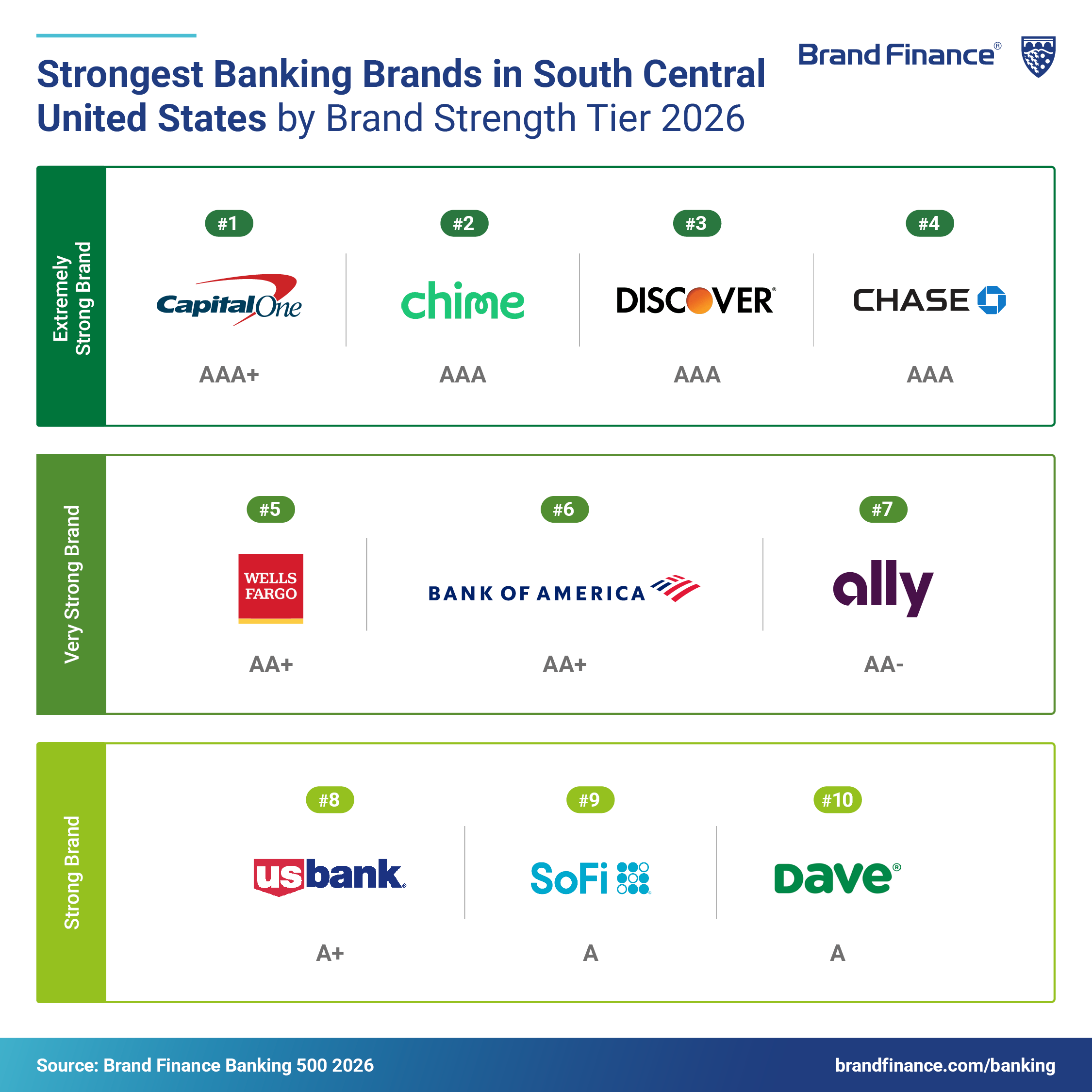
Capital One is the strongest banking brand in South Central, with a regional Brand Strength Index (BSI) score of 94.3 out of 100 and corresponding AAA+ rating. According to Brand Finance data, 85% of consumers in the region are familiar with the brand and 46% understand what it offers. More than half (55%) would consider Capital One and over a quarter (26%) prefer it, a level of conversion no other brand in the region matches.
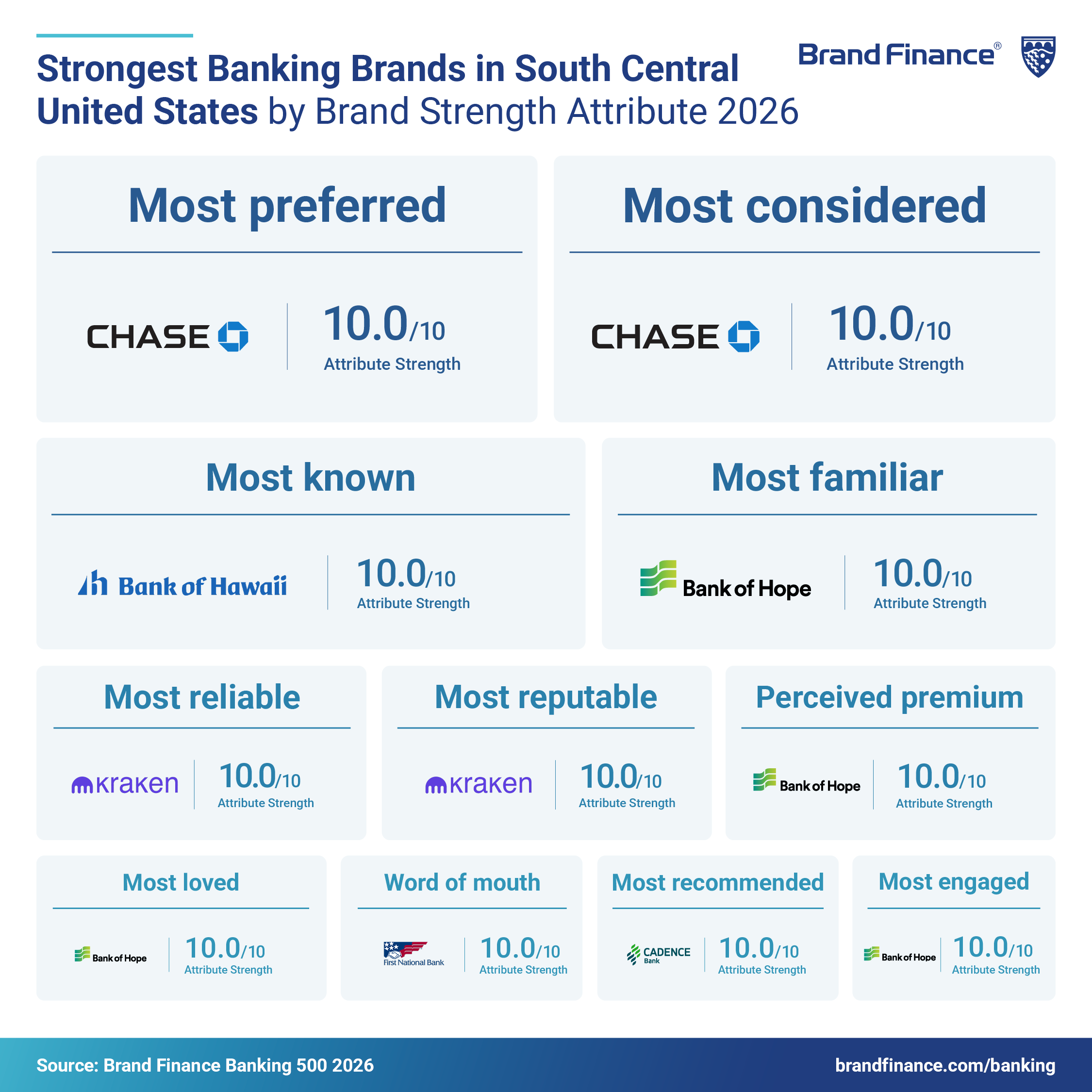
Consumer perceptions of quality support that scale, with Capital One scoring 10 out of 10 for both reputation and reliability when benchmarked against regional peers.
Chime and Discover Bank close behind
Chime ranks second, with a BSI score of 89.8 out of 100. Brand Finance research shows 71% of South Central consumers are familiar with the brand and 23% prefer it, giving Chime one of the strongest conversion rates in the region. Word of mouth is its standout metric, the highest of any banking brand researched in South Central, and it scores 10 out of 10 for recommendation against peers. Chime also rivals Capital One on quality, scoring 9.5 for reliability, 9.8 out of 10 for reputation and 10 for likeability. Its main challenges are in reach and price acceptance, with the latter scoring just 3.8 out of 10, indicating that Chime’s strength lies in how well it converts and is championed by the consumers who know it, rather than its scale or pricing power.
Discover Bank ranks third (BSI 88.7) with a stronger presence at the top of the funnel than Chime; 78% of South Central consumers are familiar with the brand and 33% understand what it offers. What separates the two is conversion: Discover Bank records lower preference and weaker perceptions across brand attributes, and its word of mouth is among the lowest in the region, suggesting that its familiarity has not yet translated into the same level of consumer enthusiasm.
Presence does not equal preference
South Central’s banking market is attracting growing attention. Local political leaders and the financial executives drawn to Dallas are promoting the city’s financial boom as “Y’all Street”: Goldman Sachs is building a Dallas campus for more than 5,000 employees and in September 2026, Morgan Stanley announced a USD684 million expansion to establish a US hub in Dallas, expected to support more than 3,800 jobs. According to the Federal Reserve Bank of Dallas, financial services jobs in the region grew more than 23% between February 2020 and July 2026, compared with 6% in New York City over the same period.
Brand Finance’s data suggests that a large physical presence does not automatically translate into consumer goodwill. Chase (fourth, BSI 85.0) has the widest reach of any banking brand in the region, with 90% familiarity and 41% understanding, and scores 10 out of 10 on both consideration and preference when benchmarked against peers. Its perceptions are weaker, however, with scores of just 7.6 out of 10 for reputation and 4.9 for reliability, suggesting that Chase’s scale has yet to convert into real confidence among South Central consumers.
Wells Fargo (fifth, BSI 76.6) and Bank of America (sixth, BSI 75.8) show a similar reliance on scale. Both earn 80% familiarity, but Wells Fargo converts 40% consideration into just 16% preference, and benchmarks below competitors on quality perceptions and price acceptance. Bank of America, which is expanding its presence in Uptown Dallas, holds up better on conversion, with 35% consideration and 18% preference, but records the weakest recommendation score of any brand in the top 10. U.S. Bank (eighth, BSI 63.7) performs respectably across perception metrics, scoring between 6.8 and 7.7 out of 10 on reputation, reliability, engagement and likeability, but its benchmarked preference score of just 4.0 suggests consumers rarely choose it over competitors.
Challengers limited by reach
Ally (seventh, BSI 69.3) is known by fewer than half (43%) of South Central consumers but outperforms much larger banks on perception. It scores 10 out of 10 for price acceptance, 9.4 for reliability, 9.0 for likeability, when benchmarked against peers, and word of mouth sits above 50%. With 14.5% preference from a comparatively small base, Ally is a high-quality brand consumers are willing to pay for, but one that too few currently know. Together, Chime and Ally represent digital brands whose brand health often matches or exceeds that of established banks, but whose overall strength is limited by reach.
SoFi (ninth, BSI 59.6) is building awareness as a digital challenger, with 56% familiarity and 25% understanding. Its reputation score (6.0 out of 10) is respectable, but reliability (3.9) suggests it has yet to earn the same level of trust established by incumbent brands.
Rounding out the top 10, Dave ranks 10th with a BSI score of 55.9.
Laurence Newell, Chairman, Brand Finance Americas commented:
“Capital One leads South Central across the funnel, with consumers who not only know the brand but understand it and actively choose it in large numbers. Beyond the top position, the picture is more mixed. The major banks are investing heavily in the region, but presence is not the same as preference, and challengers such as Chime and Ally are often rated more highly by the consumers who know them. In a market changing as quickly as South Central, understanding how consumer perceptions shift over time is as important as knowing where they stand today, for incumbents and challengers alike.”




Brand Finance is the world’s leading brand valuation consultancy. Bridging the gap between marketing and finance, Brand Finance evaluates the strength of brands and quantifies their financial value to help organisations make strategic decisions.
Headquartered in London, Brand Finance operates in over 25 countries. Every year, Brand Finance conducts more than 6,000 brand valuations, supported by original market research, and publishes over 100 reports which rank brands across all sectors and countries.
Brand Finance also operates the Global Brand Equity Monitor, conducting original market research annually on 6,000 brands, surveying more than 175,000 respondents across 41 countries and 31 industry sectors. By combining perceptual data from the Global Brand Equity Monitor with data from its valuation database — the largest brand value database in the world — Brand Finance equips ambitious brand leaders with the data, analytics, and the strategic guidance they need to enhance brand and business value.
In addition to calculating brand value, Brand Finance also determines the relative strength of brands through a balanced scorecard of metrics, compliant with ISO 20671.
Brand Finance is a regulated accountancy firm and a committed leader in the standardisation of the brand valuation industry. Brand Finance was the first to be certified by independent auditors as compliant with both ISO 10668 and ISO 20671 and has received the official endorsement of the Marketing Accountability Standards Board (MASB) in the United States.
Brand is defined as a marketing-related intangible asset including, but not limited to, names, terms, signs, symbols, logos, and designs, intended to identify goods, services, or entities, creating distinctive images and associations in the minds of stakeholders, thereby generating economic benefits.
Brand strength is the efficacy of a brand’s performance on intangible measures relative to its competitors. Brand Finance evaluates brand strength in a process compliant with ISO 20671, looking at Marketing Investment, Stakeholder Equity, and the impact of those on Business Performance. The data used is derived from Brand Finance’s proprietary market research programme and from publicly available sources.
Each brand is assigned a Brand Strength Index (BSI) score out of 100, which feeds into the brand value calculation. Based on the score, each brand is assigned a corresponding Brand Rating up to AAA+ in a format similar to a credit rating.
Brand Finance calculates the values of brands in its rankings using the Royalty Relief approach – a brand valuation method compliant with the industry standards set in ISO 10668. It involves estimating the likely future revenues that are attributable to a brand by calculating a royalty rate that would be charged for its use, to arrive at a ‘brand value’ understood as a net economic benefit that a brand owner would achieve by licensing the brand in the open market.
The steps in this process are as follows:
1 Calculate brand strength using a balanced scorecard of metrics assessing Marketing Investment, Stakeholder Equity, and Business Performance. Brand strength is expressed as a Brand Strength Index (BSI) score on a scale of 0 to 100.
2 Determine royalty range for each industry, reflecting the importance of brand to purchasing decisions. In luxury, the maximum percentage is high, while in extractive industry, where goods are often commoditised, it is lower. This is done by reviewing comparable licensing agreements sourced from Brand Finance’s extensive database.
3 Calculate royalty rate. The BSI score is applied to the royalty range to arrive at a royalty rate. For example, if the royalty range in a sector is 0-5% and a brand has a BSI score of 80 out of 100, then an appropriate royalty rate for the use of this brand in the given sector will be 4%.
4 Determine brand-specific revenues by estimating a proportion of parent company revenues attributable to a brand.
5 Determine forecast revenues using a function of historic revenues, equity analyst forecasts, and economic growth rates.
6 Apply the royalty rate to the forecast revenues to derive brand revenues.
7 Discount post-tax brand revenues to a net present value which equals the brand value.
Brand Finance has produced this study with an independent and unbiased analysis. The values derived and opinions presented in this study are based on publicly available information and certain assumptions that Brand Finance used where such data was deficient or unclear. Brand Finance accepts no responsibility and will not be liable in the event that the publicly available information relied upon is subsequently found to be inaccurate. The opinions and financial analysis expressed in the study are not to be construed as providing investment or business advice. Brand Finance does not intend the study to be relied upon for any reason and excludes all liability to any body, government, or organisation.
The data presented in this study form part of Brand Finance's proprietary database, are provided for the benefit of the media, and are not to be used in part or in full for any commercial or technical purpose without written permission from Brand Finance.