This article was originally published in the Brand Finance Marathons 50 2026 report.
The world’s top 50 marathons collectively generated an estimated USD6 billion in economic impact for their host cities in 2025, according to Brand Finance’s 2026 research and analysis.
While the races themselves may take place over a matter of hours, their economic footprint extends across entire cities, supporting hotels, restaurants, transport networks, retailers and other local businesses before, during and after race day.
This concentration of activity is one of the defining characteristics of marathon economics. Tens of thousands of runners can arrive in a city for a single event, often accompanied by friends and family, while major races can attract hundreds of thousands – and in some cases millions – of spectators on the streets.
Unlike many elite sporting events, marathons place amateur participants on the same course as the world’s elite. This mass-participation model creates a particularly broad economic footprint, with spending generated not only by spectators but by the athletes themselves.
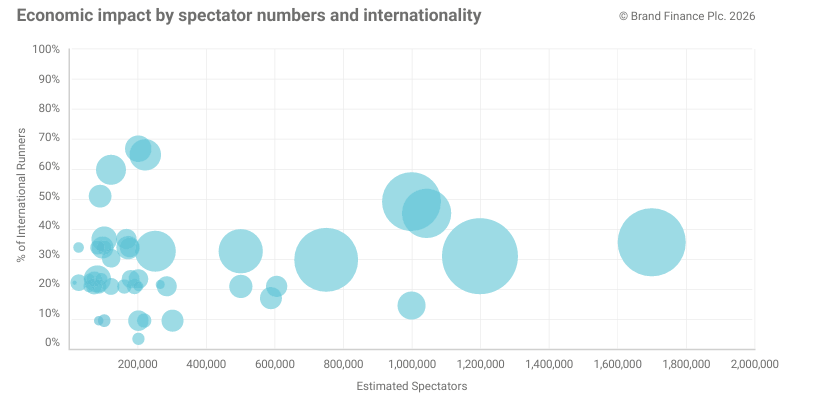
The more international runners a marathon attracts, the greater its economic impact tends to be, as visitors from overseas stay longer and spend more than their domestic counterparts. Brand Finance’s economic impact model shows that international runners and visitors stay for an average of 3.9 days, meaning the value generated extends well beyond race day.
Brand Finance’s modelling also estimates that international visitors spend around 2.5 times as much as domestic visitors on average. In major tourism destinations, the difference can be considerably greater, reaching around 10 times domestic spend in Rome and 20 times in Madrid.
The economic contribution of international runners extends further through the people travelling with them. Marathon participation is rarely an individual trip, particularly when international travel is involved.
Research from the 2025 Zurich Rock ‘n’ Roll Running Series Madrid found that international participants travelled in groups averaging 4.2 people, extending the event’s economic reach through additional spending on accommodation, food, transport, entertainment and tourism.
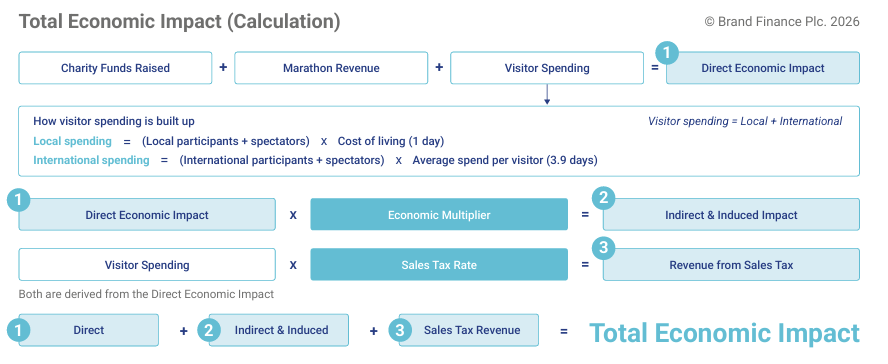
Brand Finance’s analysis captures this wider footprint by combining visitor spending, marathon revenues and charity funds raised to calculate direct economic impact. Appropriate economic multipliers are then applied to account for indirect and induced activity as money circulates through the host economy, alongside the sales tax generated through visitor expenditure.
TCS New York City Marathon, Bank of America Chicago Marathon and TCS London Marathon lead the economic impact ranking
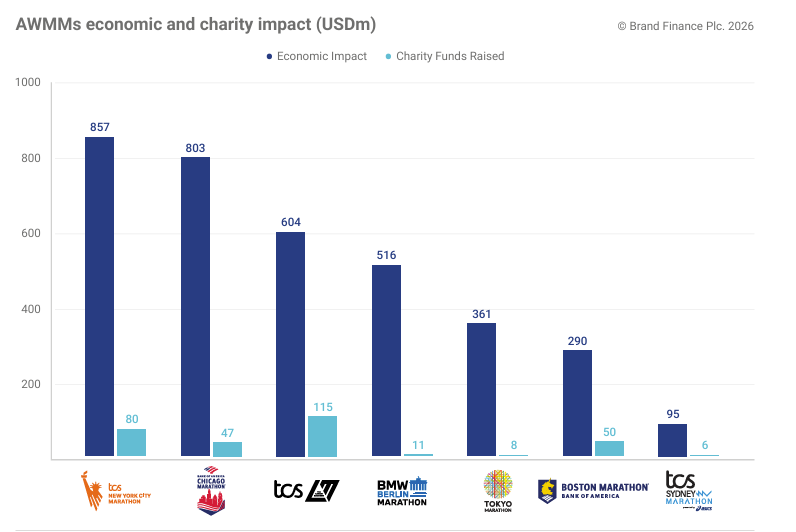
At the top of the ranking, the TCS New York City Marathon generated the greatest economic impact at an estimated USD857 million, narrowly ahead of the Bank of America Chicago Marathon at USD803 million.
The TCS London Marathon ranks third at USD604 million, meaning the three events together generated almost USD2.3 billion for their host economies.
Their scale illustrates the economic power that can be created when strong marathon brands combine large participant fields with international appeal and extensive spectator engagement.
New York City in particular benefits from the scale of the audience surrounding the race, while all three take place in major global destinations capable of converting marathon participation into wider visitor spending.
The next tier demonstrates that this effect extends across several major international marathon markets. BMW Berlin Marathon generated an estimated USD516 million, Tokyo Marathon USD361 million and Boston Marathon presented by Bank of America USD290 million, while Schneider Electric Marathon de Paris contributed a further USD247 million.
TCS Amsterdam Marathon (USD147 million), Acea Run Rome The Marathon (USD132 million) and Osaka Marathon (USD116 million) complete the top 10. Together, the 10 highest-impact marathons generated approximately USD4.1 billion – around 69% of the economic impact generated by the entire top 50.
The Abbott World Marathon Majors are particularly prominent. The seven Majors valued in Brand Finance’s economic impact analysis – New York City, Chicago, London, Berlin, Tokyo, Boston and TCS Sydney Marathon presented by ASICS – collectively generated approximately USD3.5 billion in economic impact.
More than a race weekend
The findings illustrate why the value of a marathon to its host city cannot be measured solely through entry fees or event revenues.
International runners staying for several days create demand across the visitor economy, while the friends, family and spectators surrounding them broaden the impact further. For established tourism destinations, the marathon can effectively become another reason to visit the city.
This relationship also works in the opposite direction. A compelling destination can strengthen the appeal of the marathon itself.
Routes through globally recognised cityscapes, access to cultural attractions and the wider visitor experience can influence a runner’s decision about where to compete, particularly for international participants committing substantial time and money to the trip.
Economic impact and brand strength are therefore distinct but closely connected. Economic impact measures the tangible contribution generated around an event, while brand strength captures the perceptions and behaviours that can encourage runners to choose one marathon over another.
A strong marathon brand can attract participants from further afield, draw larger audiences and support commercial partnerships; the resulting visitor activity can then translate that appeal into measurable value for the host city.
For organisers and city authorities, the opportunity extends far beyond staging a successful race. The world’s leading marathons demonstrate how a single weekend of sport can mobilise runners and spectators on a huge scale, stimulate spending across the local economy and showcase a city to an international audience. In doing so, the marathon becomes not simply a sporting event, but a significant economic and destination-brand asset.
Economic impact methodology
Assessing the economic impact of a marathon on its host city involves a comprehensive analysis of various financial inflows and outflows associated with the event. This methodology provides insights into how such events stimulate local economies, guiding stakeholders in decision-making and strategic planning. All inputs to the model were obtained through a combination of online sources, Brand Finance market research, data supplied direct from marathon organisers, and global financial benchmarks. Key components of Brand Finance's economic impact assessment methodology involved detailed analysis across six pillars.
Direct spending
Participants: Marathon runners often incur expenses related to registration fees, accommodation, dining and local transportation.
Spectators: Visitors attending the marathon contribute through spending on lodging, food, entertainment and other local services.
Organisers: Expenditures on event logistics, staffing, security and infrastructure enhancements directly inject funds into the local economy.
Indirect spending
This encompasses the subsequent economic activities resulting from direct spending. For instance, increased demand at hotels leads to higher procurement of local goods and services, benefiting suppliers and related businesses.
Induced spending
The ripple effect of increased earnings among local employees and businesses leads to further spending within the community, amplifying the economic impact.
Multiplier effect
To capture the comprehensive economic influence, multipliers are applied to direct spending figures. These multipliers estimate the extent to which initial expenditures circulate within the local economy, accounting for indirect and induced effects.
Charity impact
Marathons are used as a celebrated platform for fundraising activity to a wide selection of charity partners. Total charitable funds collected in association with the event were included in the assessment.
Tax revenues
Enhanced economic activities lead to increased collection of sales taxes, lodging taxes, and other municipal revenues, bolstering public finances.