This article was originally published in the Brand Finance Marathons 50 2026 report.
Measuring the wellbeing benefits of marathons
Marathons create value that reaches well beyond the finish line. For the first time, Brand Finance has measured that impact, which we call societal value.
Societal value describes how a marathon enables people to lead healthier, more active and more satisfying lives, and it is distinct from a race’s economic impact. A marathon can reshape a runner physically and mentally, and its benefits and inspiration extend outward to families, workplaces and communities. It is assessed through two lenses: wellbeing, meaning the value people gain from feeling better through being active, including life satisfaction, mood and social connection; and healthcare, meaning the cost savings associated with being more active. Our research speaks most directly to the wellbeing lens; on healthcare, we draw on external evidence to show what’s at stake.
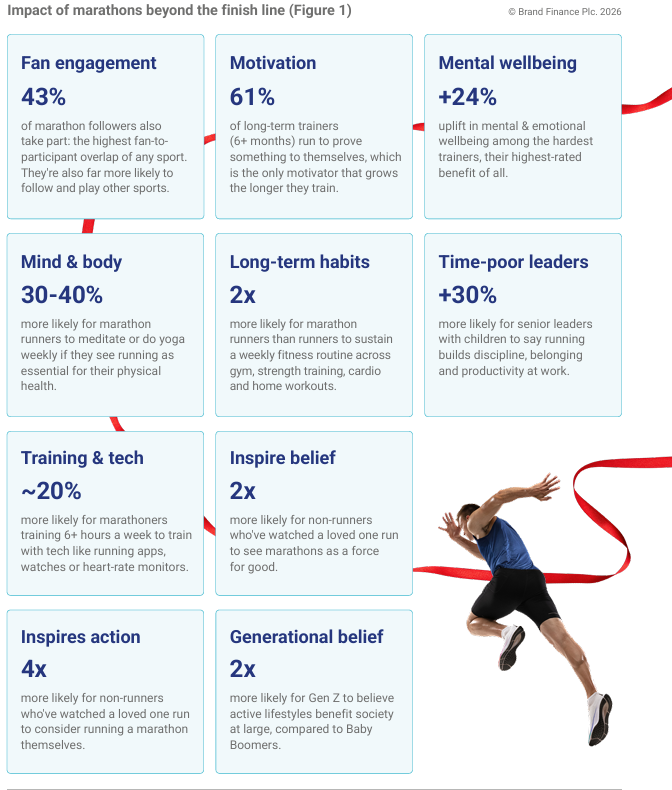
Our research captures societal wellbeing at three levels: the runner, community and society. At each level, we look at how marathons build a stronger sense of self, a lasting activity habit and an influence on those around them. This section focuses on the runner and society, while the community level is explored in the Inspiration and the next generation section (pages 46-47). The benefits often reach further than you might expect. Compared with runners who have neither children nor senior roles, senior leaders with children are 30% more likely to say running builds discipline, belonging and productivity at work. Finding the hours pays off.
The 10 insights in Figure 1 sum up the chapter at a glance. Together they demonstrate how marathons train the mind as much as the body, build habits that outlast race day and spark inspiration that spreads from runner to spectator and from one generation to the next. That inspiration matters. Marathons have the highest fan-to-participant overlap of any sport, with 43% of marathon followers also taking part. That is a huge opportunity, and a real challenge. When flagship races are oversubscribed, smaller, more accessible races become more important in soaking up demand. For organisers, sponsors, employers and policymakers, that frames the marathon as a growing platform for healthier, more active communities.
Self level: Value to the runner
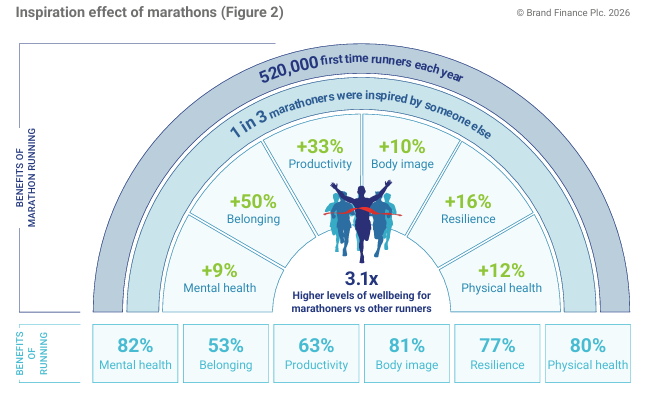
Among runners, the most commonly reported benefits are to their mental health (82%), body image (81%) and physical health (80%), followed by building resilience, increasing productivity and sense of belonging (Figure 2). Combined with the fact that running is accessible, low-cost and can be done almost anywhere, this makes for a powerful foundation.
What happens when you go the full 26.2 miles? Our research indicates that running a marathon is associated with a substantial uplift in wellbeing.
Stepping up to the marathon distance gives runners a wellbeing boost 2.3x greater on aggregate than regular running. The benefits do not stop with the runner: once you add the inspiration they pass on to family, friends and those around them, the overall impact gain rises to 3.1x. The largest gains observed are in sense of belonging and increased productivity levels, with boosts also recorded in resilience, physical health, body image and mental health.
Among those who trained the hardest (in terms of block duration and weekly hours) mental benefits outweighed physical ones. They recorded a 24% uplift in mental and emotional wellbeing, their highest-rated benefit of all.
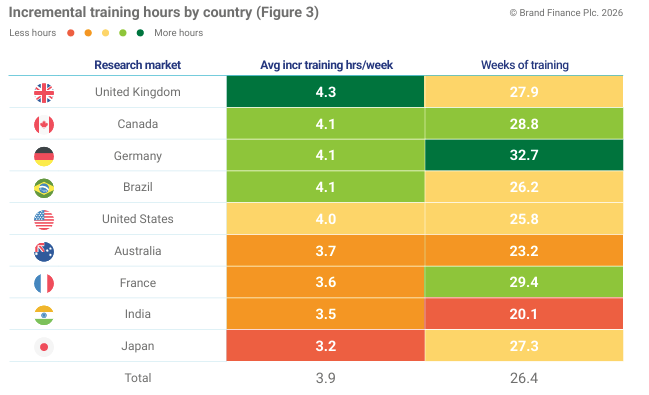
Technology plays a part too. Marathoners training six or more hours a week were around 20% more likely to train with tech such as running apps, watches or heart-rate monitors, and those who considered training tech important reported higher levels of wellbeing. How hard marathoners train also varies by market. German marathoners were the most committed of all, putting in around four extra hours a week over a build-up of nearly 33 weeks, or roughly 135 additional hours per race.
UK runners train hardest week to week (4.3 extra hours a week over around 28 weeks), while marathoners in India and Australia train for shorter blocks, putting in around 3.5 and 3.7 extra hours a week over roughly 20 and 23 weeks respectively (Figure 3).
What does this mean in practice? For employers, this could help make the case for supporting staff who train, such as with flexible hours, workplace run clubs or race entry support, because the payoff shows up in productivity and belonging at work. For organisers and brands, it’s a reminder that runners reap benefits during their training journey, not just on race day, and that’s where there’s room to support them.
Society level: Health and activity
The benefits extend to physical activity at an enormous scale. The world's strongest marathon brands in 2026 generated an estimated 160 million additional hours of physical activity over the race year, 72 million of which came from first-time marathoners. Activity on this scale has the potential to create real healthcare savings for individuals and national systems.
The World Health Organization estimates that, if levels of physical inactivity aren’t reduced, they will cost public healthcare systems around USD300 billion between 2020 and 2030, roughly USD27 billion a year. In the U.S. alone, not getting enough aerobic activity is linked to 12.6% of healthcare spending, around USD205 billion a year.
2025 research also found that insufficiently active U.S. adults incur USD1,355 per year more in healthcare costs than active adults, with inactive adults (no weekly activity) spending USD2,025 more than active ones. Every extra hour of activity chips away at that, and marathons are generating millions of additional activity hours.
For governments and health bodies, mass participation events seem to be a natural partner in getting populations moving, and the activity extends well beyond running: marathoners are 2x more likely than other runners to keep up a weekly fitness routine across the gym, strength training, cardio and home workouts.
Marathoners who strongly agree that running is essential to their physical health are also 40% more likely to meditate or do yoga weekly than those who do not.
Inspiration & the next generation
A marathon’s influence does not end with the runner. The motivations that bring people to the start line, and the effect they have on those watching, help explain how participation spreads from one runner to the next and from one generation to the next.
Self level: Motivations to run a marathon
So, what makes someone sign up for a 26.2-mile race? The leading motivation for running a marathon is the desire to prove to oneself that it can be done, while improved health and fitness ranks second, followed by goals and discipline, pride and belonging, and other factors (Figure 4).
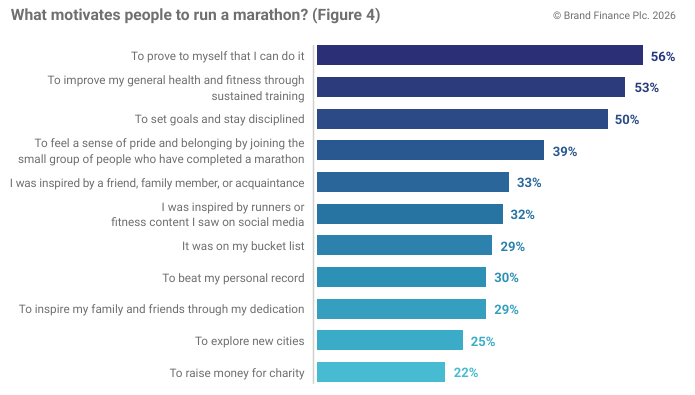
Personal growth is the common thread. Alongside proving oneself and getting fitter, setting goals is cited by around half of marathoners, and nearly four in 10 run for the pride of joining the relatively small club of marathon finishers. This aligns with the wellbeing findings, where belonging shows the largest uplift (+50%).
Motivations also shift with experience and between groups. 61% of long-term trainers (six months or more) run to prove something to themselves, and this is also the only motivator that grows the longer someone trains. Men and women are drawn to the start line for much the same reasons, but women are significantly more likely to run to inspire family and friends (33% vs 27%).
External influences on marathon participation also play a notable role. Around one third of marathoners run to inspire their own family and friends, and around one in five runs for charity. Although charity ranks lower as an individual motivation, its impact cannot be overlooked. The top 50 strongest marathon brands in 2026 raised USD434m for charity in 2025, equivalent to USD370 for every runner. The top 10 marathon brands accounted for 76% of that total.
Race organisers must consider that everyone arrives at the start line with a different ‘why’, and the most successful events will cater for each mindset: the one chasing milestones and personal bests, the health seeker who wants structured training support, and the fundraiser who wants their journey seen and shared. In other words, today’s runners are already recruiting tomorrow’s, which is where the ripple effect begins.
Community level: The outward ripple
Each race draws spectators and volunteers who far outnumber its participants, reflecting the contagious enthusiasm of marathon events. One in three marathoners say they were inspired to run by someone else, pointing to a strong ripple effect, or social multiplier, through which a marathon’s reach extends well beyond its field.
The effect is most visible among spectators who do not run. Non-runners who have watched a friend or family member run a marathon are 4x more likely to consider running one, 2x more likely to see marathons as a force for good and 40% more likely to be active every week than those who have not. Cheering on someone you know changes how spectators see the sport, and how they behave.
For a spectator to actually become a marathoner, though, the path starts small: a first 5K, a local run club, or a Couch to 5K app. The parkrun movement is a great example. What began as a single time trial in South-west London in 2004 has grown to more than 2,600 free weekly 5K and youth events in more than 20 countries, with over 10 million registered participants. Entry points like these lower the barrier to starting, and a series of steps builds the confidence and fitness to take on a marathon.
Society level: The next generation
As the marathon participation grows, the next generation is already lining up. The world's top marathons introduce around 520,000 first-time runners each year. The ripple effect doesn’t stop there, with organisers responding with larger fields and youth events. The TCS London Marathon, for example, has announced a two-day event in 2027 for more than 100,000 runners, alongside more than 20,000 young runners taking part in its mini marathon.
Youth races, mini marathons, community 5Ks and partnerships with grassroots clubs all create routes into marathon running, giving race organisers a growing role in bringing new runners through. While of course the marathon is the end goal, the journey to and anticipation for that race brings new runners in and keeps them coming back.
Support for this growth is strongest among those closest to the sport. Marathoners are nearly 1.5x more likely than non-runners to see events as inspiring youth activity and healthier communities. The generation coming through is also the most convinced of the wider benefits of being active: Gen Z respondents (aged 18-29) were 2x more likely than Baby Boomers (aged 62-80) to believe active lifestyles benefit society. That bodes well for the sport’s future.
The societal value of a marathon can be seen in many ways. For the runner, the marathon delivers greater wellbeing and better health. For those cheering them on, it can be the prompt to get out there and become more active themselves. For society, it means millions of additional hours of activity and more than half a million new marathoners each year. The value of the marathon movement is collective, and with the next generation lining up, it’s set to go the distance. For organisers, sponsors, employers and governments, the message is simple: back a marathon, and you back a healthier, more active society.