This article was originally published in the Brand Finance Marathons 50 2026 report.
Marathon runners share a finish line, but not necessarily the same reason for getting there. There is no single type of marathon runner and no single way into the sport. Just as segmentation helps brands understand who their customers are and how to reach them, understanding these differences is the starting point for organisers, sponsors and brands looking to reach more runners.
Brand Finance’s survey of more than 2,000 half and full marathon runners identifies six distinct runner personas, each defined by what motivates them, how they train and what they look for in a race. Health is a common thread: between 40% and 80% of every persona say they run a marathon to improve their general health and fitness. What differs is how running fits into the rest of their lives, what they spend and how they choose a race.
Lifestyle Maximalists
Running is one part of a full, active, social life.
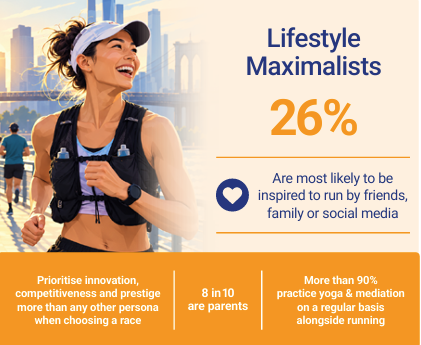
For Lifestyle Maximalists, the marathon is one part of a busy and varied lifestyle. They are more likely than any other persona to swim, practise yoga and meditate alongside their running. That reason extends to home life: half (50%) have children aged four to 12 and 27% have children under four, the highest of any persona.
Their reasons for running are also broadest: 46% say they are inspired by runners on social media, 38% to inspire family and friends through their dedication and 32% by the chance to explore a new city, the highest of any persona on all three. When choosing a race, prestige, innovation and competition all count.
Lifestyle Maximalists are also among the biggest running-related spenders, with 46% spending more than GBP1,000 on running-related kit and equipment.
Discipline Builders
Trains the body, follows the plan, skips the extras.
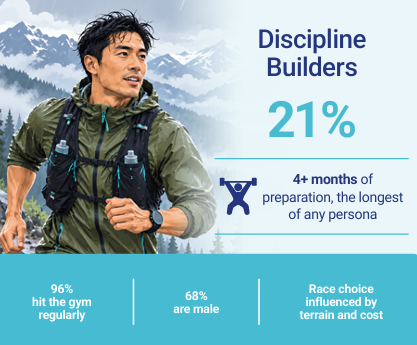
Discipline Builders start preparing for a marathon earlier than any other persona, typically more than four months before race day, and add around four hours a week of training during preparations. Their training is physical rather than mindful: 96% complement their running with gym, strength and cardio work, but few practise yoga or meditation. Most (64%) run to prove to themselves that they can, followed by improving health and fitness and staying disciplined (54%). They choose races on practical grounds, with weather (40%), terrain (34%) and cost among their top considerations. Alongside Running Purists, they are the most male-dominated persona (68%).
Data-Driven Strivers
Trains body and mind and measures every step.
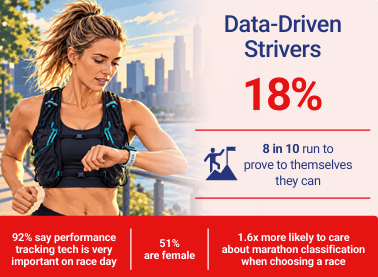
Data-Driven Strivers are the most committed when it comes to marathon training. They add the most hours to their week when preparing, own the most kit and are the persona most engaged with performance tracking. Like Discipline Builders, the marathon is about proving something to themselves, with 82% citing this as inspiration for running, and 40% want to beat a personal best. They are also the persona most likely to prioritise a race’s classification, such as Major or label status (24%). Their running-related spending habits are high, mirroring those of the Lifestyle Maximalist, but Data-Driven Strivers are the only persona that is predominantly female, at 51%.
Experience Seekers
There for the day out, not the training.
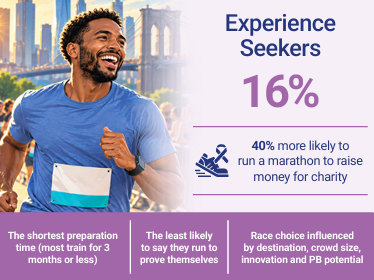
Experience Seekers are drawn by the event itself. They are by far less concerned with proving themselves (28%) and more with the occasion, drawn by host cities, crowd sizes and novelty. For them, running is often a shared experience. They are 40% more likely to run for charity, and 25% more likely to say they want to inspire family and friends through their dedication. Their focus is on the excitement of the day rather than the build-up; they spend the least time preparing of any persona. Alongside Lifestyle Maximalists, they are the youngest persona, with 36% belonging to Gen Z.
Running Purists
Just run. Minimalists.
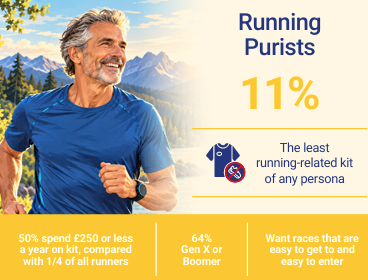
Running Purists keep it simple. They run regularly, do little else in the way of training and need the least kit of any persona. What they want from a marathon is practical: somewhere easy to get to (46%), easy to enter (34%) and affordable (31%). This persona isn’t concerned with the newest kit or data tracking tools – 51% of running purists spend under GBP250 on running-related expenses for a marathon, the least of any persona – and are the oldest persona (64% Gen X or Boomer, and 44% all Boomer). They don’t buy in to the tech, and run in its simplest form, because they love it – and have likely been doing it for a long time. This is also why they tend to add the fewest hours to their running when training for a marathon, at an average of just 3.6 hours.
Health-First Runners
Running for health, not identity.
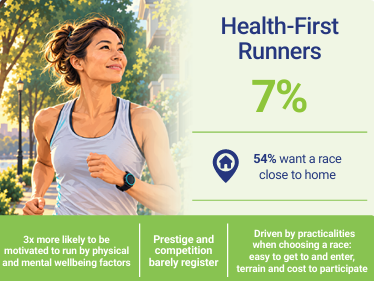
For Health-First Runners, running is personal maintenance for body and mind. They show the strongest wellbeing motivation of any persona and place almost no importance on running as an identity or community. Their ideal race is close to home (53%), with good weather (47%), manageable terrain (47%) and a reasonable cost (45%). Prestige (4%), competition (3%) and innovation (0%) barely register. They run because they know it’s good for them.
Two ways to choose a race
The personas divide clearly on what makes a race worth entering. Discipline Builders, Running Purists and Health-First Runners choose on access: location, weather, terrain, cost and ease of entry. Lifestyle Maximalists, Data-Driven Strivers and Experience Seekers look for something more, such as prestige, innovation, competition and scale.
The gaps can be wide. Race classification, such as Major or label status, matters to 24% of Data-Driven Strivers but just 8% of Running Purists. With around six in 10 runners in the aspiration-led group and four in 10 in the access-led group, a strong marathon brand needs both: the premium elements that attract some runners, and the practical reassurance that others look for first. Valencia, known for its flat, fast course, has built a proposition with clear appeal for the likes of Data Driven Strivers, 38% of whom want to beat a PB. Races aiming for mass participation need a broader message, one that speaks as much to ease of access, cost and location as to finishing times and prestige.
Beyond race day
Organisers can also look beyond the marathon itself. The access-led personas want races that are local, affordable and easy to enter, and Experience Seekers commit the least time to preparation. For both, shorter events hosted by marathon organisers, such as 5K or 10K races, could offer more regular ways to take part and an accessible first step for newer runners. Community formats such as run clubs and parkrun may play a similar role, giving people a social route into the sport that can build towards a marathon over time. For organisers, this turns a single race day into a year-round relationship with runners.
Where the spending goes
Spending varies as widely as motivation. Lifestyle Maximalists and Data-Driven Strivers make up 44% of runners but around 70% of those who spend more than GBP1,000 on a marathon, making them a natural focus for kit, technology and travel brands, but they want different things. For Data-Driven Strivers, technology is central to training, and wearables, apps and performance data are an obvious fit. Lifestyle Maximalists look for breadth, from cross-training and recovery to travelling for a race. Along with Experience Seekers, they care most about the social side of race day, from live results screens and digital race photos to online communities, so shareable experiences may matter to them as much as kit.
13% 7% 12% Within the marathon-running population, however, seniority varies considerably between personas. Lifestyle Maximalists account for 39% of C-suite and board-level runners, and 61% of SVPs and VPs, despite making up around a quarter of runners overall. At the other end, around half of running purists (51%) and Health-First Runners (47%) spend under GBP250. This is a reminder that no single message will suit every runner, and that the marathon should remain open to runners whatever their budget.
Who runs at the top?
Brand Finance's 2026 research reveals that senior business leaders are disproportionately represented among marathon runners. 16% of marathon runners surveyed hold C-suite positions, compared with just 7% of recreational runners who have never completed a marathon. (Figure 1) This represents a 129% higher proportion among marathon runners, compared with a 40% difference in 2025, suggesting that the gap is widening.
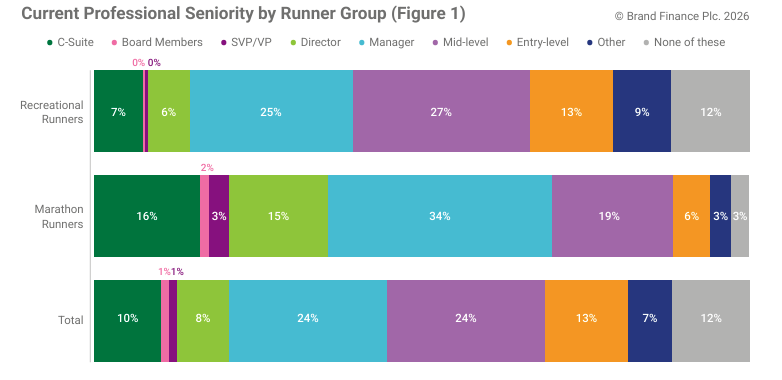
The trend extends across senior leadership more broadly, with 36% of marathon runners occupying positions from director to C-suite level. Marathon runners are also more likely to hold C-suite positions than respondents overall, where the figure stands at 10%.
Within the marathon-running population, however, seniority varies considerably between personas. Lifestyle Maximalists account for 39% of C-suite and board-level runners, and 61% of SVPs and VPs, despite making up around a quarter of runners overall.
Experience Seekers are the second-largest C-suite group (21%); nearly a quarter of them hold C-suite or board roles, notable given they are among the youngest personas. Data-Driven Strivers are most often in manager roles (44%), while Running Purists and Health-First Runners are more likely to occupy mid-level positions (32% and 30%, respectively).
Together, Lifestyle Maximalists and Experience Seekers account for six in 10 C-suite and board level runners. Both are drawn to the wider marathon experience, suggesting that the appeal of major races to senior professionals extends beyond competition and performance. For organisers and sponsors, these findings highlight the opportunity to engage an audience with a high concentration of senior decision-makers.
This is particularly relevant for B2B brands, while the differences between personas underline the importance of tailoring partnerships and experiences to the audiences they want to reach.