


New Brand Finance data reveals Dallas Cowboys remain NFL’s most valuable and strongest brand, while the Atlanta Falcons grow fastest
LONDON, 17 November 2026 – The combined brand value of the 32 NFL franchises has risen 8% to USD28.6 billion, a strong recovery from last year’s 10% decline, according to a new report from Brand Finance, the world's leading brand valuation consultancy. The NFL remains the most commercially powerful league in U.S. sport, with its franchise brands worth around twice those of the NBA.
Revenue growth has been the main driver. Regular-season audiences reached their highest level since 1989, while NFL league-wide revenue surpassed USD22 billion in the 2025 season, according to Forbes estimates. The NFL also agreed to take a 10% stake in ESPN. Investor appetite has also intensified, with the Seattle Seahawks selling for a record USD9.6 billion and private equity firms such as Arctos Partners buying minority stakes across the league.
Cowboys hold firm at the top
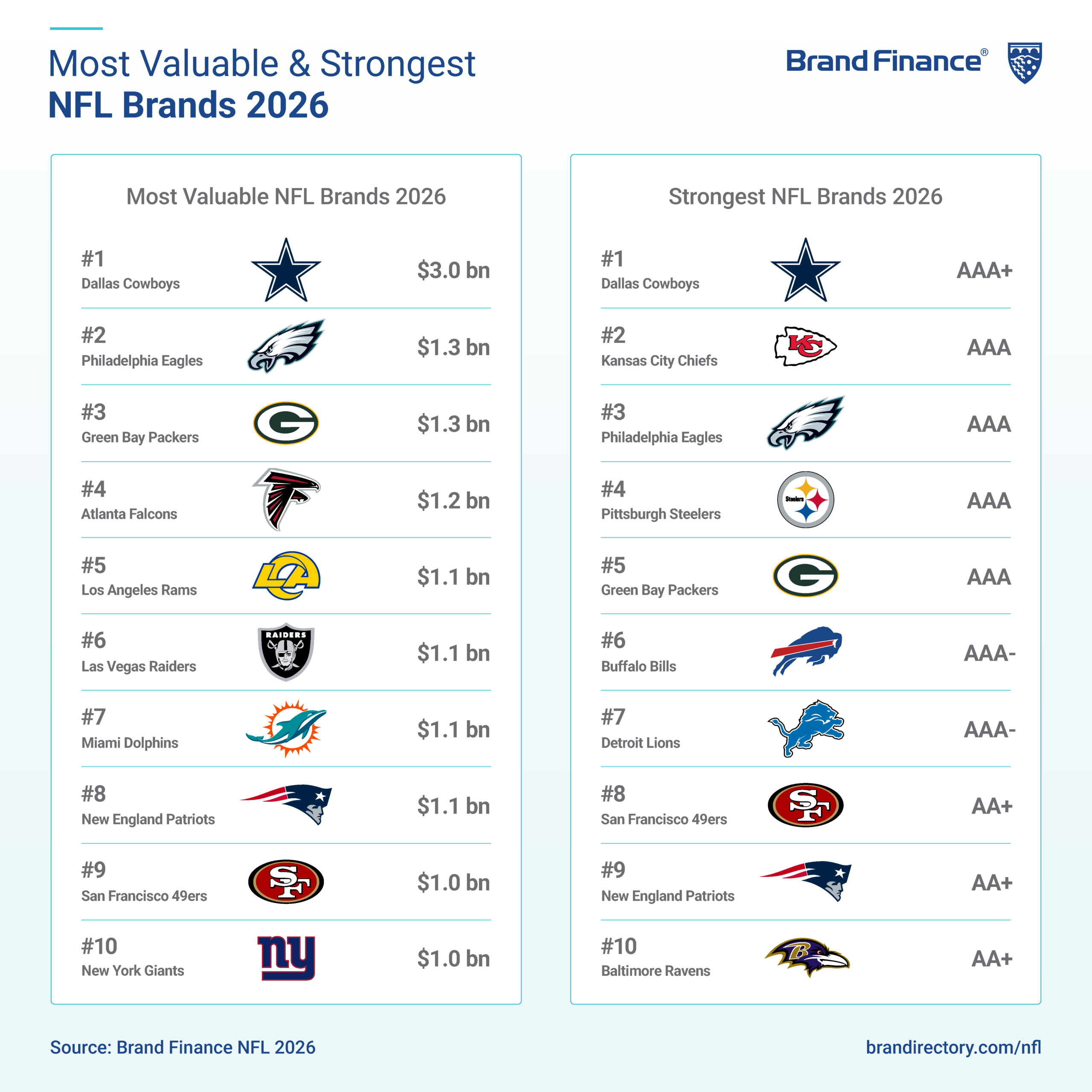
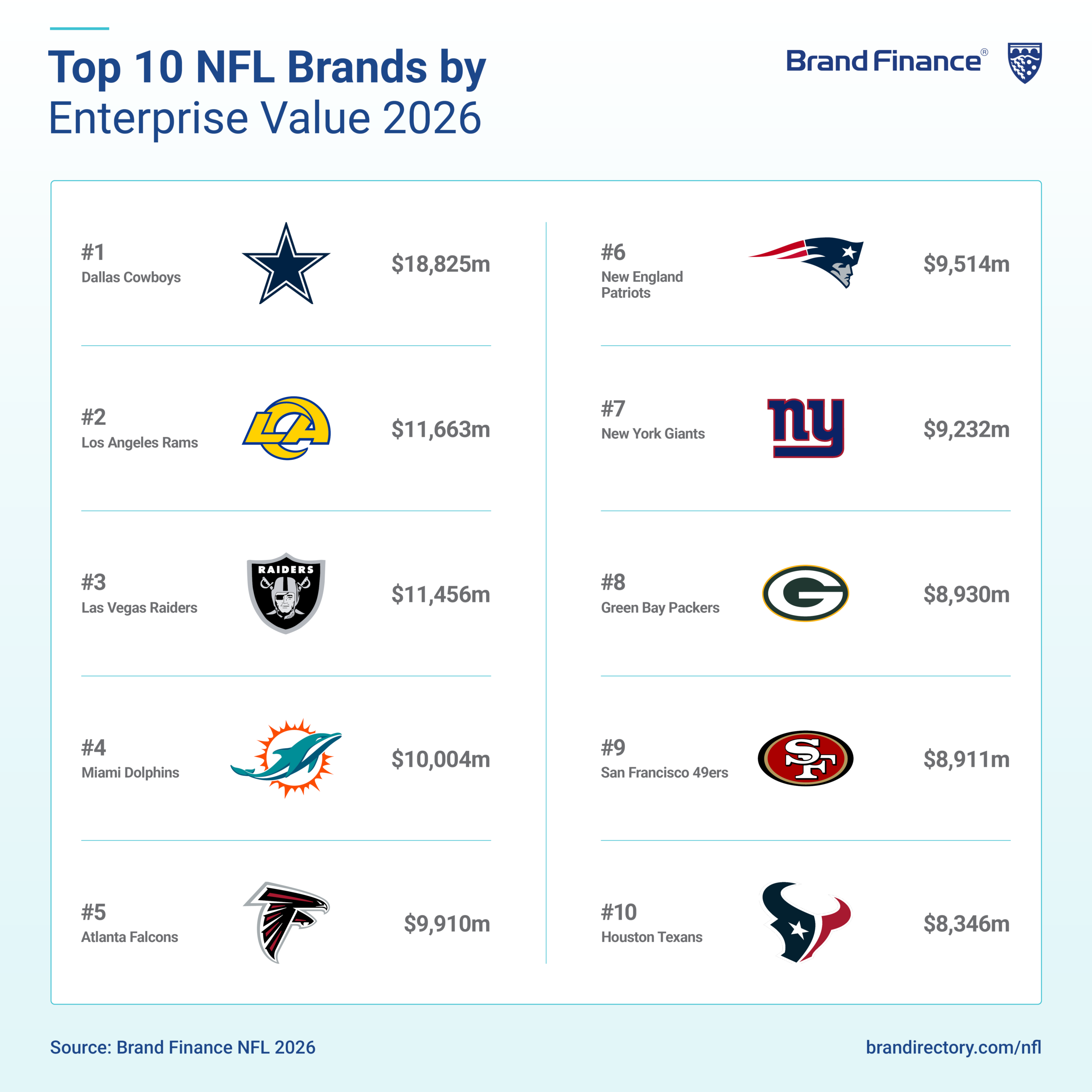
The Dallas Cowboys remain the NFL’s most valuable brand, stable at USD3.0 billion, despite missing the playoffs in both the 2024 and 2025 seasons. Their brand value is more than double that of the second-ranked Philadelphia Eagles (USD1.3 billion). Brand Finance estimates the Cowboys’ enterprise value at USD18.8 billion, the highest of any sports franchise it values.
The Cowboys are also the strongest NFL brand and the only franchise rated AAA+, noting the maximum score in Brand Finance’s research for perceptions of both their merchandising and stadium. However, trust in the team's leadership has declined year on year, against a backdrop of controversy surrounding the trade of star player Micah Parsons.
Falcons soar without on-field success
The Atlanta Falcons are the fastest-growing NFL brand, up 77% to USD1.2 billion and climbing 16 places to fourth in the rankings. The growth came despite an eighth consecutive season without playoff football, driven instead by a credible leadership reset, with Kevin Stefanski appointed head coach and former MVP Matt Ryan returning as president of football. Mercedes-Benz Stadium also hosted eight FIFA World Cup matches, including a semi-final, drawing more than a million visitors to the city and likely boosting the Falcons' international visibility.
Other movers
The Green Bay Packers rose two places to third, with brand value up 22% to USD1.3 billion. The Los Angeles Rams climbed seven places to fifth, up 41% to USD1.1 billion, after a 12-win season and an NFC Championship appearance. The Las Vegas Raiders fell three places to sixth, down 4% to USD1.1 billion, after a 3-14 season and declining perceptions of the team’s management and reputation.
Brand to watch: Buffalo Bills
The Buffalo Bills’ brand value rose 12% to USD821 million, and an upgraded AAA- rating makes them the sixth-strongest NFL brand. Their followers are the league’s most likely to talk about the team with friends and family, according to Brand Finance’s research. The new USD2.1 billion Highmark Stadium, which opened in June 2026, is not yet reflected in this year’s valuation, giving the brand clear room to grow.
Alfred DuPuy, Managing Director, Brand Finance North America, commented:
“The NFL’s brand value rebound shows the strength of a model that rewards franchises whether or not they win. Shared broadcasting revenues and audiences averaging 18.7 million viewers per game in 2025 – the highest recorded since 1989 – give every team a reliable foundation, and investors are paying record prices to own a share of it. The Falcons show that leadership credibility and a distinctive fan experience can build a brand ahead of results. But rising ticket prices and publicly funded stadiums are testing fans’ goodwill. The franchises that keep investing in their supporters and communities will be best placed to protect their brand value.”


Brand Finance is the world’s leading brand valuation consultancy. Bridging the gap between marketing and finance, Brand Finance evaluates the strength of brands and quantifies their financial value to help organisations make strategic decisions.
Headquartered in London, Brand Finance operates in over 25 countries. Every year, Brand Finance conducts more than 6,000 brand valuations, supported by original market research, and publishes over 100 reports which rank brands across all sectors and countries.
Brand Finance also operates the Global Brand Equity Monitor, conducting original market research annually on 6,000 brands, surveying more than 175,000 respondents across 41 countries and 31 industry sectors. By combining perceptual data from the Global Brand Equity Monitor with data from its valuation database — the largest brand value database in the world — Brand Finance equips ambitious brand leaders with the data, analytics, and the strategic guidance they need to enhance brand and business value.
In addition to calculating brand value, Brand Finance also determines the relative strength of brands through a balanced scorecard of metrics, compliant with ISO 20671.
Brand Finance is a regulated accountancy firm and a committed leader in the standardisation of the brand valuation industry. Brand Finance was the first to be certified by independent auditors as compliant with both ISO 10668 and ISO 20671 and has received the official endorsement of the Marketing Accountability Standards Board (MASB) in the United States.
Brand is defined as a marketing-related intangible asset including, but not limited to, names, terms, signs, symbols, logos, and designs, intended to identify goods, services, or entities, creating distinctive images and associations in the minds of stakeholders, thereby generating economic benefits.
Brand strength is the efficacy of a brand’s performance on intangible measures relative to its competitors. Brand Finance evaluates brand strength in a process compliant with ISO 20671, looking at Marketing Investment, Stakeholder Equity, and the impact of those on Business Performance. The data used is derived from Brand Finance’s proprietary market research programme and from publicly available sources.
Each brand is assigned a Brand Strength Index (BSI) score out of 100, which feeds into the brand value calculation. Based on the score, each brand is assigned a corresponding Brand Rating up to AAA+ in a format similar to a credit rating.
Brand Finance calculates the values of brands in its rankings using the Royalty Relief approach – a brand valuation method compliant with the industry standards set in ISO 10668. It involves estimating the likely future revenues that are attributable to a brand by calculating a royalty rate that would be charged for its use, to arrive at a ‘brand value’ understood as a net economic benefit that a brand owner would achieve by licensing the brand in the open market.
The steps in this process are as follows:
1 Calculate brand strength using a balanced scorecard of metrics assessing Marketing Investment, Stakeholder Equity, and Business Performance. Brand strength is expressed as a Brand Strength Index (BSI) score on a scale of 0 to 100.
2 Determine royalty range for each industry, reflecting the importance of brand to purchasing decisions. In luxury, the maximum percentage is high, while in extractive industry, where goods are often commoditised, it is lower. This is done by reviewing comparable licensing agreements sourced from Brand Finance’s extensive database.
3 Calculate royalty rate. The BSI score is applied to the royalty range to arrive at a royalty rate. For example, if the royalty range in a sector is 0-5% and a brand has a BSI score of 80 out of 100, then an appropriate royalty rate for the use of this brand in the given sector will be 4%.
4 Determine brand-specific revenues by estimating a proportion of parent company revenues attributable to a brand.
5 Determine forecast revenues using a function of historic revenues, equity analyst forecasts, and economic growth rates.
6 Apply the royalty rate to the forecast revenues to derive brand revenues.
7 Discount post-tax brand revenues to a net present value which equals the brand value.
Brand Finance has produced this study with an independent and unbiased analysis. The values derived and opinions presented in this study are based on publicly available information and certain assumptions that Brand Finance used where such data was deficient or unclear. Brand Finance accepts no responsibility and will not be liable in the event that the publicly available information relied upon is subsequently found to be inaccurate. The opinions and financial analysis expressed in the study are not to be construed as providing investment or business advice. Brand Finance does not intend the study to be relied upon for any reason and excludes all liability to any body, government, or organisation.
The data presented in this study form part of Brand Finance's proprietary database, are provided for the benefit of the media, and are not to be used in part or in full for any commercial or technical purpose without written permission from Brand Finance.
