




This article was originally published in the Brand Finance Global Top 250 Hospitals 2026 report.

Research Director,
Brand Finance
Global healthcare systems are under unprecedented pressure. Worldwide healthcare spending now exceeds USD9 trillion annually1, representing close to 10% of global GDP1and continues to rise as populations age and disease burdens grow2. At the same time, investment in artificial intelligence (AI) in healthcare has accelerated rapidly, spanning diagnostics, imaging, workflow optimisation and clinical decision support. Market estimates suggest global spending on AI-enabled healthcare solutions runs into the tens of billions of dollars annually3 , with strong growth expected over the coming years.
Against this backdrop, AI is frequently positioned as a signal of progress and leadership in healthcare. The implicit assumption is that institutions investing heavily in AI should also benefit reputationally. But does this assumption hold among those closest to healthcare delivery?
Brand Finance study among healthcare professionals
Brand Finance specialises in understanding how brands build strength, reputation and value. As part of a wider global Brand Finance study among healthcare practitioners, we analysed what truly drives reputation of healthcare institutions among this critical audience. The research covered healthcare practitioners in 30 countries across the Americas, Europe, Asia, APAC, and the Middle East & Africa regions, with a total global sample of 2,500+ respondents in 2025 and 2026, including both general practitioners and specialists. The importance of each attribute was derived using regression analysis, with the reputation of a healthcare organisation as the outcome variable and the associated image and capability attributes as the explanatory/independent factors. This approach allows for an objective understanding of what actually drives reputation, based on hard data rather than what is most visible or frequently discussed.

AI is not a leading driver of reputation
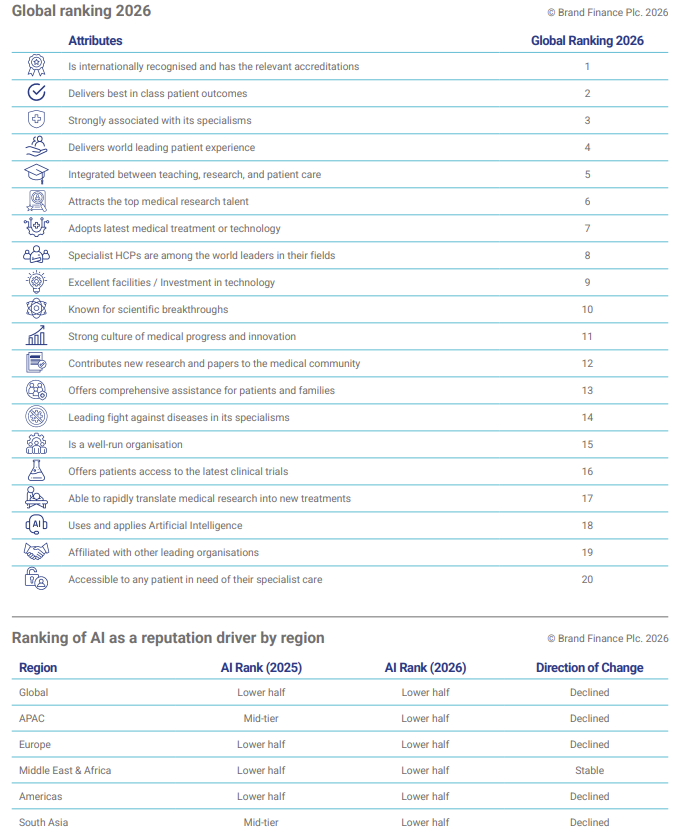
One insight stood out. Despite the scale of investment and attention it receives, AI is not a key driving attribute of healthcare reputation at a global level. The attribute related to the use and application of AI ranks in the lower half of reputation drivers and has declined in relative importance over the last year. In short, healthcare practitioners place far less weight on AI than on many other factors when forming views of institutional reputation.
This is not to suggest that leading healthcare institutions are lagging in AI adoption. Many globally respected hospitals score strongly on the ‘uses and applies artificial intelligence’ attribute, spanning multiple regions.
Examples include Mass General Brigham in the U.S., Singapore General Hospital (SGH), Saudi Arabia’s King Faisal Specialist Hospital and Research Center (KFSHRC), University Hospital of Zurich/Universitätsspital Zürich, Seoul National University, and Hospital Israelita Albert Einstein in Brazil.
By contrast, healthcare reputation continues to be anchored in enduring fundamentals. At a global level, the strongest drivers of reputation are international recognition and accreditation, best patient outcomes, and strength in specialist areas. While their relative ordering varies across regions, it shows that healthcare reputation is shaped by perceived expertise and performance rather than by tools alone.
Looking across regions, the pattern for the importance of AI, holds. Across the Americas, Europe, Asia, APAC and MEA, AI tends to rank lower than many other reputation drivers and, in most markets, has moved down the ranking rather than up. Even where AI ranks marginally higher, it does not emerge as a leading driver of reputation.
Several explanations are plausible. AI has increasingly become an expectation rather than a differentiator. Experience, clinical skill, and final (positive) patient outcomes remain central to reputation in healthcare.
Why might AI matter less for reputation? A few hypotheses: +
- AI has increasingly become an expected feature of modern healthcare systems rather than a differentiating signal. As adoption becomes more widespread, its presence alone earns limited reputational credit.
- Experience and clinical skill continue to sit at the heart of healthcare reputation. Practitioners tend to associate reputation with judgement, expertise, and outcomes, rather than with the tools used to support decision-making.
- Responsibility and accountability for patient outcomes ultimately rest with clinicians, not algorithms. Reputation therefore follows human judgement and ownership of decisions.
- While AI has delivered meaningful advances in specific applications, its impact remains uneven across healthcare systems and is often invisible in day-to-day clinical interactions, limiting its salience as a reputational driver.
For healthcare leaders, the implication is clear. Technology investment alone cannot buy reputation. Reputation plays a critical role in attracting clinical talent, shaping institutional influence, and supporting long-term performance and revenue.
The organisations that build enduring reputations will be those that integrate technology with expertise, accountability and, (positive) patient outcomes, and communicate this effectively to the healthcare professionals who matter most.