




This article was originally published in the Brand Finance Global 500 2026 report.
The first Olympic Sponsor on record dates back to 1928, when a freighter delivered the 1,000 cases of Coca-Cola to U.S. Team and the Amsterdam event. Ever since, sponsors have been integral supporters of the Olympic games.

Sports Services Manager,
Brand Finance
As the world turns its attention to the Milano Cortina 2026 Winter Olympic Games, global brands are preparing to leverage one of the most prestigious sponsorship platforms in sport. Many Olympic TOP partners are among the world’s most valuable brands featured in the Brand Finance Global 500 creating an ideal opportunity to explore how these partnerships drive brand and business performance.
The strategic role of sponsorship
The primary goal of sponsorship is to foster positive perceptions and behaviours among stakeholders more effectively and efficiently than conventional marketing methods. This is typically achieved by reaching a targeted audience and aligning with the existing attributes of the rights-holder. The specifics of how this works can vary significantly based on the brand, industry, sport or category, rights-holder, and the activation strategies involved. Ultimately, any partnership should aim to deliver a return on investment, often measured by short-term sales increases and long-term brand-building benefits.
The Olympic Partner (TOP) programme remains the pinnacle of global sports sponsorship, granting exclusive worldwide marketing rights across all Olympic and Paralympic Games. These partnerships aim to deliver measurable returns through enhanced brand familiarity, stronger stakeholder engagement, and long-term brand equity growth. Brand Finance’s sponsorship impact modelling links these perception shifts to financial outcomes, assessing how exposure influences consumer behaviour and ultimately uplifts brand strength and brand value.
Brand Finance has assessed the brand value and strength of these brands as part of our annual analysis, detailed below in Figure 1.
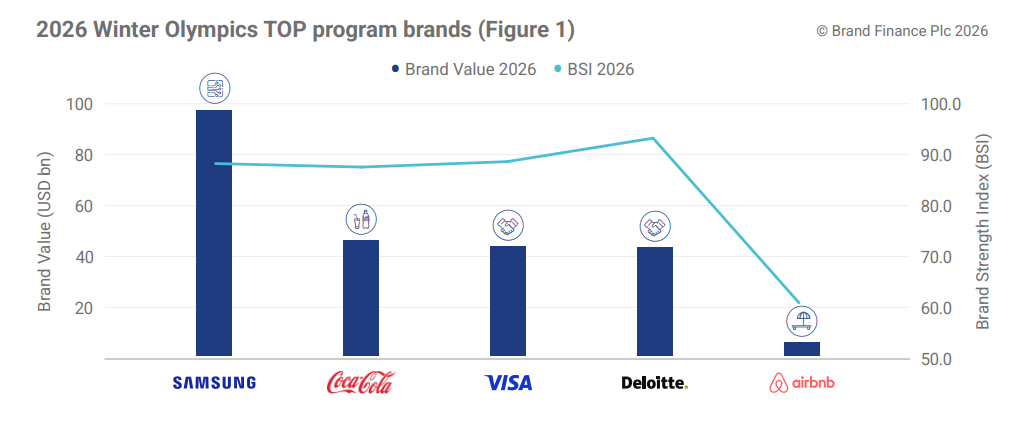
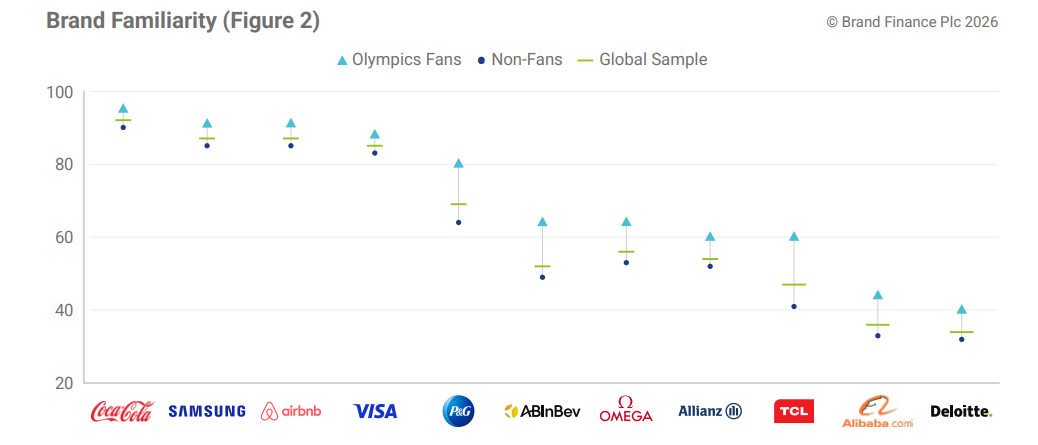
When measuring the impact of Olympics sponsorship on these brands' strength and, ultimately, their brand value, data from Brand Finance’s 2025 Global Brand Equity Monitor study indicates that increased exposure, engagement opportunities, and media coverage enhance global familiarity. In other words, Olympics followers are significantly more familiar with these brands compared to non-followers.
Brand familiarity
Among the 11 brands, the greatest relative uplift in familiarity experienced by TCL, who only joined the programme as recently as February 2025. Alibaba and AB InBev round off the top 3, although all brands receive a positive boost in this metric (Figure 2).
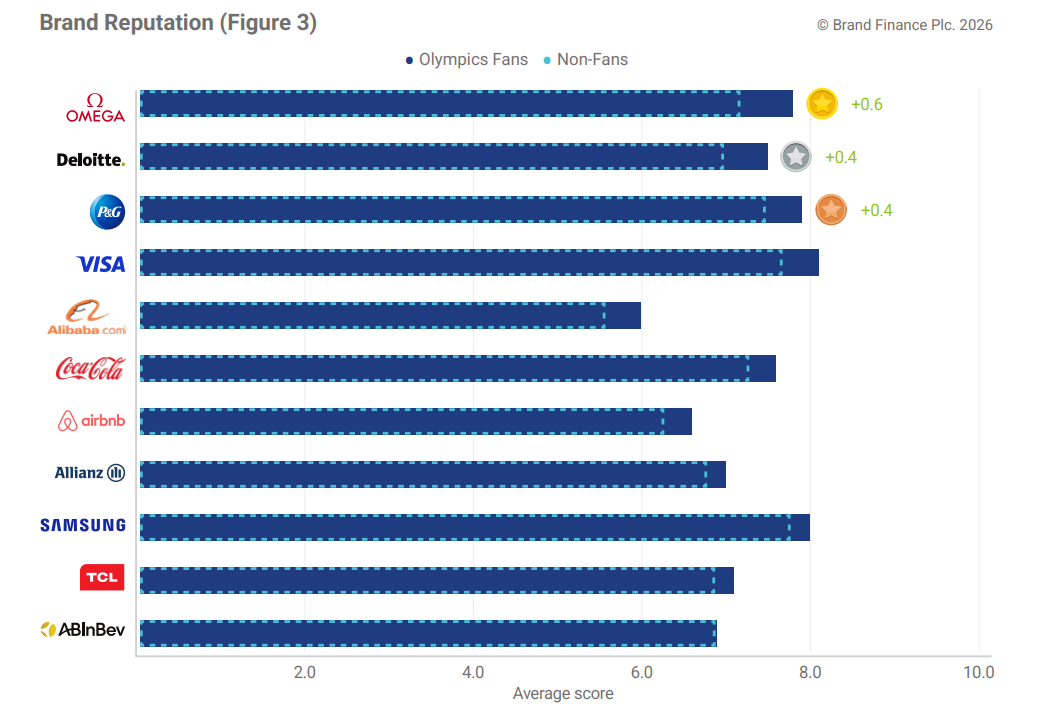
The data also reveals an uplift in reputation among Olympics followers compared to non-followers, demonstrating the impact of sponsorship on public perception.
Brand reputation
Among the 11 brands, Omega, Deloitte, and P&G saw the largest boosts in reputation, with increases of +0.6, +0.4, and +0.4 points, respectively (Figure 3).
These demonstrated stakeholder perception changes must be linked to financial gains for sponsors to measure financial effectiveness. Sponsorship impact modelling assesses brand KPIs to understand how partnership exposure influences stakeholders’ behaviours towards the brand to drive beneficial business outcomes.
This process involves analysing market research data to compare perception differences between exposed and non-exposed groups. Modelling the changes in business performance enables an understanding of the sponsorship’s return on investment.
The analysis can also be used to model the impacts on a brand's Brand Strength Index (BSI) score to determine any uplift due to the partnership. This can then be applied to the Brand Valuation model to understand how much value has been locked up in the value of the brand as an asset – giving a comparison between the marketing efforts’ value in terms of both short term sales activation and long term brand building.
With the Milano Cortina 2026 Winter Olympic Games less than a month away, the research aims to illustrate that Olympic sponsorship can play a significant role in building brand familiarity, strengthening reputation, and deepening engagement.
Over time, these shifts in perception can support improved brand strength and, in turn, generate tangible financial returns for TOP partners.