This article was originally published in the Brand Finance Marathons 50 2026 report.
Every year, the world’s biggest marathons bring tens of thousands of runners and hundreds of thousands of spectators onto city streets. Organisers rightly judge success by entries, finishers, sponsorship and the economic activity of race weekend.

Place Branding
Consultant,
Brand Finance

Place Branding
Senior Analyst,
Brand Finance
Yet those measures miss something just as valuable, which is what a marathon can do for the brand of the place that hosts it. Managed well, a major marathon is a platform on which a city can present itself to the world and boost its familiarity and reputation, which calls for a greater focus on place branding and understanding soft power.
From start line to city break
Major marathons are international events. Many runners travel from abroad, and few travel alone. Partners, children and friends often come too, turning the race into an extended holiday. An American running in Athens may well bring family and spend days exploring Greece.
Those visitors fill hotels, restaurants and public transport. Once in a destination, they engage with everything else it offers, from its food and culture to its landmarks and neighbourhoods. The result is spending and, with it, a direct experience of the place.
Location is part of the product, not a by-product of race choice. Brand Finance’s research conducted among marathon runners found that a great location is one of the top three drivers of consideration when choosing a race. Flat, fast courses such as Amsterdam or Valencia have their appeal, but the destination itself is central, so how a city markets itself can influence its ability to attract runners.
Races in places with established reputations, such as the TCS London, Boston or Athens marathons, attract runners almost immediately, but their reputational boost may be smaller. Lesser-known places stand to gain more, provided they promote themselves before, during and after the race.
A platform, not a guarantee
Place branding research has long recognised that mega-events give a place a platform to reach new audiences and build familiarity. Marathons work in a similar way. Broadcast coverage, sponsor activity and participants’ social media posts carry images of the city’s streets and landmarks around the world, making the race a form of destination marketing.
It is also a place asset. Just as IKEA contributes to Sweden’s brand, a major marathon can help shape how a city is seen.
There is a caveat, however. Hosting an event does not, on its own, create lasting soft power. Attention can be short-lived, and a spike in interest is not the same as a lasting change in perceptions.
Whether greater familiarity and a reputation boost can persist after a short-term spike fades remains a hypothesis worth exploring. The event amplifies, but the outcome depends on how the place uses the exposure.
Sport as a cultural touchpoint
Brand Finance’s soft power research already points to a link between sport and how people engage with countries. Using regression analysis, our Global Soft Power Index identifies which experiences drive perceptions of a nation, from familiarity and reputation to its appeal as a place to invest, work, study or visit. “Sports teams and events” is one of 12 touchpoints tested.
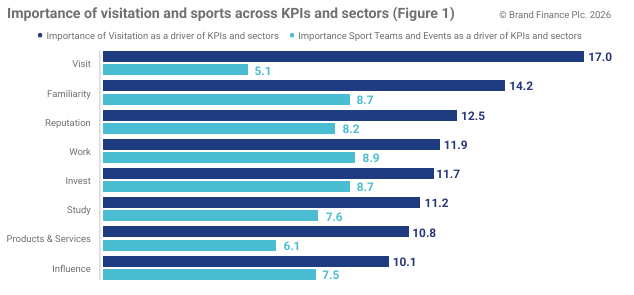
Globally, sport ranks sixth as a driver of familiarity, reputation, investment appeal and work appeal, and fifth for study, its strongest showing. It also ranks eighth for influence and visit appeal. Sport is not the strongest touchpoint, but it is a consistent one, placing in the top half for five of the eight KPIs and sectors measured.
Brand Finance's research shows that visiting a country is among the four strongest drivers of every marathon brand metric measured and is the single biggest driver of familiarity. The link may seem intuitive, but unlike the question of lasting impact, it is not a hypothesis. The research provides empirical evidence of the role that first-hand experience plays in shaping perceptions and awareness of a country. A marathon’s added value lies therefore not only in sport engagement per se, but in bringing people to experience a destination first-hand.
Turning attention into advantage
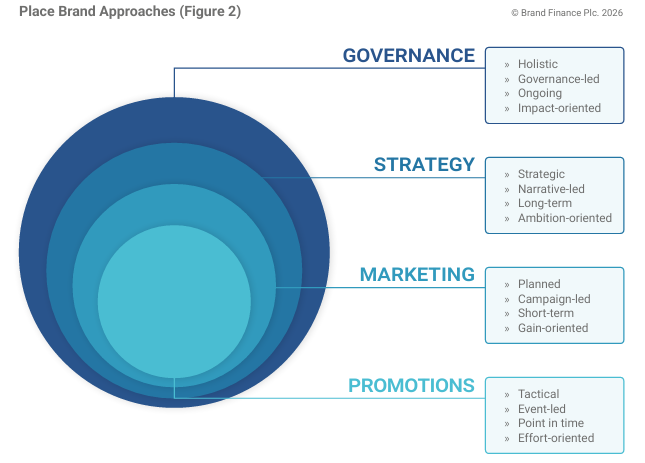
Why do some events leave a lasting legacy while others fade? Place-branding research points to one recurring factor, which is whether the destination turns the opportunity into something greater. Not every place does, which helps explain why the effects of major events are so inconsistent. The event creates attention, but place brand strategy determines what happens to it afterwards. This is where governance, a core pillar of Brand Finance’s approach to place branding, comes in.
Governance looks at how a place’s stakeholders work together to manage and grow its reputation. For a marathon, that means the race organiser, city authorities, tourism board, sponsors, hotels and local businesses coordinating to align race marketing with destination messaging, encourage visitors to stay longer and carry the event’s imagery into wider campaigns.
London 2012 is a good example. The Olympic Games became a catalyst for the GREAT campaign, which went on to promote the UK well beyond the Games. The event was a starting point, not the final objective.
Ultimately, a major marathon is much more than a race. It attracts visitors, showcases a city to a global audience and creates an opportunity to strengthen its international profile. But visibility alone is not enough. The cities that benefit most will be those that use the event as a starting point for building lasting familiarity, a stronger reputation and greater soft power.