




This article was originally published in the Brand Finance Brazil 100 Report 2026.

Head of Sports Services,
Brand Finance
What are the objectives of sponsorship?
The underlying objective of sponsorship is to create positive perceptions and behaviours among stakeholders in a more effective and efficient way than would be possible with normal marketing tools. Generally, this is achieved by accessing a targeted audience and aligning with the existing attributes of the rights-holder. Exactly how this functions varies considerably depending on the brand, industry, sport/category, rights-holder, and activations. Ultimately, any partnership should deliver a return on investment, which is usually considered in terms of short-term sales boost and long-term brand building benefits.
In a market where product offerings are commoditised, brands turn to strategic partnerships, like sponsorships, to stand out. These types of partnerships serve not only to boost brand visibility but also to elevate brand perception, offer premium experiences to audiences, and remain front-of-mind.
The banking industry showcases the difficulties of differentiation in highly competitive environments, as core product offerings can appear interchangeable to the regular consumer. Leading brands in such sectors use partnerships to retain market share, create emotional relevance and validate a premium positioning through sponsorships, often aligning with globally recognised events, destinations, and experiences, including major football properties, that reflect their international reach and service proposition.
The effect of Itaú’s partnership activations
When measuring partnerships, it's important to remember that the focus leans towards brand building and delivering long-term benefits. Itaú, the most valuable Brazilian brand in 2026 and the 40th most valuable among the world’s leading banking brands, has a brand value of USD8.6 billion, and through sponsorship has become deeply rooted in Brazilian football culture.
Itaú has been tapping into the world’s most followed sport through its football sponsorship strategy for almost two decades, with Brand Finance’s Global Brand Equity Monitor (GBEM) study showing that 72% of Brazilian nationals follow the sport.
As a long-standing partner of the Brazilian Football Confederation (CBF), Itaú has sponsored Brazil’s men’s and women’s national teams across all categories since 2008. The partnership was renewed again in 2022 through to 2026 and provides Itaú with extensive brand visibility across team kits, training gear, media backdrops and other national-team assets. Following the renewal, the sponsorship has expanded its focus towards digital activations and e-sports, including the e-Brasileirão and the eSeleção, helping the banking brand strengthen engagement with younger, digital-first audiences.
Brand Finance’s 2026 GBEM study reveals a marked difference in strong familiarity with Itaú’s brand between football-following and non-football following Brazilian consumers. Football fans exhibit the highest level of strong familiarity (73% versus 62% among non-fans). Moreover, 49% of Brazilian football fans state ‘I know a lot about this brand’ compared to 37% of non-fans. This represents an uplift of almost 12% (Figure 1).
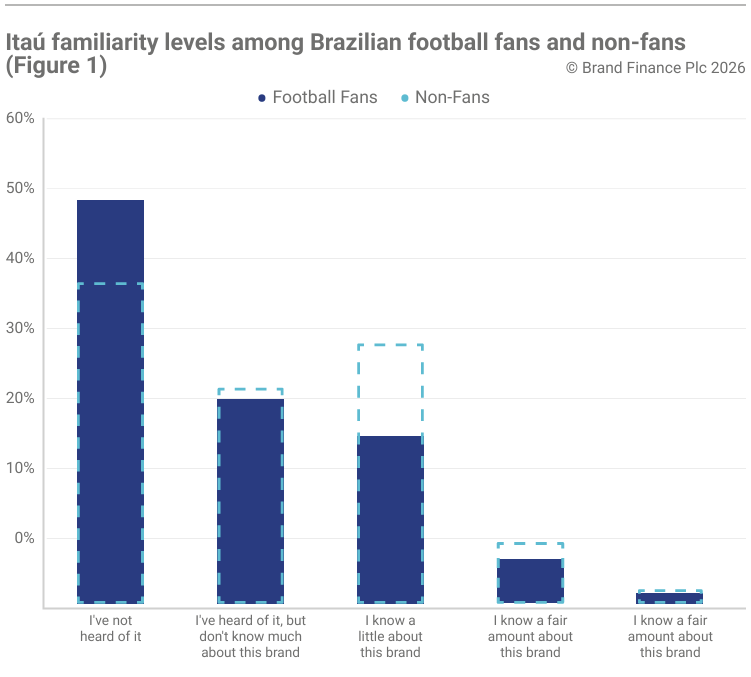
This market research does not exclusively target respondents who have reported being exposed to or engaged with specific partnerships. Instead, it assumes exposure among followers of the sport in general. While this approach provides a conservative view of the impact, it is evident that the partnerships are delivering benefits to the brand. The Brand Finance research covers 42 markets, over 175,000 respondents and 5,000 brands, and so is unique in its breadth of coverage, allowing a unique view into brand strength, and by extension sponsorships, around the world.
In line with strengthening Itaú’s brand funnel and perceptions, Brazilian football fans also more likely to consider the brand, suggesting that stronger familiarity with the bank is translating into greater mid-funnel engagement (Figure 2).
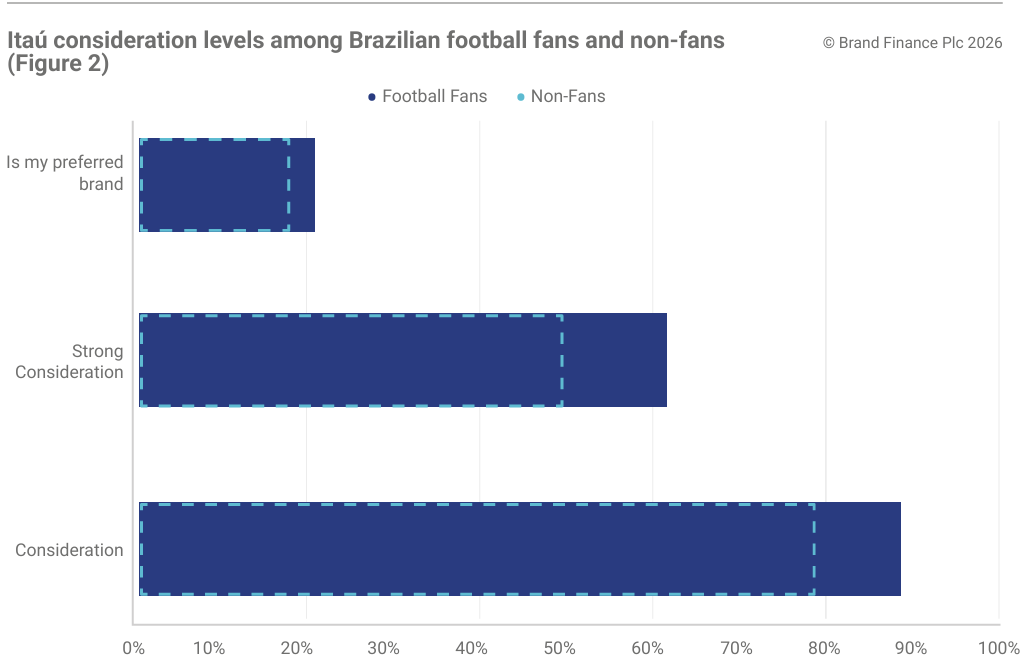
Brand Finance data also indicates that football fans are more quickly increasing positive brand attributes compared to non-fans, but they also represent a strategic audience segment. Their heightened responsiveness to the partnership makes them a valuable group to retain and nurture. Maintaining this momentum is key to deepening long-term brand equity and ensuring sustained impact from the association.
Itaú has established strong brand equity among Brazilian football fans, leading to improved perceptions. As a result, Itaú is regarded as a trusted, customer-centric banking brand, evolving beyond a traditional banking institution to a more modern, aspirational brand. This is further supported by the full brand funnel, where awareness and familiarity of the brand are already high among both football fans and non-fans, but Brazilian football followers are more likely to consider and prefer the brand (Figure 3).
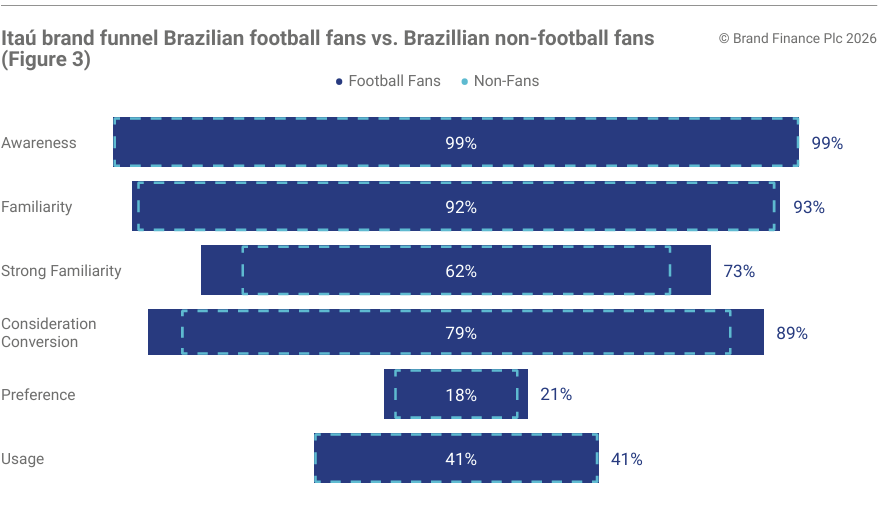
In fact, according to Brand Finance’s data, each percentage point of increased brand consideration is expected to deliver 0.18% in market share.
To make the most effective use of a partnership, it is crucial to understand engagement by analysing the channels they use to connect with their sport. Combining this with the analysis of the channels which sports fans have used to engage with the sport can also allow tactical recommendations into how to optimise effectiveness. For example, Brand Finance’s research shows how Brazilian fans are engaging with their domestic league and how targeting these interactions can lead to a broader and more segmented audience.