






Brands drive penetration, enable cross-category revenue growth, increase profitability, reduce risk and allow businesses to distinguish themselves from competitors. This is why it is key to measure them effectively.
The importance of managing brands and evaluating their progress and future prospects has been recognised since the early days of branding. Procter & Gamble, the originators of the brand management function, recognised the need for rigorous and continuous assessment of their brands' performance as far back as 1931:
"Examine carefully the combination of effort that seems to be clicking and try to apply this treatment to other territories that are comparable".
Neil McElroy, Former P&G President in his famous three-page memo.
Other big brand owners soon followed suit. Brands and branding have such a crucial role in business success, so a process of brand evaluation is essential. However, while most larger companies conduct some sort of brand evaluation, the scale and sophistication of the practice differ wildly. Some companies under-track, some over-track, some track inappropriate things that have no relevance for improving business performance.
Nowadays, there is established best practice to ensure rigour and structure when measuring the strength of your brand. This is why we accord with ISO 20671, the international standard on brand evaluation, which sits alongside ISO 10668, the international standard for the monetary valuation of a brand.
What Is Brand Evaluation?
Before we get into the nitty-gritty, we should set out our guiding principles when setting out to evaluate our brand. Fit-for-purpose brand assessments deliver:
- Data that are relevant to improving business performance.
- Are delivered in a timely fashion.
- Are produced for an audience that can act on the information.
- Enable the prioritisation of perceptual metrics according to their importance
Brand evaluation is the measurement of the strength of a brand. In laymen’s terms, how ‘good’ the brand is and the impact it has on stakeholders’ actions, whether to buy the product, what price to pay, whether to work for an organisation, etc. Specifically, our definition of Brand Strength is as follows:
The cumulative familiarity and perceptions of a brand in its addressable market, which leads to economic value through, for example, reduced risk, increased demand and willingness to pay.
Brand evaluation is also an input into brand valuation, which focuses on the monetary value of a brand and its commercial worth to a company as a transferable and income-generating asset. The evaluation takes into account non-financial considerations as well as obvious factors such as sales, profit, and ROI.
The two concepts are inherently linked – some kind of evaluation is required as part of a brand valuation exercise. In turn, brand evaluation should track brand performance on dimensions which link directly or indirectly to commercial performance and are not ‘vanity metrics’.
Our conceptual framework for brand evaluation is intended to identify the links between actions/investments and the brand knowledge, perceptions, and stakeholder behaviour that they cause. While the levers, as well as the drivers of brand preference, differ by sector, the overarching idea is seen in this graph.
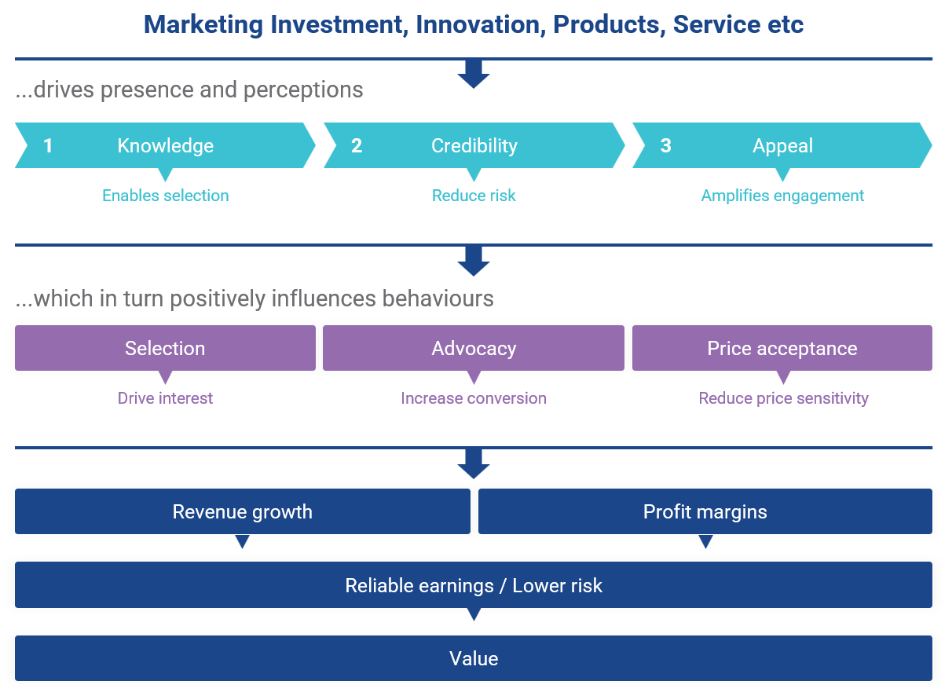
Diagnostic and holistic evaluation programmes should use a range of relevant indicators to assess:
- The overall strength and reputation of the brand.
- Strong and weak aspects of the brand.
- How the brand is responding to marketing activities, e.g. advertising.
- The impact of the brand on the actions of customers and other stakeholders.
- Why the brand is evolving in the ways observed.
Naturally, any evaluation will generally be in some sort of competitive context - many of the key measures are only insightful when compared with other brands. Even organisations with few or no direct competitors (e.g. a state-monopoly energy provider) will still wish to benchmark in some way, and in any case, will be competing with others on some level (e.g. with other large organisations for talent/employees).
Brand evaluation is not a precise science. Some aspects of good practice are universal, and general principles of measurement can be applied in virtually all situations. But every brand and organisation is different, and brand owners should seek to adopt this broad evaluation framework to meet their specific needs. There is no one-size-fits-all solution, which can be a challenge for organisations which lack sufficient internal resource and expertise to design and manage evaluation programmes.
Finally, evaluation can contain both qualitative and quantitative assessments, and best practice combines both. A purely qualitative assessment can be problematic – such programmes are always open to challenge by appearing to be more subjective – and more sophisticated ROI analysis is impossible without a degree of quantification. Hence to all intents and purposes, evaluation is largely a quantitative discipline.
Setting up a Brand Evaluation Framework
Brand evaluation programmes only deliver real value to an organisation if they provide a measurement framework which allows performance to be tracked with reasonable accuracy and confidence. Evaluation should never be ad-hoc or designed on a whim – brand owners must think carefully about what they are measuring and why.
Best practice in brand evaluation begins with a clear sense of the different measures required. At this stage, some brand owners focus on what might be termed equity measures – e.g. whether stakeholders know and like the brand. But input measures should also be considered – e.g. how well is this brand supported in the media? or what is its innovation spend? – as well as output measures which reveal how customers are behaving and what impact their behaviour has on the business.
Tracking these groups of data and establishing an understanding of how each element links and influences the others helps to form the core of value-based brand management systems that can identify the return on investment of specific brand-related actions.
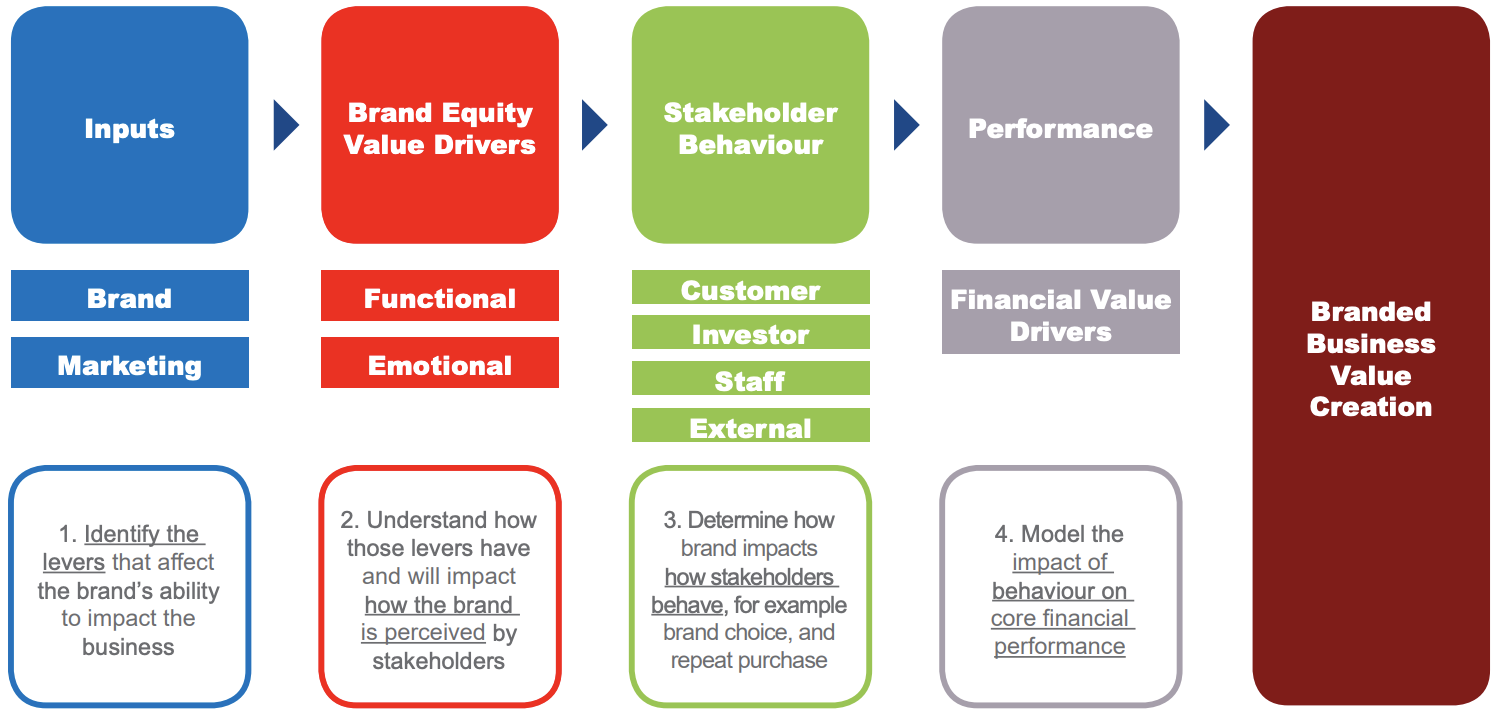
A basic understanding of how brands drive commercial outcomes, and how brands themselves succeed should underpin any evaluation framework. In particular, a knowledge of some of the fundamental principles of brand growth is helpful when designing an evaluation framework, and especially when choosing which measures to track.
Although many of the more commonly-used measures have been validated to have an impact on sales or market share, some brand owners struggle to quantify the precise relationships (and in turn to understand which measures have the biggest commercial impact and should be prioritised in ongoing evaluation).
Such linkages can be determined via sophisticated analysis conducted internally or via external modellers. However, to do so requires sufficient data covering all relevant inputs and outputs. This underlines the need for rigour and consistency.
Brand Strength Index (BSI) - How it Works
When conducting our brand evaluations, the objective is that each brand is assigned a Brand Strength Index (BSI) score out of 100, determined based on performance across an outcome based structure of perceptions and customer behaviours. An overview of the typical structure can be seen below:
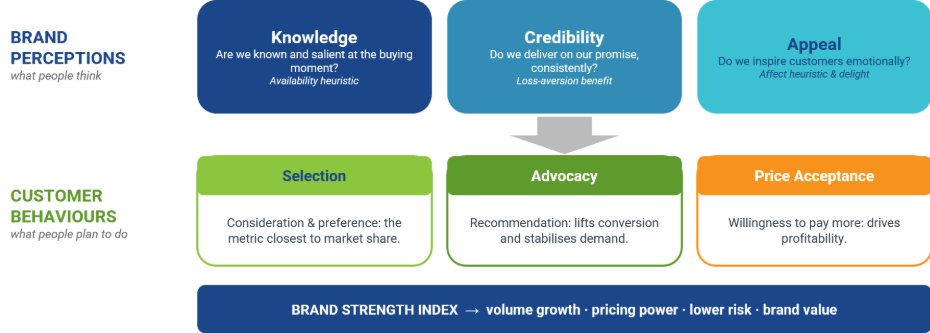
This structure is created in a consequential framework. First we look at brand knowledge, which measures the extent the brand is known by the relevant audience, and the attitudes that audience holds over the brand’s functional credibility and emotional appeal. Second, we look at how those perceptions impact on behaviours with respect to their likelihood to select and advocate for the brand and the price they are willing to accept.
This approach summarises the core brand strength metrics which have the clearest connection to financial outcomes but it can be useful to conduct additional analysis to understand what is driving those metrics’ performance. In particular, we use an analysis call the Brand Inputs Index where we measure the performance on a variety of diagnostic metrics looking at views on different marketing levers the business can influence.
Crucially, attributes are not equally or judgmentally weighted. We use statistical techniques to understand the relative importance of each metric in driving brand choice, thereby allowing it to act as a forward-looking indicator. This weighting allows us to index the raw data, weight the results and end up with a score out of 100.
The starting point is a strong measurement framework, backed by compelling empirical evidence outlining the links between brand investment and performance, and ultimately commercial success.
Benefits of the Brand Strength Index (BSI)
Having a broad framework and set of principles in place brings a number of benefits:
- Confidence: That the measures are meaningful, commercially relevant and actionable.
- Efficiency: management time is focussed only on the necessary category or organisation-specific customisation.
- Consistency: Data sources are identified in advance, and consistent.
- Stronger benchmarking and insight: Consistency of KPIs provides robust benchmarking, and better insight because the speed and magnitude of trends is interpreted more clearly.
- Communications: Clearer communication of results.
- Brand Commercialisation: Where required, hard evidence to use in licencing/sponsorship negotiations, and in addressing internal brand architecture debates.
This type of evaluation framework obviously meets the fundamental objective of providing marketing and senior management with a comprehensive dashboard of brand performance and progress against strategic goals – but it goes much further. Analysing brands using this framework allows us to track the links between inputs, brand perceptions, behaviours and financial performance.
Outputs are fed into strategic plans and help develop the commercial case for brand investment. Further applications include:
- Internal Tracking: Corporate, team and personal target-setting, including incentivisation and reward
- Partner Conversations: Ammunition for retailer/dealer support and other external discussions.
- Scenario planning: Determining the impact of potential changes to brand strategy or investment.
Role of ISO and Development of ISO:20671
As mentioned above, ISO has developed (with our input) the first-ever global standard on brand evaluation – ISO:20671.
This standard sets out a rigorous framework and set of principles for conducting brand evaluation from an input/output point of view. As such it is intended to serve as the standard for the development and implementation of other standards for brand evaluation - and in addition, aligning to the international standard of brand valuation – i.e. ISO 10668.
The standard contains several elements. It sets out a brand evaluation framework, conceptually similar to those used by Brand Finance and some other organisations, incorporating both brand inputs and outputs.
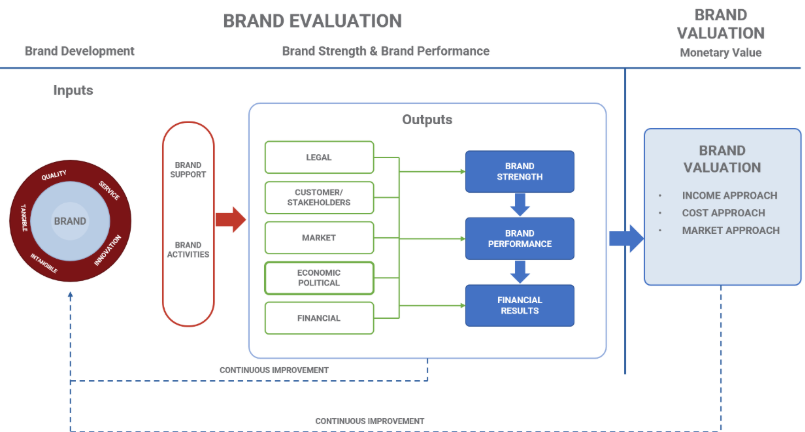
The framework outlines the concept of brand strength as focused on the extent of impact the brand has on stakeholders and highlights that this is the first stepping stone towards determining a brand’s value. As a leading contributor to the standard, Brand Finance’s BSI approach is of course also compliant with ISO 20671.
ISO 20671 also outlines the fundamental principles of brand evaluation, including the need to take into account a range of input measures, external factors, brand strength and their impact on performance measures and financial results.
In this respect, a comprehensive check-list of possible elements and dimensions is outlined, although ISO stresses (as do we) that measures and dimensions have to be customised somewhat depending on the brand and category: “Applicable indicators should be determined e.g. according to company size, particular type of brand, purpose of the brand evaluation, different external regulating environment.”
ISO goes further than many best-practice discussions through its consideration of the brand evaluation process, and not just the content/data and analytic approach. Specific principles outlined are:
- The need for a suitably experienced ‘brand evaluator’ (whether internal or external), at least to design and set-up an evaluation system (if not actively manage it)
- Obligations of the brand evaluator, including the need for transparency, consistency and objectivity. More specifically, the standard outlines the importance of justifying the inclusion (or exclusion) and weight given to specific measures – measurements must not be based around vague or personal choice or the views of a ‘committee’.
- A clear understanding of the role and impact of different stakeholders on brand strength and outcomes, and the need for evaluation measures to take this into account.
- An audit process to confirm “the integrity of the brand evaluation system, its compliance with this international standard and/or reviews whether the brand evaluation practices of the entity are effectively implemented and maintained”.
- The need to ensure that required data inputs are available and of sufficient quality.
Overall, ISO 20671 provides a welcome set of standards and best-practice checklists which all organisations would benefit from following. It is imperative that brand owners assess the extent to which their evaluation system follows the best-practice principles of the ISO standard. While many larger organisations are likely to be compliant with most aspects of the standard – even within some of the biggest branding operations globally it is not unusual to find evidence of corner-cutting and inconsistency (for smaller/niche brands, segments, and markets, for example).
The Marketing Accountability Standards Board (MASB)
Marketing Accountability Standards Board (MASB) is an industry body established to establish standards and processes necessary for evaluating marketing measurement in a manner that “ensures credibility, validity, transparency, and understanding”.
MASB is a participant in the development of the ISO but had in addition outlined brand evaluation standards and processes which are valuable contributions to the marketing discipline. Of particular relevance is the Marketing Metric Audit Protocol (MMAP) - a formal process for assessing the robustness of brand metrics, and the extent to which these are indicative of the impact of marketing activities on the financial performance of the brand owner.
It includes the conceptual linking of marketing activities to intermediate marketing outcome metrics and in turn to commercial outcomes, as well as an audit as to how the metrics meet the validation & causality characteristics of an ideal metric.
As part of this programme, MASB has carefully audited the conceptual framework and rigour of a number of leading research/evaluation agency systems (including Brand Finance), and in 2016 published “Accountable Marketing”, considered to be one of the definitive texts on marketing and brand evaluation.
A Brand Evaluation Checklist
In order to ensure your organisation has a brand evaluation system that provides a comprehensive measure of brand health and progress, here are some key steps every brand-owner should take:
- Identifying roles and responsibilities – who is responsible for brand evaluation, and ensuring the overall system is fit for purpose?
- Ensure that the overall conceptual framework is comprehensive and predictive of brand growth and commercial success
- Developing & reviewing the measurement framework – are all relevant brand inputs, perception measures, and behaviours covered?
- Identifying/reviewing data sources. For existing programmes, this includes cutting irrelevant data and scoping out additional research or data needs
- Determining the links between marketing activities and brand strength, and between brand strength and commercial value (sales, profits, brand value)
- Establishing appropriate measurement and reporting frequencies, and ensuring that measures are updated appropriately
- Determining a reporting hierarchy and system
- Ensuring the system is correctly used as a benchmark for performance and input into brand strategy
In Conclusion
But the rewards are considerable – the entire organisation benefits from clear measures of performance and the impact of business actions upon the brand. Hence, as brands account on average for 20% business value, an effective evaluation programme pays for itself, by outlining a roadmap towards stronger, more resilient, and ultimately more profitable brands. As Warren Buffet points out, a strong brand ensures that strong commercial performance is enduring and resilient to competitive attack:
…all the time, if you’ve got a wonderful castle, there are people out there who are going to try and attack it and take it away from you. And I want a castle that I can understand, but I want a castle with a moat around it.
Warren Buffett, CEO of Berkshire Hathaway
Brand owners must develop effective programmes and processes to evaluate the strength and performance of their brands. There are good checklists of good practice available, including ISO 20671 – but these can only ever be a guide. Professional expertise and an understanding of business goals and purchasing patterns/dynamics will always be required; there is no such book as ‘Brand Evaluation for Dummies’.
Hence even the most sophisticated branded enterprises will acknowledge challenges of brand evaluation – and the need for constant review and improvement (of the evaluation process) without tinkering for its own sake.