




This article was originally published in the Brand Finance Technology 100 Journal 2026.

This year’s Global 500 ranking reveals that the combined value of the world’s 500 most valuable brands rose by 11% to USD10.4 trillion in 2026, substantially outpacing average global economic growth at approximately 3%.
On average, brands now represent around 20% of total enterprise value, underlining their significance in driving shareholder value and business resilience.
Strong brands are not simply keeping pace with economic conditions; they are actively propelling growth. The 2026 ranking highlights both continuity and concentration at the top, with technology brands continuing to dominate. Apple remains the world’s most valuable brand, exceeding USD600 billion in brand value, while Microsoft continues to close the gap as the world’s second most valuable brand.
Artificial intelligence has emerged as a major driver of brand performance, with NVIDIA ranked among the fastest-growing brands in the study, more than doubling its brand value in 2026.
Technology brands dominate the upper echelons of the ranking, accounting for eight of the top 10 positions. Collectively, the top 10 brands now represent 27% of the total value of the Global 500, illustrating an increasing concentration of economic power, influence, and brand equity among a small number of global players.
Against a backdrop of rising complexity and uncertainty, compounded by global issues from climate change to geopolitical conflict and cost of living, the issue of trust has become even more integral to brand strength.
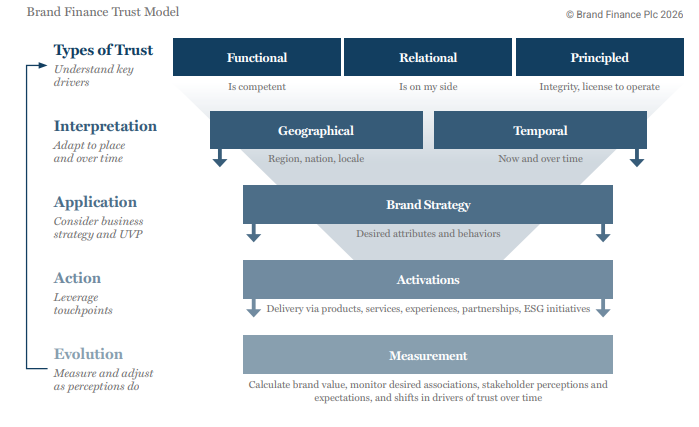
Public trust in governments and institutions continues to erode, with misinformation and disinformation now among the most severe global risks. At the same time, longer-term data suggests that businesses and brands are increasingly perceived as more trustworthy than traditional institutions, creating both opportunity and responsibility. Examples from the Global 500 and Technology 100 rankings illustrate how trust influences brand performance. Brands with high functional trust, such as Google, benefit from strong confidence in their ability to meet user needs. Others, including Tesla, have experienced pressure on brand value as doubts about reliability and leadership erode trust amid intensifying competition.
Fintech brand Revolut stands out as the fastest-growing brand in the Global 500 study, driven by strong gains in relational trust through improved customer service, supported by progress in functional credibility such as securing banking licenses.
Microsoft performs strongly on principled trust, consistently scoring well for its approach to governance and AI leadership despite the inherent challenges faced by global technology platforms.
Across sectors, the combined effect of functional, relational, and principled trust is a significant driver of brand consideration.
As AI accelerates the creation of both authentic and synthetic content, amplifying uncertainty and misinformation, trusted brands are likely to play an increasingly important role in guiding consumer choice. In this environment, trust is no longer a peripheral reputational attribute but a central pillar of brand value and long-term competitiveness.