




View the full Brand Finance World's Most Valuable B2B Brands 2026 report here.

Brand Finance
Why trust matters differently in B2B
The world has become harder to interpret. Increasing geopolitical tensions, economic pressure, social division and intensifying nature related risks have created an environment in which long-standing points of stability feel less dependable than they once were. Technology is reshaping how information is produced and circulated, making it harder than ever to judge what is reliable. Confidence in traditional institutions has weakened, and scepticism has grown.
The 2026 Edelman Trust Barometer describes a world retreating into insularity. Seven in 10 people are now unwilling or hesitant to trust someone with different values, facts or cultural backgrounds. Confidence in shared institutions has continued to erode, with trust in national government leaders falling by 16 points over five years. This is not simply a consumer or political phenomenon. It is reshaping the environment in which every B2B relationship operates.
Procurement teams, executive decision-makers, investors and sustainability officers are all navigating the same world. Their professional judgements about suppliers, partners and service providers are being made within a context of heightened scrutiny and reduced tolerance for ambiguity. The bar for trust has risen, and the consequences of misplaced confidence are more visible and more costly than they were a decade ago.
And yet many B2B organisations have been slow to manage trust in their brand deliberately. Across sectors, there is a widespread tendency to treat brand as secondary to technical or commercial performance. This assumption takes different forms in different organisations: some prioritise product or operational excellence, some rely on long-standing relationships, some default to price competitiveness. What they share is the belief that brand trust will follow from performance, without needing to be managed as a distinct asset in its own right.
Brand Finance research shows that trust is the single most important driver of choice across various sectors, such as energy, technology and financial services. In B2B sectors, stronger brand trust is associated with greater resilience, higher price acceptance in procurement negotiations, and more durable client relationships, with direct implications for revenue and enterprise value.
This article proposes a practical framework for B2B organisations that want to manage trust more deliberately and understand its commercial impact.
A practical framework for brand leaders to measure and manage trust
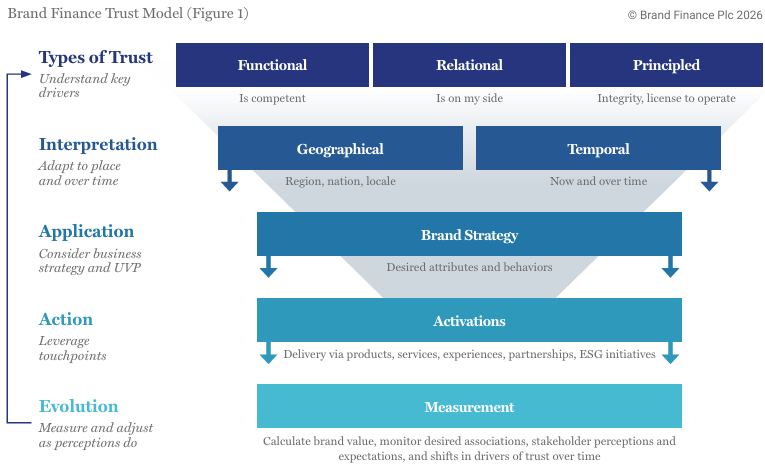
Brand Finance's Trust Model (Figure 1) identifies three main dimensions through which trust is formed: functional, relational and principled. The relative weight of these dimensions varies by sector and is more complex in B2B context, given that the stakeholder landscape is broader, and the commercial implications of making the right or wrong choice are higher.
Function trust: Necessary but not sufficient
In high-stakes B2B environments, functional trust dominates. Buyers and specifiers need confidence that a supplier can deliver, that technical expertise is genuine, project governance is rigorous, and performance under pressure is demonstrated rather than claimed. Brand Finance research in engineering shows that proven delivery and technical capability is the primary driver of consideration.
Functional performance creates a threshold, a licence to compete, but it does not differentiate in mature markets where multiple competitors can credibly claim technical excellence. Organisations that have built their reputation on operational or product quality often find that this is enough to win business but not enough to sustain it at a premium, particularly as procurement processes become more formalised and competitive.
Relational trust: The partnership dimension:
Beyond capability, B2B buyers assess the quality of the relationship. Is the organisation easy to work with and responsive? Does it understand the customer’s specific context? Is the client treated as a valued partner? These considerations matter most where long-term engagement is the norm, and they influence initial contracting as much as decisions to renew or expand agreements. They also matter to senior decision-makers whose confidence in the relationship often carries as much weight as formal due diligence.
Principled trust: Integrity and licence to operate
The third dimension relates to an organisation's broader conduct: whether it behaves with integrity, acts transparently, operates responsibly and aligns its stated values with its actual behaviour.
Across Brand Finance's Sustainability Perceptions Index, principled attributes account for more than 15% of brand consideration in Insurance, rising to over 25% in real estate where corporate citizenship is most salient.
In B2B markets, principled trust has specific and growing relevance. Supply chain sustainability requirements, increasingly embedded in procurement frameworks across energy, chemicals and mining, mean that a supplier's ESG credentials are now a qualifying criterion in ways they were not five years ago. Regulatory pressure, investor scrutiny and the reputational stakes of high-profile industrial operations are creating genuine commercial consequences for B2B organisations whose principled trust is weak, even if the current political environment in some Western nations is favouring silent action as shown in our 2026 Sustainability Perception Index.
How the trust pillars vary by sector
Brand Finance's sector analysis across chemicals, engineering, IT services, energy and mining shows that while all three dimensions of trust matter across the board, the relative weight of each varies considerably by sector context. Understanding where trust is most demanded, and where the gaps are largest, is the starting point for deliberate investment.
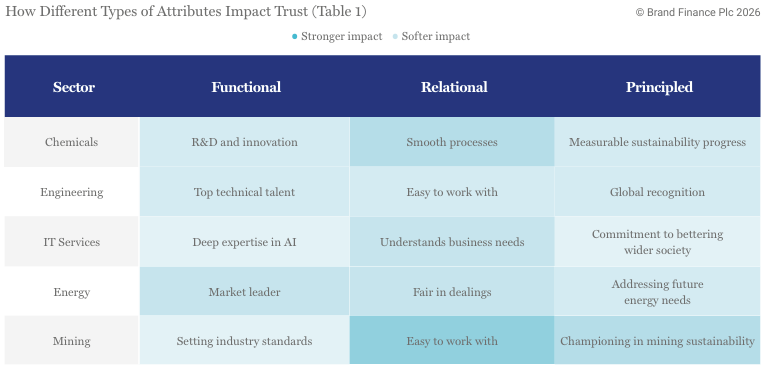
Table 1 shows the importance of different types of trust (the stronger the colour, the higher the importance), and what is the top attribute within each. For engineering and energy sectors, the balance between functional, relational and principled trust is evenly distributed, while for the other three sectors, relationships and ways of working are the main drivers of trust.
Measuring trust and linking it to value
Across B2B sectors, brand investment often meets scepticism, and decisions are expected to be justified through commercial evidence rather than strategic intuition. This is a reasonable expectation, and Brand Finance’s approach helps to make the case for managing trust more deliberately by directly connecting the measurement of trust to commercial outcomes (Figure 2).
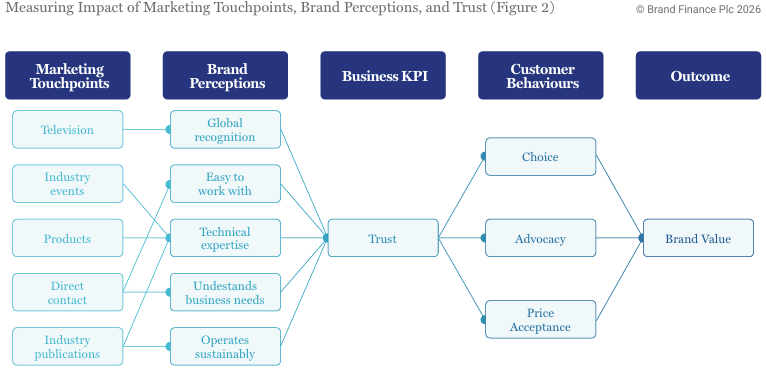
Rather than treating trust as a variable that sits outside the financial model, we use Structural Equation Modelling (SEM) to make relationships visible: from touchpoint experience to perception formation, from perception to trust as a key performance indicator, from trust to behavioural metrics and then to financial outcomes.
The result is a model that helps to prioritise which touchpoints to invest in, and quantifies the contribution of trust to consideration, retention and price premium.
The model also clarifies where investment in trust-building generates the greatest return. In sectors where price sensitivity is high and differentiation is difficult on functional grounds, relational trust improvements can drive measurable gains in retention rates and contract value. In sectors where ESG procurement criteria are tightening, principled trust investment can reduce the cost and risk of qualification. The analytical framework reframes the investment question: brand trust is not a soft outcome, it is a structured set of perceptions, formed through specific experiences, that drives behaviours and measurable commercial impact.
Conclusion
In B2B markets, brand trust has always mattered. What is changing is the wider context in which companies are operating, the range of stakeholders from whom it must be earned, and the rigour with which it is now being assessed by direct customers, procurement functions, sustainability officers and investors who have both the frameworks and the incentives to scrutinise it carefully. The three dimensions of trust, functional, relational and principled, each play a role, and their relative weight varies by sector and by the specific commercial context. Managing this complexity requires more than strong operational performance. It requires structured measurement, clear frameworks for understanding what drives trust and where it is at risk, and the willingness to invest in the capabilities and behaviours that build it.
Brand Finance's work across B2B sectors demonstrates that brand trust, when measured and managed deliberately, functions as a financial asset with a quantifiable contribution to brand value, commercial performance and long-term resilience. Brand trust is a business asset. And it compounds.