





Senior Place Branding
Analyst, Brand Finance

Place Branding Analyst,
Brand Finance
Domestic perceptions play a critical yet often underexplored role in shaping national reputation and soft power. While nation branding strategies traditionally prioritise international audiences, the perceptions held by a country’s own citizens provide an essential lens through which reputation formation, credibility, and long-term influence can be understood. Empirical analysis of Brand Finance’s domestic and global perception data highlights systematic differences between how nations are viewed internally and how they are perceived internationally, revealing distinct patterns across pillars of soft power and significant regional variation.
These domestic–global perception gaps are not merely statistical anomalies. They reflect structural differences in lived experience, information exposure, and expectations, and they carry important implications for nation brand strategy. In an increasingly competitive global environment, where trust, credibility, and legitimacy are central to influence, understanding where domestic confidence aligns with or diverges from global recognition is essential for effective nation brand management.
Institutional confidence at home, limited recognition abroad
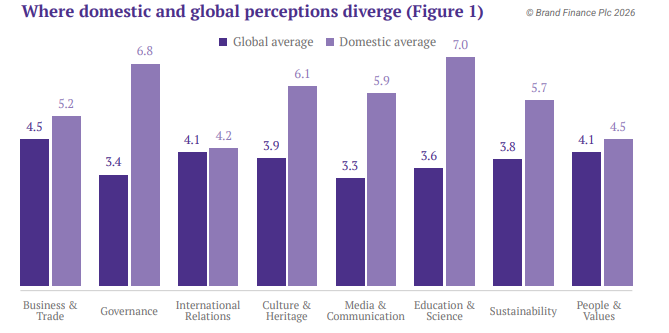
Across the dataset, domestic audiences consistently rate their countries more positively than global respondents on institution-led pillars of soft power, most notably Governance and Education & Science (Figure 1). On average, domestic perceptions exceed global perceptions by more than three points on both pillars, making these the most pronounced positive domestic–global gaps observed.
This pattern suggests that citizens possess a higher degree of confidence in their country’s institutional performance than is recognised externally. Governance quality, public service delivery, and education systems are experienced directly and continuously by domestic audiences. Reforms, investments, and incremental improvements are therefore more visible and more tangible at home than they are abroad. International audiences, by contrast, rely on indirect indicators such as media coverage, rankings, and legacy reputation, which often lag behind recent developments.
A similar, though slightly less pronounced, domestic uplift is observed in Media & Communication and Culture & Heritage (Figure 1). These pillars are embedded in everyday life and national identity, reinforcing domestic familiarity and pride. Global audiences may engage with a country’s culture selectively, but they are less exposed to the full breadth and evolution of cultural expression that citizens experience routinely.
By contrast, pillars such as Business & Trade, People & Values, and International Relations show considerably smaller domestic–global gaps (Figure 1). In these areas, domestic and global perceptions are more closely aligned, showcasing what our news cycle mostly consist of, economics and global affairs.
What translates globally, and what does not
Correlation analysis between domestic and global scores reveals a clear distinction between pillars that translate efficiently across borders and those that do not. Business & Trade exhibits one of the strongest alignments between domestic and global perception, indicating that economic attractiveness and commercial capability are widely observable and comparatively easy for international audiences to assess. Specifically, perceptions of a strong and stable economy show a 79% correlation (Figure 2) between domestic and global audiences, reflecting the visibility of macroeconomic indicators, trade flows, and investment activity. However, it is notable that ‘a strong and stable economy’ is one of the few metrics where global perceptions exceed domestic ones, reflecting a broader context of recent economic uncertainty in the past year, where citizens may perceive neighbouring economies as performing better than their own.
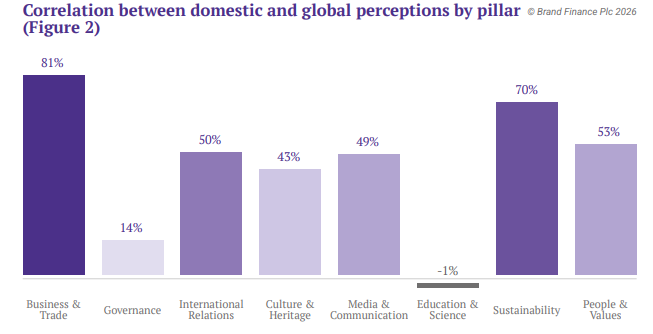
In contrast, Governance and Education & Science display very weak correlations between domestic and global perception (Figure 2). This divergence indicates that improvements in these areas, while recognised domestically, do not automatically convert into international reputational gains. Institutional strength and educational capacity often require external validation, through international benchmarks, partnerships, accreditation, or measurable global impact, before they are fully recognised beyond national borders.
This distinction has important strategic implications. It suggests that reputation formation is not solely a function of performance, but of proof architecture. Certain pillars require deliberate mechanisms to translate domestic reality into internationally credible signals.
Regional divergence: Europe and MENA
While domestic–global perception gaps are evident across regions, their direction and magnitude vary significantly. The contrast between Europe and the Middle East & North Africa (MENA) is particularly pronounced.
Europe: domestic scepticism amid strong global reputation
In Europe, domestic audiences consistently rate their countries lower than global audiences on several attributes, including a strong and stable economy, political stability, high ethical standards, and ease of communication (Figure 3). This results in a negative domestic–global gap across multiple governance-related indicators.
Despite this domestic scepticism, European countries continue to benefit from strong global reputational capital. Long-established perceptions of institutional robustness, economic resilience, and democratic governance continue to shape international views, even as domestic audiences express greater dissatisfaction.
This divergence reflects the high expectations European citizens place on public institutions and governance standards. Extensive media scrutiny, political pluralism, and direct exposure to policy shortcomings contribute to more critical domestic assessments. Global audiences, by contrast, often evaluate Europe relative to other regions, reinforcing a more favourable comparative perception.
For nation brands, this imbalance presents a strategic challenge. Persistent domestic scepticism can erode internal trust and constrain policy ambition, even when international reputation remains strong. Over time, this disconnect risks undermining the credibility and sustainability of the nation brand abroad too.
MENA: strong domestic confidence, limited global uptake
MENA countries exhibit the opposite pattern. Domestic perceptions are substantially higher than global perceptions across all pillars and attributes. This indicates a high level of domestic confidence in national direction, reform agendas, and institutional performance (Figure 3).
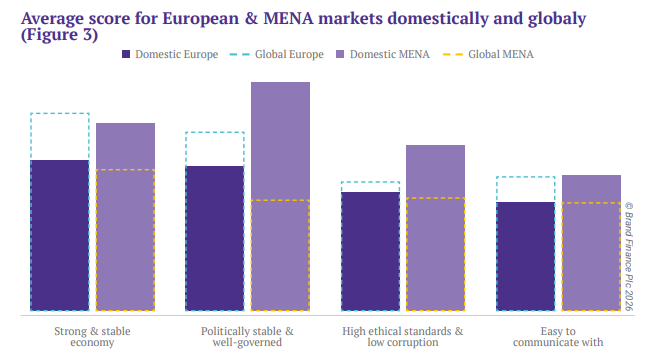
These positive domestic assessments likely reflect visible transformation, large-scale investment, and coherent national narratives that resonate strongly with citizens. However, the comparatively lower global scores suggest that international audiences have not yet fully absorbed or validated these changes.
In this context, the domestic–global perception gap represents unrealised reputational potential rather than a risk. The challenge lies in converting domestic confidence into externally recognised credibility.
What domestic–global perception gaps reveal about legitimacy and credibility
Domestic–global perception gaps are not inherently problematic. Their strategic significance lies in direction, scale, and persistence. When examined together, these gaps offer a diagnostic tool for understanding where national reputation is constrained by weak internal legitimacy, and where it is limited by insufficient external recognition.
Where domestic perceptions are lower than global perceptions, as observed across much of Europe, the primary risk is not reputational decline abroad but erosion of internal confidence. Persistent domestic scepticism towards economic stability, governance, ethical standards, and ease of communication can weaken the coherence between lived experience and external messaging. Over time, this misalignment risks undermining policy credibility, reform momentum, and public support for international engagement, even when global reputation remains comparatively strong.
Conversely, where domestic perceptions exceed global perceptions, as seen across much of MENA, the challenge is one of under-leveraged reputation. Strong domestic confidence in governance, education, leadership, and stability does not automatically translate into international credibility. Without external validation, domestic achievements may fail to deliver proportional gains in influence, investment, or attractiveness, limiting the strategic return on reform and investment.
In both cases, the perception gap signals a misalignment between experience, evidence, and reputation. Understanding why this misalignment persists is essential for effective nation brand management.
Three structural dynamics help explain these divergences. First, information asymmetry plays a central role. Citizens experience institutions, education systems, and governance outcomes directly, while international audiences rely on mediated signals that are often partial, delayed, or filtered through legacy narratives. Second, reputational inertia slows the pace at which global perceptions adjust. Long-standing associations continue to shape international views long after domestic conditions have evolved, whether positively or negatively. Third, there is a critical distinction between confidence and credibility. Domestic confidence may be rooted in lived improvement and national pride, but global credibility depends on comparability, transparency, and trust in independent sources.
How perception gaps should reshape nation brand strategy
1. Design credibility rather than assume it
Institution-led pillars, particularly governance and education, require translation rather than promotion. Improvements in these areas must be accompanied by internationally recognisable proof points, including:
- benchmarking and rankings
- accreditation and standards
- third-party evaluation
- partnerships with globally trusted institutions
Performance alone is insufficient; credibility must be intentionally constructed.
2. Use economic narratives as strategic gateways
High-transfer pillars such as economic performance and business attractiveness are more readily legible to global audiences. These pillars can act as gateways through which governance and education reforms gain traction, particularly when institutional improvements are linked to tangible economic outcomes.
3. Treat domestic sentiment as a reputational asset
Domestic perception should be understood as a strategic indicator, not a background variable. Sustained gaps between domestic sentiment and global reputation weaken the long-term foundations of a nation brand by eroding internal trust, legitimacy, and confidence. These are not only political assets; they are reputational ones.
4. Calibrate strategy to regional gap patterns
Perception gaps vary systematically by region and demand tailored responses:
- Europe: prioritise rebuilding domestic trust through transparency, service delivery, and visible institutional responsiveness.
- MENA: accelerate international recognition of domestic progress through validation, engagement, and credible global signalling.
Uniform nation branding strategies risk reinforcing, rather than correcting, these misalignments.
Aligning internal confidence with external credibility
Domestic and global perceptions represent two distinct but interconnected dimensions of national reputation. The gap between them offers insight into where confidence exists, where credibility is lacking, and where strategic intervention is most needed. Rather than viewing these gaps as inconsistencies to be resolved, nation brands should treat them as signals, revealing where reputation is constrained by scepticism at home or by invisibility abroad.
In an era where influence increasingly depends on trust and legitimacy, nation branding can no longer focus exclusively on external audiences. Aligning internal confidence with external credibility is now a central task for place brand managers seeking to build durable soft power and sustained global appeal.