This article was originally published in the Brand Finance Marathons 50 2026 report.
Technology has become a standout part of the modern marathon. Live tracking, official apps and digital engagement are now used by almost every major race, and runners increasingly arrive on the start line with a smartwatch, a fuelling plan and a clear view of their own performance data.

Valuation Director,
Brand Finance
New research from Brand Finance allows the runner and organiser perspectives to be compared directly. Brand Finance surveyed 2,500+ marathon runners alongside 30 senior organisers behind many of the world’s leading races, including Boston, Berlin, New York City, Tokyo, Chicago, Sydney, Valencia and Xiamen, across more than five continents. Together, the findings show an industry that has largely mastered the collection data but is at an earlier stage in using it to inform decisions. They also point to an audience that receives comparatively little attention from either group: the spectator.
Runners: Technology as a training tool
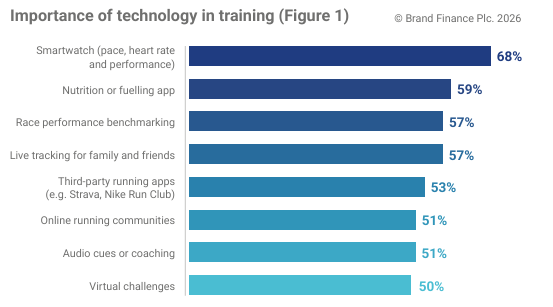
For runners, technology is first and foremost a training aid. According to Brand Finance’s research, the smartwatch is the single most valued tool (Figure 1), rated very or extremely important by 68% of marathoners, ahead of fuelling apps (59%) and performance benchmarking (57%).
Technology use is higher among those who train the most. Among runners training six or more hours a week, 66% use a running app, compared with 57% of those training two hours or less, The same pattern holds for sports watches (69% against 58%) and heart rate monitors (59% against 49%).
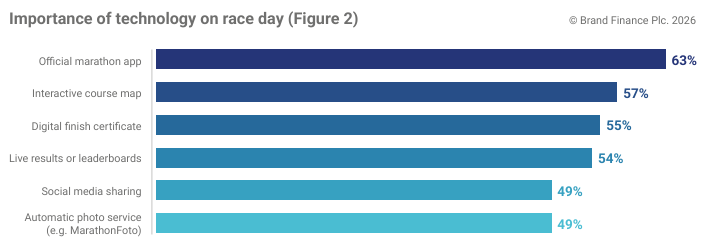
On race day, runners’ priorities become more practical (Figure 2). The official app, with live tracking, start times and race information, is rated important by 63%, followed by the interactive course map at 57%. The finish-line moment matters almost as much, with digital certificates (55%) and live leaderboards (54%) scoring slightly ahead of social sharing and photo services (both 49%).
Organisers: From capturing data to acting on it
Among organisers surveyed by Brand Finance, core digital services are close to universal (Figure 3). Live tracking, email, social media, participant-data tools and live screens are each used by 93–96% of organisers, and the official app by 81%. Adoption of more advanced tools is considerably lower: 37% currently use AI tools and 30% use AI health insights, the least adopted categories in the survey.
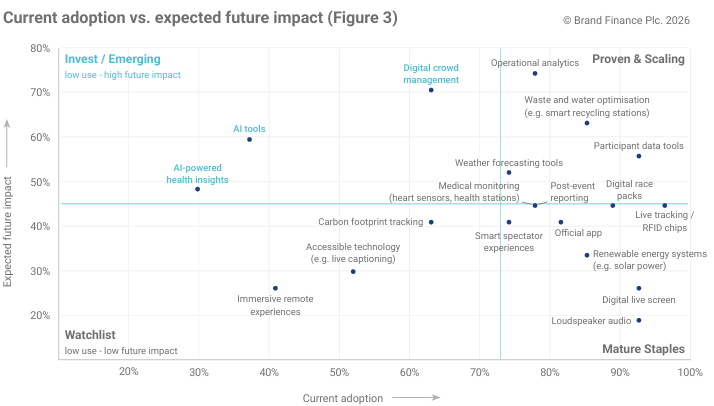
Organisers’ expectations for the future run largely in the opposite direction. Operational analytics (74%) and crowd management (70%) are the solutions most widely expected to have a high impact, and 59% expect high impact from AI tools. Traditional broadcast elements rank lowest, with loudspeaker audio at 19% and live screens at 26%.
Asked about their most successful initiatives, organisers most often cited real-time runner tracking, which serves friends and families following the race as well as operations and safety teams.
Integrated crowd monitoring, which combines movement, weather and course status in a single live view, and digital-first administration such as e-waivers and live bib printing, were also highlighted.
The most reported difficulty was integration. As one organiser put it:
“The individual systems can work well, but connecting them, ensuring data is accurate and timely, and making the information genuinely useful to people making decisions on race day can be complex.”
Other challenges include bandwidth ceilings on live streaming and drone feeds, unreliable real-time weather and traffic data, and early-stage AI-based timing.
Where runners and organisers agree, and where they differ
Live tracking is the clearest point of agreement. It is used by 96% of organisers and named as their most successful initiative, while the official app with live tracking is runners’ top race-day priority (63%). A further 57% of runners value tracking that lets friends and family follow their progress.
There is, however, less alignment on personalised performance data. The tools runners most value focus on the individual – smartwatches, fuelling plans and benchmarking against others or past results, yet AI health insights are the least adopted solution among organisers (30%). This suggests there may be room for races to offer more personalised data on the day itself.
The spectator is the blind spot; they appear to be the least well served group. Fifty-nine percent of organisers are confident their technology meets runners’ needs compared with 30% for spectators. Meanwhile, runners place considerable value on spectator-facing tools. The interactive course map, used to plan where to watch and cheer (57%) ranks second among their race-day priorities. One organiser described spectators as a “potentially unaddressed target”.
Live leaderboards show a similar gap. More than half of runners (54%) rate live results screens and leaderboards as important, while organisers place digital live screens near the bottom for future impact (26%). This may indicate that organisers see the current format as limited, rather than the underlying demand.
Barriers and priorities
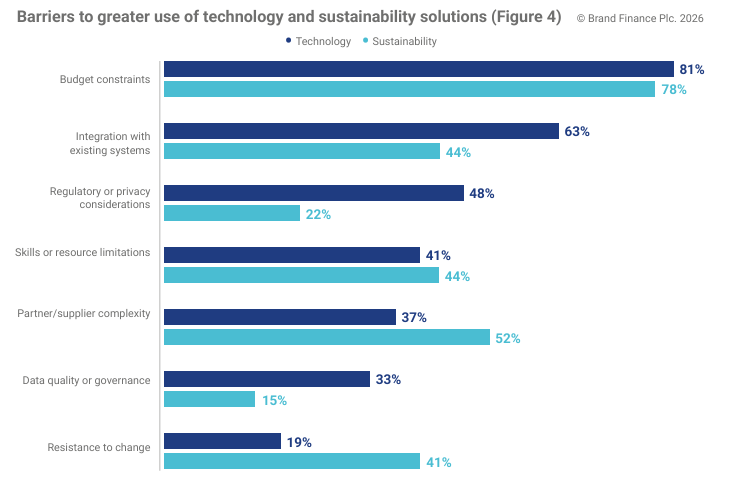
Budget is the most widely cited obstacle, named by around 80% of organisers for both technology and sustainability (Figure 4). Beyond cost, the barriers differ. For technology, the main challenges are integration (63%) and regulation or privacy (48%). For sustainability, they relate more to people and partnerships, led by partner and supplier complexity (52%) and resistance to change (41%).
The findings suggest several areas where technology partners could add value:
+Integration: Helping organisers bring registration, timing and race day data into a single, reliable picture
+AI and analytics: Expected impact is high but adoption is low, leaving predictive crowd management, operations and health insight open to early movers
+Spectator experience: Course maps, personalised tracking and live feeds could do more for those watching along the route, an audience runners see as broadly unaddressed
+Operational sustainability: Moving beyond cups and offsets towards carbon visualisation, Scope 3 travel tools and technology that encourages more sustainable behaviour during the event
+Scalable platforms: Shared, portfolio-wide platforms could lower the entry cost for individual organisers and help address the most widely cited barrier to adoption
The marathon has digitised. The next advantage belongs to those who turn its data into decisions, and its crowds into audiences.