




This article was originally published in the Brand Finance Technology 100 Journal 2026.
This year, Brand Finance launched the seventh iteration of the annual Global Soft Power Index, measuring global perceptions of all 193 member states of the United Nations.

The findings are based on a survey of more than 150,000 respondents from over 100 countries and encompass 55 different Soft Power metrics. Among these is the ‘advanced in technology and innovation’ attribute, which sits within the Education & Science pillar.
In the Global Soft Power Index 2026, Education & Science ranks as the third strongest driver of investment recommendation among global audiences, underscoring the significant role that perceived scientific and technological capability plays in shaping capital flows.
Nations that perform strongest in the ‘advanced in technology and innovation’ attribute typically combine world-class education and research systems with highly visible technology ecosystems - from US digital and semiconductor leaders to China’s platform and hardware giants, and Japan and South Korea’s high-end manufacturing and electronics champions.
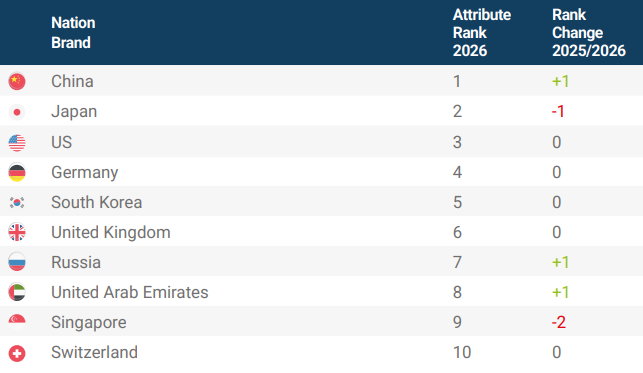
Within this landscape, China overtook Japan to rank 1st globally for technology and innovation perceptions in 2026, reflecting the scale and momentum of its expanding tech ecosystem. The U.S. remains in 3rd place, followed by Germany in 4th, and South Korea in 5th; the UK, UAE, Singapore, and Switzerland also rank among the top 10.
However, the Brand Finance Technology 100 ranking reveals a far more concentrated picture of global tech brand equity. U.S. brands account for more than three quarters of total brand value, while China’s 25 brands contribute just under 13%, with South Korea and Japan following at just under 4% and 2% respectively. Germany’s two brands contribute just over 1%.
Notably, half of the top ten nations for perceived technological and innovation leadership in the Global Soft Power Index have no brands represented in the Technology 100 ranking at all. This disparity suggests that perceptions of technological strength are shaped by far more than globally visible consumer brands.
The Global Soft Power Index illustrates how many of the world’s most advanced economies have built their reputation through excellence in scientific research, higher education, institutional innovation, and cutting-edge advances in artificial intelligence, underscoring that technological Soft Power is built on multiple sources of credibility and influence.
It also reflects a wider shift: technology is no longer viewed as a narrowly defined sector, but as an integrated, everyday component of modern economies and societies.
China: From technological system to global platforms
China overtook Japan to rank 1st globally for its advanced technology and innovation in 2026. This climb underscores China’s 1st place ranking in the Education & Science pillar in the Global Soft Power Index.
This leadership reflects sustained breakthroughs across high-growth sectors, including electric vehicles, artificial intelligence, renewable energy, and globally scaled digital platforms.
Few brands illustrate this shift more clearly than TikTok/Douyin, now the 6th-most valuable technology brand worldwide, with a brand value of USD153.5 billion - its highest ever. With average global awareness of around 91%, TikTok has become one of the most recognised social platforms in the world, embedding Chinese technology into everyday cross-border communication. This visibility likely contributed to China’s 14-rank improvement in perceptions of being ‘easy to communicate with,’ reinforcing its image as both technologically advanced and globally connected.
Alongside this consumer-facing success, brands such as WeChat - less visible internationally but central to daily life within China - underpin the country’s reputation as a highly integrated digital society. Together, these platforms reflect a broader Chinese model: technology as a comprehensive system, spanning infrastructure, platforms, hardware, and policy.
The US: Enduring brand-led dominance
Despite China’s rise in perception, the U.S. remains the world’s dominant force in technology brand equity, retaining third place for tech and innovation perceptions while overwhelmingly leading the Technology 100 in terms of brand value.
This leadership is anchored by tech giants like Apple, Microsoft, Google, Amazon, and Meta, which dominate smartphones, cloud computing, AI tools, operating systems, and digital advertising, as well as rising semiconductor and hardware giants including NVIDIA, Intel, AMD, and Qualcomm, which underpin global AI development, gaming, and telecom ecosystems.
This concentration reflects a distinctive U.S. advantage: the ability to convert innovation into globally trusted, consumer-facing brands at unprecedented scale. While other nations increasingly match or exceed the US in specific technologies, no other country has come close to replicating this brand-building engine.
Japan and South Korea: Legacy leadership, forward-thinking innovation
Japan and South Korea rank 2nd and 5th, respectively, for perceptions of being advanced in technology and innovation in the Global Soft Power Index.
Japan’s technological leadership plays a major role in its economic strength and global brand appeal, contributing to its 1st-place global ranking for its iconic products and brands, surpassing even the U.S. for this attribute. Among the Technology 100, Japan’s enduring consumer electronics giants - including Sony (29th), Panasonic (47th), Nintendo (55th), Canon (63rd), and Fujitsu (82nd) - underscore this legacy. Panasonic’s recent investments in AI ventures further highlight Japan’s continued push into advanced digital technologies.
South Korea’s strong perceptions in technology and innovation are rooted in its long-standing leadership in consumer electronics, combined with an increasingly forward-looking national strategy. Brands like Samsung, the world’s 8th-most valuable tech brand in 2026, continue to reinforce the country’s position at the forefront of global technology.
Building on this reputation, South Korea’s 2026 fiscal strategy is firmly geared towards innovational growth, directing substantial investment into future-defining sectors such as AI, semiconductors and robotics. With major brands like Samsung already directing significant domestic investments alongside government support, the country is aligning industrial strength with strategic policy to enhance its technological leadership.
Innovation without brands: Europe and the small nation paradox
The 2026 Global Soft Power Index reveals another key trend: smaller and mid-sized economies are punching above their weight in global perceptions of technology and innovation. Germany (4th), the UK (6th), and Switzerland (10th) are all seen as among the world’s most technologically advanced nations, despite the latter two having no brands ranked in the Technology 100.
While they are less dominant in big-tech and consumer electronics, these nations’ strong innovation reputations are closely linked to leadership in pharmaceuticals, scientific research, advanced engineering, and robust regulatory frameworks. World-class healthcare systems - including pioneering advancements in AI-driven healthcare - alongside internationally recognised research and education institutions reinforce these perceptions, supported by the UK’s 2nd and Switzerland’s 5th place rankings for their excellent education systems.
These examples highlight somewhat of a paradox in modern tech Soft Power, in that nations can be seen as highly technologically advanced and trusted even without the brand scale that drives global visibility and commercial dominance.
The UAE: State-led strategy driving tech Soft Power
The UAE is an example of a nation whose strong tech perceptions are driven less by consumer-facing brands and more by ambitious national strategies and infrastructure.
Key examples include major investments in smart cities such as Dubai and Masdar City, alongside high-profile space initiatives like the Mars Mission.
The country has also appointed a dedicated Minister of State for AI and introduced a nationally developed AI curriculum for all public schools, making it one of the first nations in the world to mandate AI education nationwide.
Together, these initiatives have bolstered the UAE’s economic credibility and investment appeal, reflected in its 3rd place ranking for future growth potential and 7th place ranking for investment recommendation.
The results highlight how the UAE has positioned itself as a future-oriented, innovation-driven economy through strategic state-led initiatives, even without a large portfolio of globally recognized brands.
The 2026 Global Soft Power Index reveals that technological leadership is no longer a single, unified concept. Rather, tech Soft Power is visible in diverse models of innovation and influence across the globe; brand-led dominance, encapsulated by the U.S.; system-level technological capability, increasingly associated with China; precision, trust, and industrial depth, characteristic of Europe and Japan; and strategic, state-signalled ambition, exemplified by South Korea and the UAE.
As technology becomes more geopolitical, regulated, and embedded in daily life, success will depend not only on innovation itself, but on the ability to translate innovation into trusted, globally visible brands and systems. The next phase of global tech power may therefore depend less on who invents the most, and more on who shapes how innovation is experienced, adopted, and trusted worldwide.
Top 10 Nations for 'advanced in technology and innovation' 2026