






This article was originally published in World Trademark Review.
A strong brand can account for more than 20% of the value of a business and it can be leveraged to drive corporate growth in multiple ways.
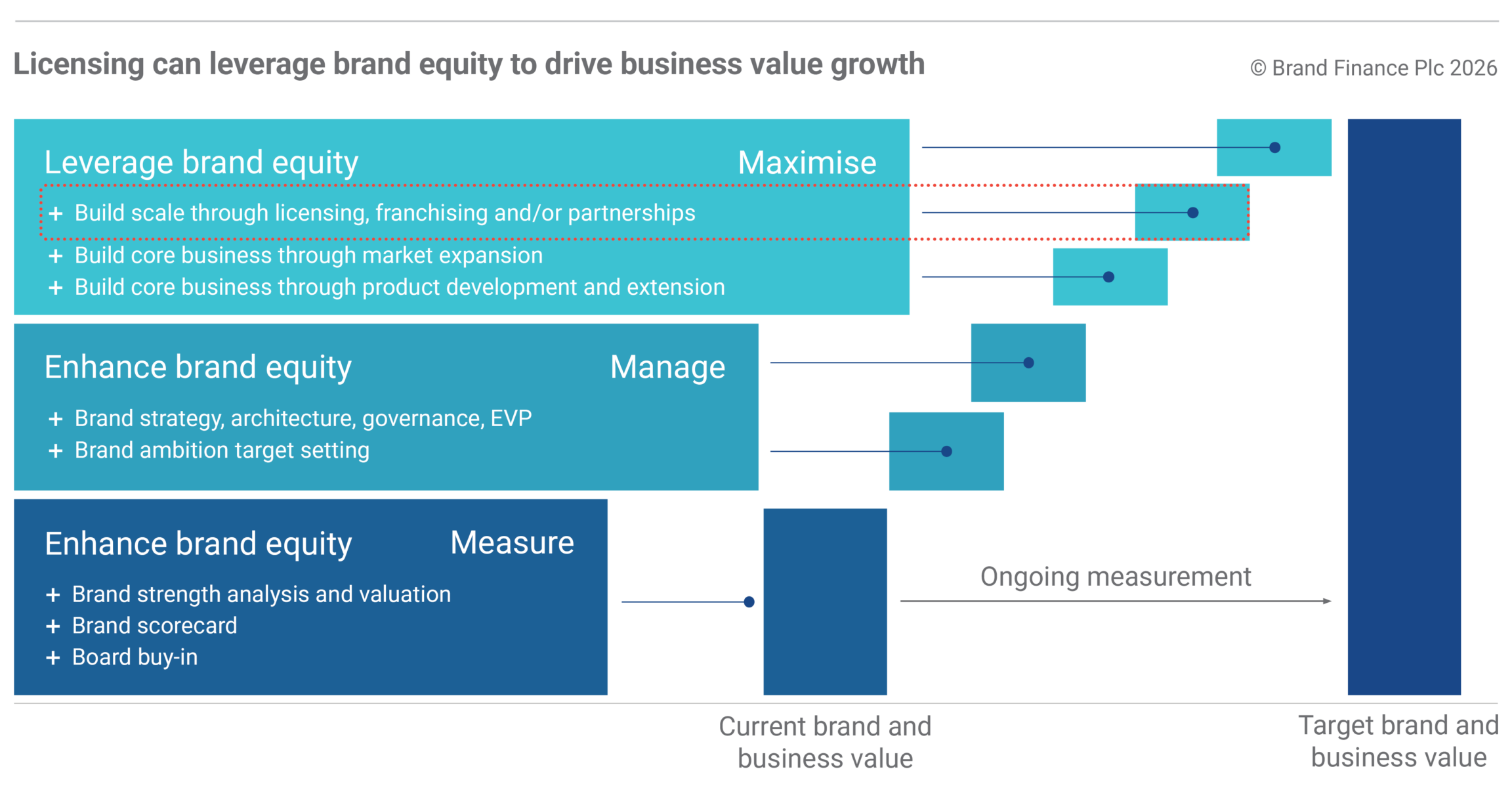
Once a value baseline is established, brand equity can be enhanced to create a strong brand through sustained brand-building and good management, then leveraged to maximise revenue and business growth through building the core business via product development and category extension, or via geographic expansion.
Brand licensing, though less commonly pursued, offers a particularly attractive opportunity for low risk, capex-free revenue growth, with licensing operations often achieving profit margins of 80-90%.
Our focus here is not simple trademark licensing (such as you might see in branded apparel arrangements), but rather ‘branded business licensing’, where companies are increasingly adopting licensing as an additional component to their core business model (oil and gas, and telecommunications companies, being examples).
In these cases, the strategy is to license the brand for use on an agreed product or service portfolio, often encompassing comprehensive customer experience guidelines, in a defined geographic territory. This enables licensors to expand their branded geographic footprint into new markets, as well as to maintain brand presence in subsidiary disposal situations.
But, in practical terms, what is best practice when it comes to implementing a value-creating brand licensing strategy?
Value-based approach to brand licensing strategy
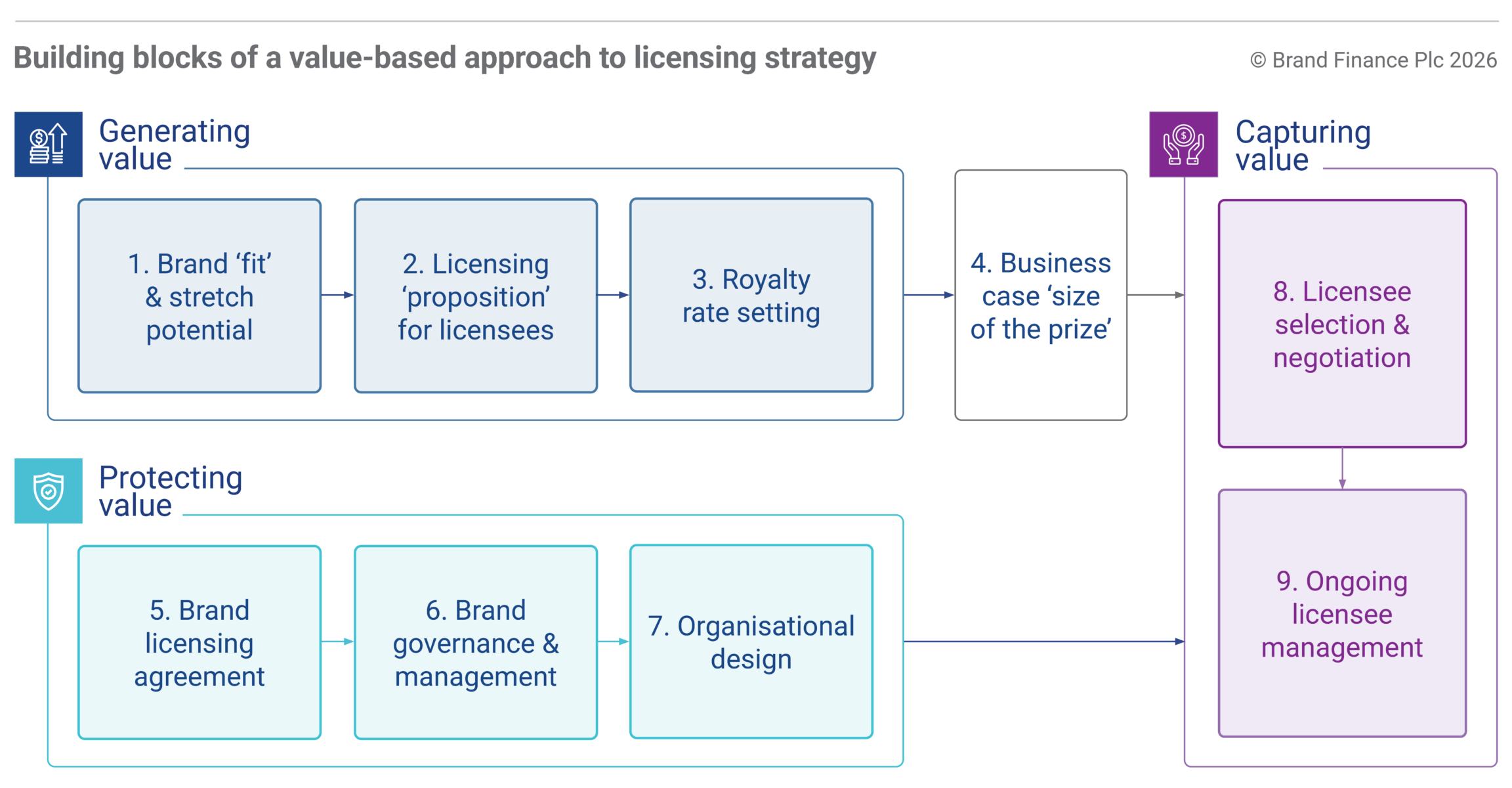
Brand Finance’s core approach to advising on strategic brand issues is one of maximising value, a key objective of licensing – whether that be the value of the brand being licensed or the overall value of the licensor and licensee businesses. Accordingly, the chart below shows the building blocks for licensors to consider when developing a successful brand licensing strategy.
Generating Value
1. Brand fit and stretch: What should be the alignment of the licensing part of a business with an organisation’s main business? Sometimes licensing scope reflects the core business proposition in terms of category coverage but increasingly companies are looking to leverage their brand asset in extended categories and geographies.
A customer and non-customer research exercise using concept board stimulus material will assess potential brand fit, consideration and expected performance versus competitors for the licensed brand in new categories. Feeding this output into financial modelling can quantify new opportunities for licensing revenue generation by testing the fit and stretch potential of the brand across different scenarios.
2. Licensing ‘proposition’ for licensees: The ‘offer’ made to licensees in return for a brand payment is critical. Beyond trademark use, this often includes access to:
- brand assets such as communications campaign materials;
- sponsorship properties;
- marketing budget support; and
- access to brand research and best practice.
This can enable higher pricing for the branded offer and help to ensure correct brand management in the hands of third parties. Centrally-funded brand assets/campaigns should be appropriate or adaptable for use in all licensee markets, while activation helps to maximise returns on sponsorship investment.
Rather than only licensing the brand’s trademark, a more comprehensive, branded customer experience-led approach including licensor-specified product specification and quality, retail format and customer experience, tends to secure most value. So, there is a continuum in approach, ranging from relatively limited brand ‘trademark’ licensing to complete ‘franchising’ of the branded customer experience.
3. Royalty rate setting: Determining a suitable brand licensing fee, whether a royalty rate or some other appropriate charging mechanism, should ideally reflect a fair sharing between licensor and licensee of the business value uplift/profit generated by use of the brand. This would involve a research and financial modelling exercise to quantify the likely value uplift of using the licensed brand compared to an existing/alternative brand in the designated market. Mechanisms to generate such uplift could be increased customer acquisition, improved customer loyalty or the ability to charge a price premium under a licensed brand, as well as possible scale economies and brand cost synergy savings.
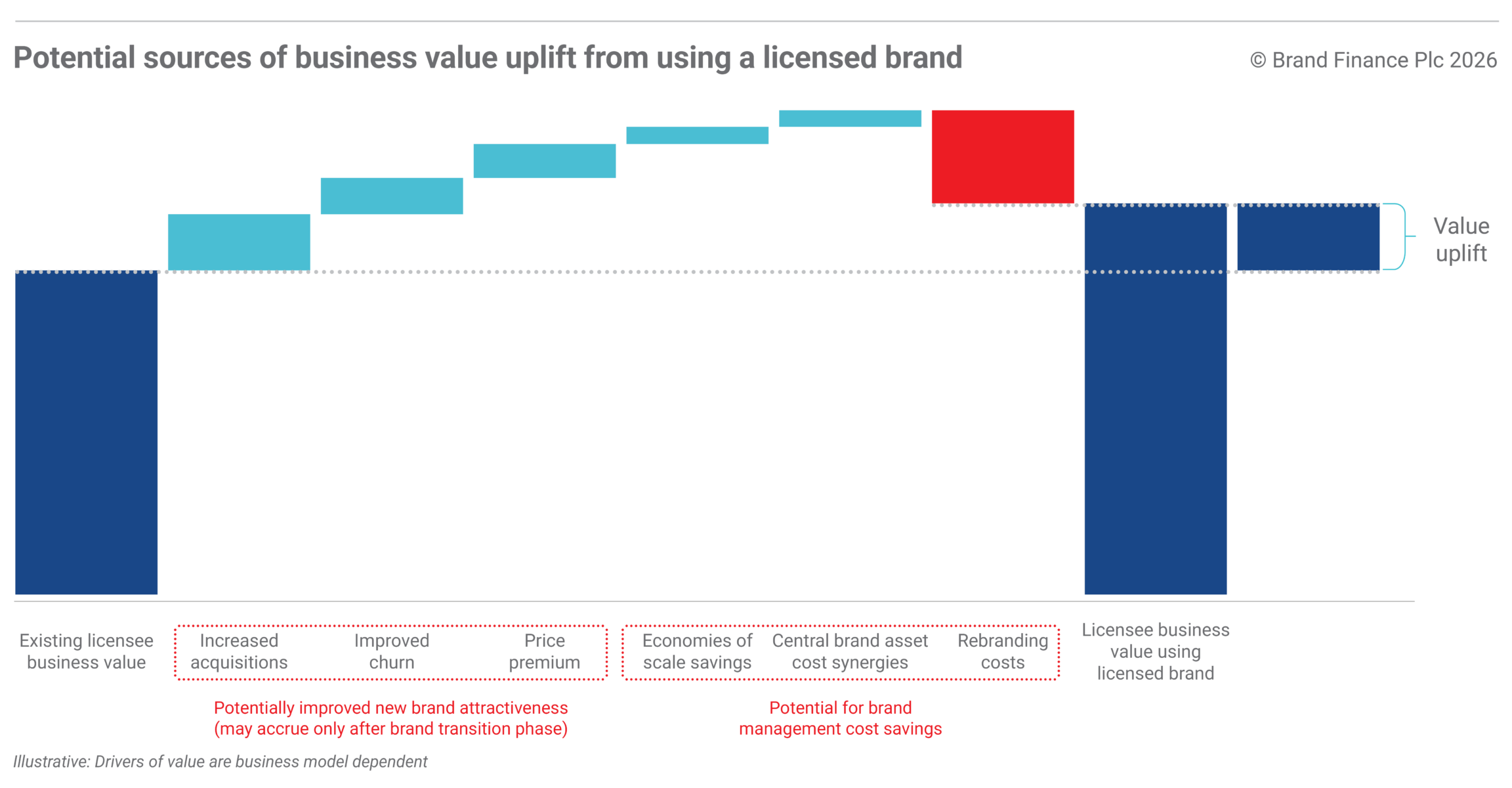
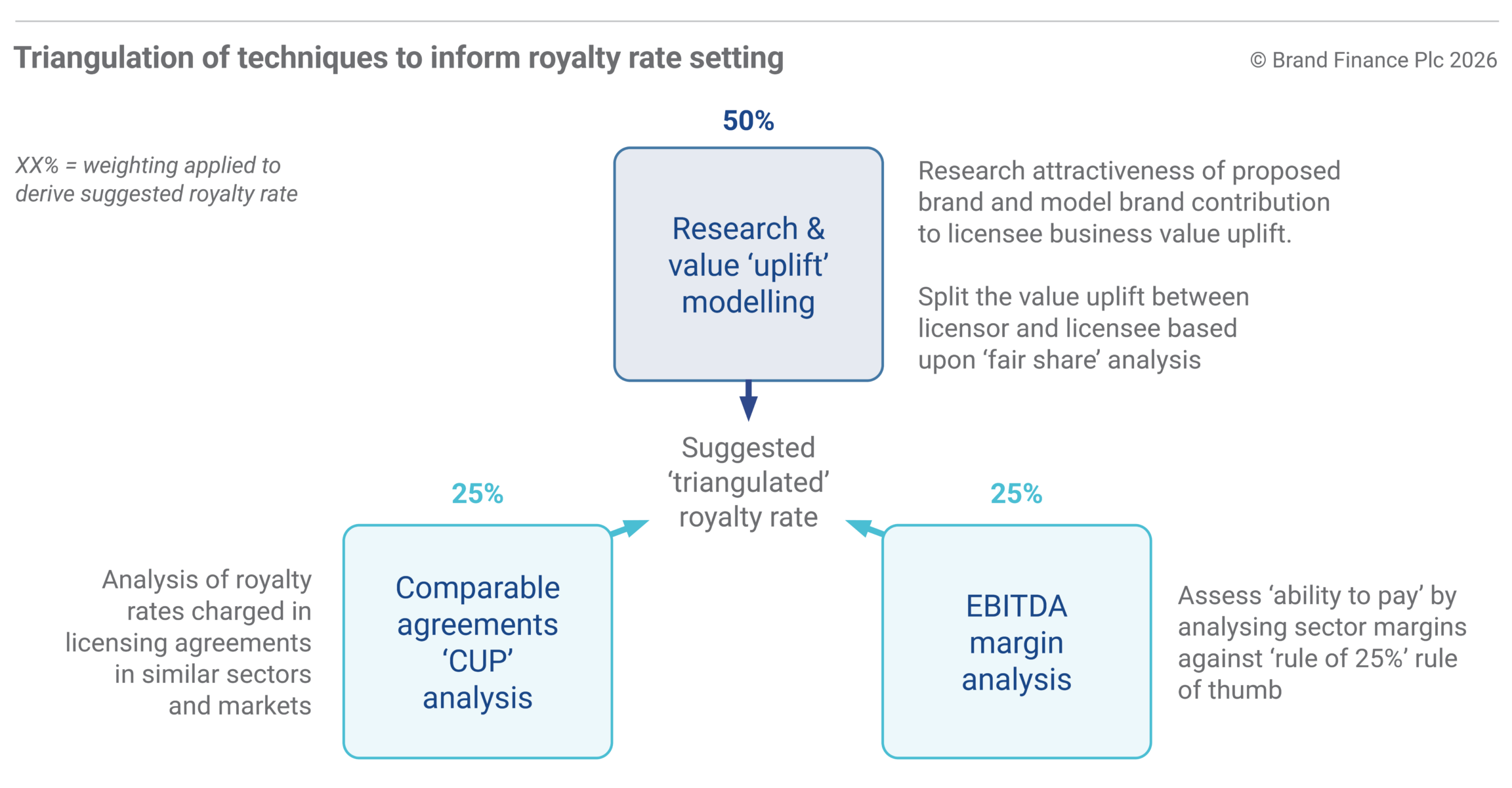
The value uplift is then split between licensor and licensee based on an assessment of which brand management activities are undertaken, which brand assets are provided and what risks are borne by each party.
Finally, the indicative brand payment is corroborated by an analysis of comparable licensing agreements and margin analysis, to support the business value uplift calculation – a robust ‘triangulation’ approach.
4. Business case ‘size of the prize’: Often underestimated is the need to develop a robust licensing business case for internal discussions with senior management, securing buy-in for the licensing strategy and the resources required to support it. The same financial modelling can then be used to develop and present an attractive case to licensees to justify brand charges.
Consideration should also be given to phasing in pre-agreed royalty payments over several years, particularly where time is needed to build brand awareness in a new licensee market.
Protecting value
5. Brand licensing agreement: These can be lengthy documents and, to be effective, they need to be comprehensive. This is due to the considerable challenge of protecting brand value when it is being managed remotely by partners.
Relevant aspects would include:
- scope of brand usage;
- contract term;
- creative brand usage rules;
- licence fee and payment terms;
- overall licensor and licensee obligations (and any restrictions);
- specific funding obligations for shared and for local brand activities;
- required brand Key Performance Indicators and auditing,
- incentives for high performance and sanctions for non-compliance; and
- liability issues, applicable law, contract termination process etc.
6. Brand governance and management: Licensors typically have strong brand strategy and brand guidelines; an essential starting point for maintaining brand standards and service quality. However, a licensing strategy requires additional emphasis on customer experience ‘moments of truth’ and the brand management process. So, this aspect of the licensing strategy looks at potential control and approval systems to manage brand usage by licensee marketing teams. Such approaches range from a more licensor-led local brand management team, through ‘pre-approval’ control, to a more arm’s length ‘post-review’ approach where licensee brand management teams are of the highest quality.
7. Organisational design: This looks at the extent to which a licensing team needs additional resources to mirror a business’ core brand team and, in some cases, the setting up of an independent Brand Company (‘BrandCo’). This is a separate legal entity dedicated to the creation of additional revenue streams and which may also gain tax jurisdiction advantages.
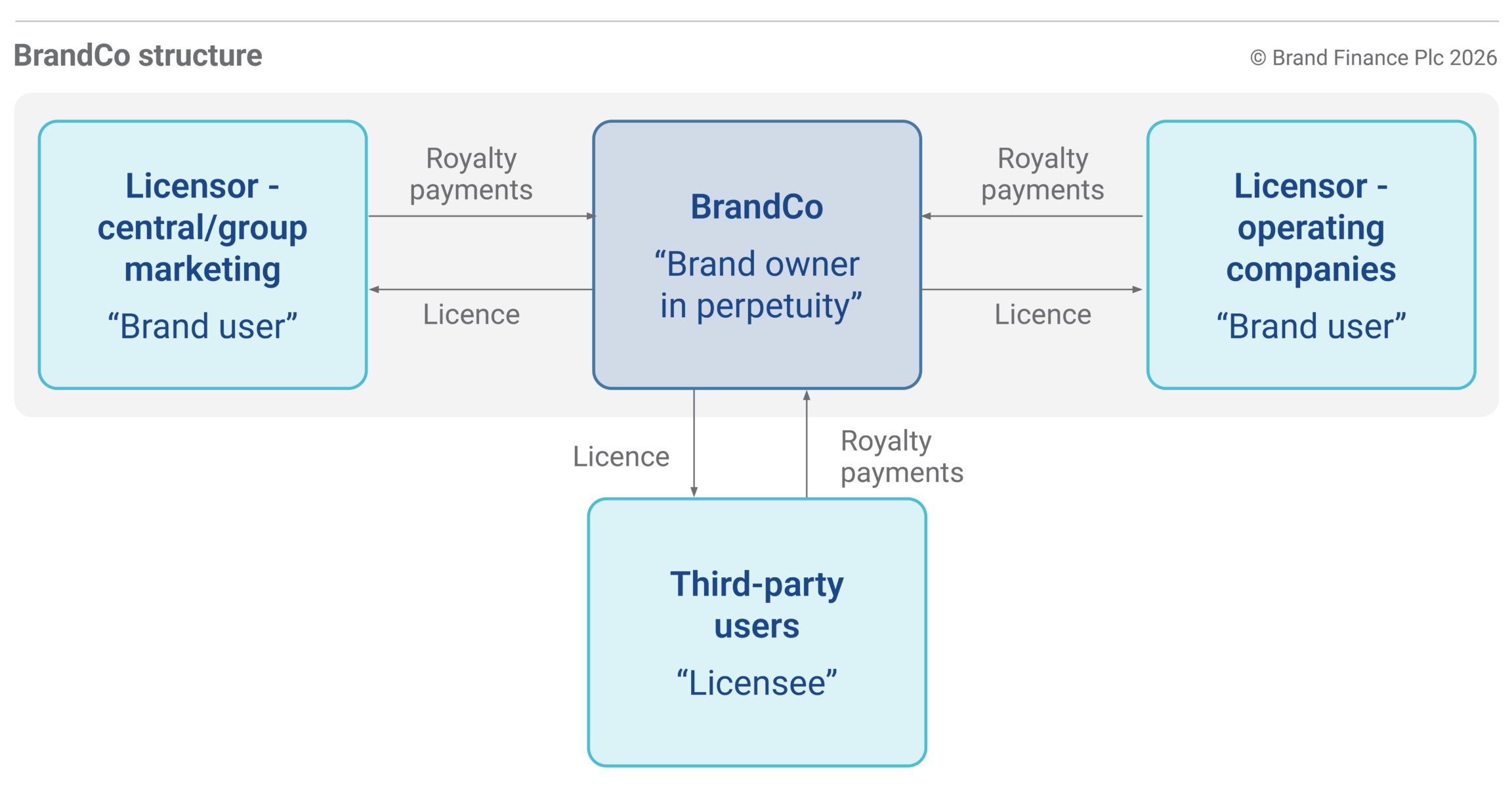
For operational consistency, such a BrandCo may become the centre of all of a company’s brand management operations across both Operation Companies (‘OpCos’) and third-party licensees. The BrandCo becomes a profit centre, gathering internal transfer pricing brand royalties from OpCos, as well as from external licensees. It is also best placed to manage the generation of synergy cost savings from system-wide efficiencies in brand asset production, sponsorship investment and media buying.
Capturing value
8. Licensee selection and negotiation: The importance of choosing the right partners should not be underestimated. All potential candidates should be assessed against an ‘ideal licensee’ scorecard. Relevant criteria could be brand management ability, financial soundness, competitive issues, etc. There should then be a graduated evaluation process, beginning with a general opening/selling presentation majoring on the attractiveness of the brand to be licensed and presenting the broad terms of the Brand Licensing Agreement, to more specific negotiating discussions tailored to individual partner candidates.
9. Ongoing licensee management: This involves developing compliance and day-to-day brand management processes based on the appropriate brand control/approval system agreed. Central to this will be a brand tracking system with timely feedback and course-correction discussions, along with periodic brand audits.
Benefits of licensing - for licensors and licensees
Brand licensing offers significant benefits for both the licensor and the licensee, making it an attractive option for expanding a brand’s reach and revenue.
Key benefits for a licensor:
- Capex-free brand footprint and market expansion: Since licensing leverages existing assets and does not require upfront capital investment, it allows companies that own strong brands to generate value without large financial commitment.
- Licensee motivation to perform: Licensees might lose their contract for non-compliance or bad performance giving them a particular incentive to work hard and perform well.
- Licensee understanding of local nuance: Licensees are generally local partners who understand the local customer and competitive environment, so can provide services optimally tailored to local tastes and trends.
- Lower operating costs and risks: Although royalties and payments can be variable and dependent on licensee success, there are generally no significant direct costs for licensors, as would be the case if brand expansion is implemented through owned operating companies. Licensing through third parties also minimises the potential commercial risk of new geographic expansion or category extension.
- Richer network in global and local markets: Exposing your brand and business to new markets, provided licensees manage delivery well to customers, enables you to build awareness, brand equity and relationships in markets where you would otherwise be absent.
Key benefits for licensee
- Brand recognition and customer loyalty: Licensees without the means or inclination to build brands can increase sales, price and customer loyalty by using a well-known and respected brand.
- Management training and/or assistance: They may also benefit from leveraging a licensor’s more sophisticated business model by taking advantage of training programmes, licensor New Product Development and know-how, which are generally a part of any licensing arrangement.
- Economies of scale: Large operations can consolidate procurement, R&D spend, head office and some elements of marketing costs centrally, creating cost synergies for the benefit of both licensor and licensees.
- Financial and start-up assistance: New businesses can take advantage of the lessons of previous identical businesses starting up, as well as other possible support, including seed financing.
- Increased likelihood of business success: Given that the business model is a proven success, there is significantly less risk that new businesses will fail if managed well day-to-day.
A low-risk, low-cost avenue for growth
As companies reach maturity in their core markets, they face increasing pressure to find new sources of growth, ideally without incurring undue risk or capex. Brand licensing is a strategy increasingly being adopted to satisfy this need, and at high levels of profitability. So long as adequate brand protection measures are put in place, significant value uplift can be created from leveraging a strong brand – to the benefit of both licensors and licensees.