This article was originally published in the Brand Finance Marathons 50 2026 report.

Head of Sports Services,
Brand Finance
Few sponsorship properties combine elite competition, mass participation and civic identity in the way marathons do. For one weekend a year, a race takes over its host city’s streets, drawing tens of thousands of runners and many more spectators into a shared experience. For sponsors, that creates something rare – an audience that does not just see a brand on race day, but lives alongside it through months of training, preparation and anticipation.
Brands engage with that audience in different ways. Naming partners such as Tata Consultancy Services (TCS) and Bank of America attach their names to the event itself, with TCS fronting a portfolio of marathons that includes London, New York City, Amsterdam, Sydney and Toronto. Kit partners such as Adidas, Asics and New Balance equip participants, while brands from Schneider Electric to Tiffany & Co reach runners through partnerships that sit outside the sportswear category altogether.
Whatever the model, the underlying objective is the same: to create positive perceptions and behaviours among stakeholders more effectively and efficiently than traditional marketing. Sponsors do this by reaching a targeted audience and aligning with the attributes embodied by the race organisers and the destination brand itself. Brand Finance’s 2026 research, which surveyed more than 9,400 respondents including more than 2,500 verified marathon runners, tests how well that works in practice, comparing marathon runners with recreational runners and the wider public across familiarity, consideration and perception.
A senior audience that is hard to reach elsewhere
The first lesson is who marathon sponsors are reaching. Within Brand Finance’s research, 18% of marathon runners hold C-suite or board positions, compared with 7% of non-runners, and a further 52% are in middle management, against 20% of non-runners.
Viewed the other way, almost two in three C-suite respondents (64%) are marathon runners, compared with 28% of those in junior management. Marathon runners in the study are most heavily concentrated among those aged 25 to 44, the mid-career years in which many people might typically move into management and senior roles.
For B2B brands, this is a considerable advantage. Senior decision-makers may be notoriously difficult to reach through conventional media, yet marathons offer access to them in an environment where they are personally invested, engaged and receptive, rather than distracted.
Familiarity: Non-endemic brands gain the most
Marathon runners are markedly more familiar with the brands that sponsor the sport than either recreational runners or the general public. The scale of that uplift, however, depends heavily on where a brand starts. For global sportswear and automotive brands such as Nike, Adidas and BMW, familiarity is already close to universal among runners, leaving little room for growth – the gap between marathon and recreational runners is two percentage points or less.
The picture changes for brands with lower starting familiarity. Mizuno (+34 percentage points), TCS (+32), Schneider Electric (+29), Tiffany & Co (+25) and Bank of America (+23) all record substantial gains among marathon runners compared with recreational runners (Figure 1).
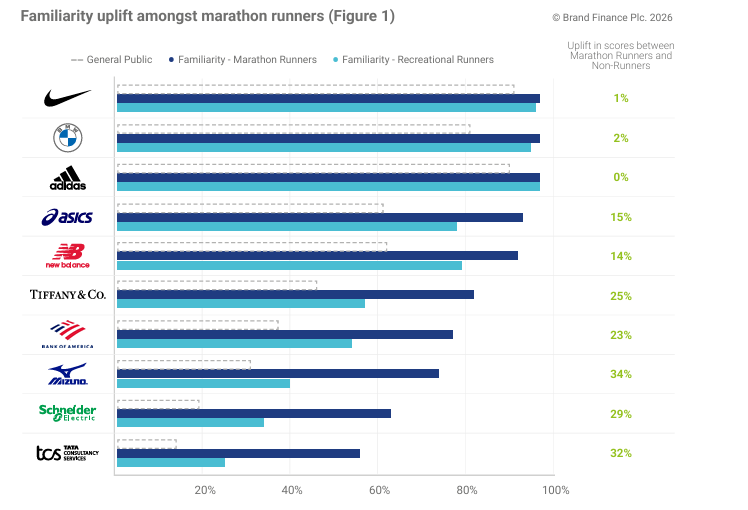
TCS illustrates the effect most clearly. As a B2B brand, it has the lowest general-public familiarity of the 10 brands shown, at 14%. That rises to 25% among recreational runners and 56% among marathon runners – four times the general-public level and the largest relative uplift of any brand in the group.
Sponsorship, in other words, allows a brand with more limited consumer visibility to build deep familiarity with precisely the audience it most wants to reach.
These gains are built through partnerships that are highly visible in the media around each event. TCS’s name forms part of the official title of the races it fronts – among them the TCS London Marathon, TCS New York City Marathon, TCS Amsterdam Marathon, and TCS Toronto Waterfront Marathon – so the brand is carried in the coverage that surrounds the race.
Schneider Electric was title sponsor of the Paris Marathon from 2013 to 2025 and used the partnership to promote its sustainability and inclusion agenda, including through the Paris Run for All, a 4km event held the day before the marathon.
Tiffany & Co has handcrafted the Samuel Rudin Trophy presented to the New York City Marathon’s men’s, women’s and wheelchair winners since 1984, while Bank of America is title sponsor of the Chicago Marathon – where charity runners raised USD47.1 million in 2025 – and presenting partner of the Boston Marathon.
From familiarity to consideration
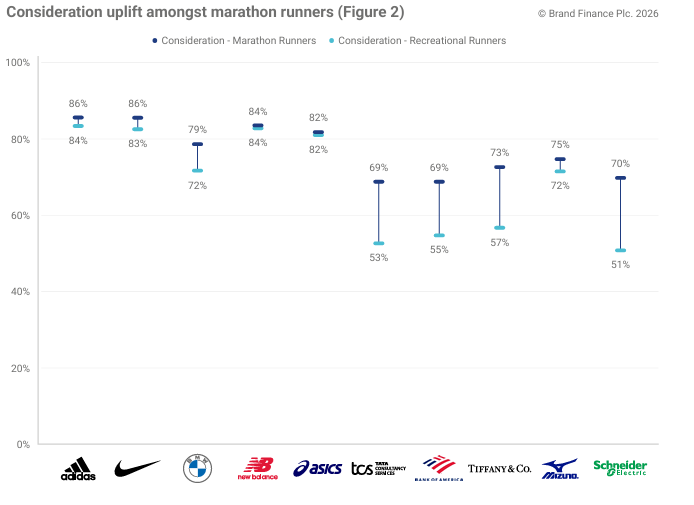
The same pattern carries through to consideration. Among respondents aware of each brand, endemic sponsors see only marginal differences between marathon and recreational runners: Nike (+3 percentage points) and Adidas (+2) edge up, while Asics and New Balance are effectively flat. Their relationship with runners is already established, and sponsorship reinforces it rather than creating it.
Non-endemic sponsors, by contrast, record the largest gains. Schneider Electric’s consideration rises by 18 percentage points among marathon runners, followed by TCS and Tiffany & Co (both +16) and Bank of America (+14) (Figure 2). For TCS, 69% of marathon runners aware of the brand would consider it, compared with 53% of recreational runners and 50% of non-runners.
Not every marathon runner will be a target customer for a B2B brand such as TCS, but the goodwill generated within this community can build positive word-of-mouth momentum that transcends different target groups. For brands outside the sports industry, the marathon provides both credibility and an authentic reason to engage.
The sponsors’ wider brand performance points the same way. Brand Finance values TCS at USD21.2 billion in 2026, making it the world’s second most valuable IT services brand for the fifth consecutive year. Schneider Electric’s brand value stands at USD6.8 billion (up 5% from 2025), making it the third-most valuable French engineering brand. Marathon sponsorship is only one of many factors behind these results, but it is a sustained and highly visible part of both brands’ marketing.
Shaping how brands are seen
Sponsorship also shapes what people believe about a brand, and the research shows a clear pattern in how this plays out. Averaged across all brands tested, marathon runners are far more likely than non-runners to associate them with environmental sustainability (39% vs 15%), social sustainability (38% vs 16%) and being well managed and governed (42% vs 20%), as well as with bringing technology and innovative solutions (37% vs 21%) (Figure 3).
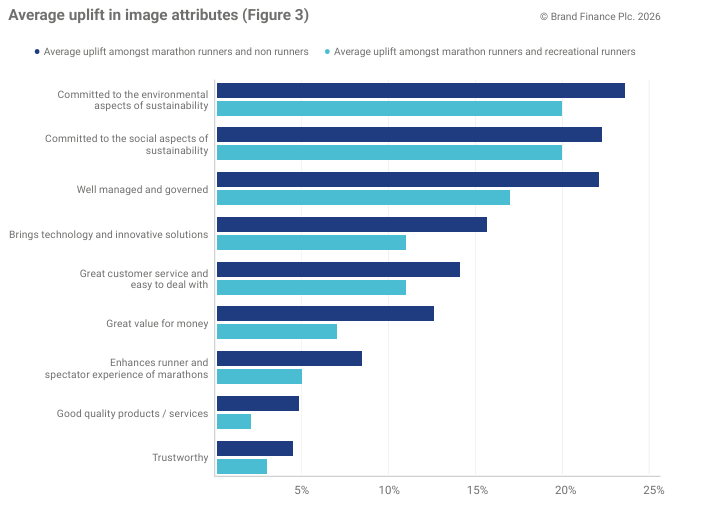
By contrast, the gaps on product fundamentals are narrow: 44% of marathon runners associate the brands with good-quality products and services, against 40% of non-runners, while trustworthiness shows a similar difference (41% vs 36%). This suggests marathon sponsorship is particularly effective at building broader corporate and reputational associations, rather than changing perceptions of products and services themselves.
This is especially relevant for B2B sponsors whose core services may not be directly experienced by runners. TCS, for example, is viewed as well managed and governed by 47% of marathon runners, compared with 29% of non-runners, while 39% associate it with environmental sustainability, compared with 20%. The partnership therefore gives the brand an opportunity to build perceptions beyond its core service offering.
Reach beyond the start line
The benefits are not confined to participants. Marathons reach friends, families and communities who turn out to support runners, and that exposure shapes attitudes too. Non-runners who have watched a friend or family member run a marathon are more than twice as likely to think more positively about marathon sponsors (29% vs 13%), and twice as likely to see marathons as a positive force for good (44% vs 22%). Every runner, in effect, brings an audience with them.
What this means for sponsors
Taken together, the 2026 findings demonstrate the breadth of marathons as a sponsorship platform. For brands outside the running category, including TCS, Schneider Electric, Tiffany & Co and Bank of America, marathon partnerships can provide a powerful route to build familiarity, consideration and positive brand perceptions among an engaged audience.
For established running and sportswear brands such as Nike, Adidas, Asics and New Balance, the opportunity is different. These brands already have near-universal familiarity among runners, leaving relatively little room for further uplift.
Rather than introducing the brand to the audience, marathon partnerships can help keep it front of mind, reinforce its credentials within running and create opportunities to engage runners directly with products before, during and after race day. In this context, a smaller uplift in familiarity or consideration should not be interpreted as weaker sponsorship performance but reflects the much stronger position from which these brands start.
The research also highlights an opportunity for sponsors across both groups. Of all the attributes tested, sponsors score lowest on enhancing the runner and spectator experience, with just 23% of marathon runners associating the average brand with this.
Brands that use their partnership to visibly improve the event – whether through technology, runner support, spectator engagement or other meaningful activations – therefore have clear room to stand out. Ultimately, as with any partnership, marathon sponsorship should deliver a return on investment, measured in both immediate commercial impact and long-term brand-building.
The evidence suggests that, where sponsor and event are well aligned and activations add genuine value for runners, marathons provide a powerful platform for brands to build familiarity, strengthen perceptions and develop deeper relationships with highly engaged audiences.