




This article was originally published in the Brand Finance Global Soft Power Index 2026
The data and analysis in this article are based on a pilot GSPI study conducted in 2025 which included a new question on how respondents got to know about the nation brands they said they were aware of. The pilot study was conducted in 5 markets – Brazil, China, France, India and USA.

Associate Director - Insights,
Brand Finance
Soft Power is often discussed as an abstract asset, but in practice it is built and lost through tangible experiences and touchpoints that shape how people come to see a country. The Global Soft Power Index captures this through perceptions: how familiar people feel with a nation, the reputation they hold of it, and the influence they believe it has. We also measure the associations behind those outcomes, such as whether a country is seen to be stable, innovative, or trustworthy.
But these perceptions do not form in a vacuum. They are shaped by experiences: what people watch and read, where they travel, the culture they consume. That is why, alongside our established analysis of perceptual drivers, we tested an experiential layer this year. We asked respondents who said they know a nation what actually made it familiar to them and modelled how those experiences connect not only to deeper Familiarity, but also to stronger Reputation and Influence.
Awareness travels fast. Familiarity does not
News and social media is the most common cited sources of awareness. But awareness is not the same as a deeper knowledge and understanding that in turn underpins trust and sustained influence. Deeper knowledge is built through direct, lived experience. Visiting and living in a country are the two strongest drivers of nation brand Familiarity. (Figure 1)
Beyond that, Familiarity is strengthened by repeated, everyday exposure: using that country’s products and services, engaging with its culture through cuisine, arts and entertainment, and following sports teams and events. By contrast, news or social media is the weakest driver of Familiarity. This is not an argument against media visibility. It is a reminder of what visibility can and cannot do.
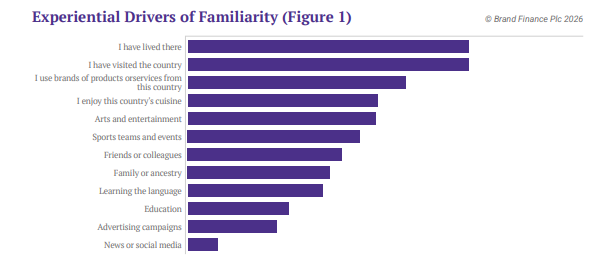
Media can put a country in front of an audience quickly, but deeper Familiarity is much more closely linked to first-hand contact and then reinforced through everyday exposure of cultural and commercial consumption.
Reputation: the strongest lever is the life people want
Reputation is most strongly associated with experiences people enjoy and talk about. Cuisine is the strongest experiential driver of Reputation, followed by visitation, arts and entertainment, and friends or colleagues. (Figure 2)
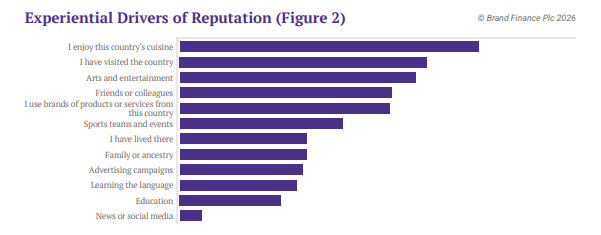
The results are intuitive but strategically important. These are touchpoints which create positive emotions, spark conversation and are reinforced socially.
They shape whether a country feels attractive, interesting, and distinctive, well beyond what audiences learn from headlines or official messaging.
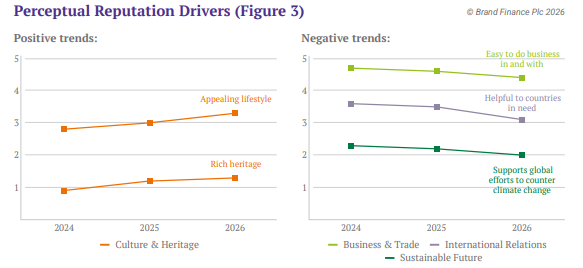
Longer-term trends in the perceptual drivers point in the same direction. Across all pillars, appealing lifestyle and rich heritage show the strongest positive movement, increasing most significantly in the past three years (Figure 3). This sits alongside the growing role of travel experience in shaping reputation with tourism-linked associations such as great place to visit and Friendly people recording the largest jumps last year. Taken together, the trends suggest that Reputation is built when a country is associated with experiences people enjoy, aspire to, and talk about – and when those experiences feel authentic rather than engineered.
Influence: The strongest lever is the life people need
Influence looks different. It is less about affection and more about utility, reliance, and repeat use. The strongest experiential driver of Influence by far is using a country’s products or services (Figure 4).
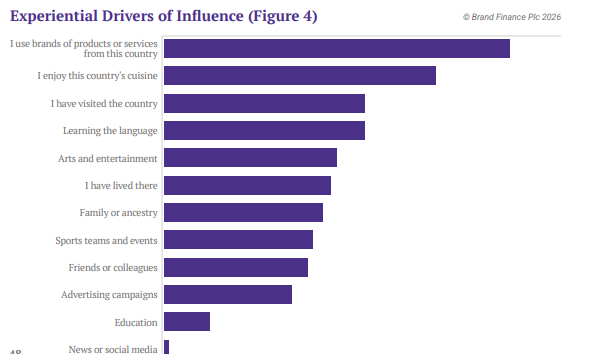
In other words, Influence is built when a country shows up in how people work, connect, purchase, and solve problems. It is then further reinforced through cultural contact such as enjoying a country’s cuisine, visiting or learning the language, all of which play a meaningful role in shaping perceived influence.
This distinction matters because it highlights that while both Reputation and Influence are about embeddedness into day-to-day life, they are driven by two different mechanisms:
+ Reputation is strengthened by cultural pull, leisure experiences, and social reinforcement.
+ Influence is primarily strengthened by everyday utility, adoption, and integration into routines with culture and language acting as strong amplifiers.
Three-year trends in the perceptual drivers of Influence reinforce this picture. The attributes gaining weight i.e., products and brands the world loves, advanced technology and innovation, and the affairs people follow closely are all tied to being visible in what people use, hear about, and pay attention to (Figure 5).
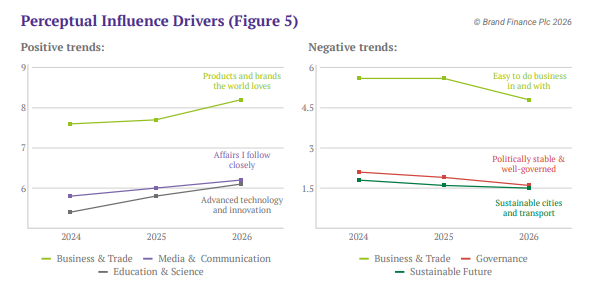
In a year dominated by fast-moving international events and the race for leadership in frontier AI-driven technologies, that kind of presence has become a bigger part of how Influence is judged.
At the same time, with tariffs and trade restrictions in play, openness and smooth market access stop feeling like the default. Friction, both internationally and domestically in some cases has become part of the backdrop so Influence is less driven by ease of doing business and or general political stability.
Linking experiences to the perceptions that matter
Looking at experiential drivers alongside perceptual drivers strengthens soft power strategy. Perceptual drivers show which associations are most closely linked to Reputation and Influence. Experiential drivers show the routes by which those perceptions are formed and reinforced.
The conclusion is that the levers are not interchangeable. Closer Familiarity is most effectively built through travel and other routes to first-hand contact, complemented by sustained exposure through culture and consumption.
Reputation is strengthened by leisure-led touchpoints and cultural experiences that people socialise around such as food and entertainment. Influence is built through everyday relevance, where products, services, platforms, and technology ecosystems embed a country in decisions and behaviours far beyond its borders.
The broader opportunity and the reason we run this kind of modelling is that it turns the Global Soft Power Index from a scoreboard into a strategy tool: not just who is strong, but why, and what would move the dial next.