




This article was originally published in the Brand Finance Global Soft Power Index 2026

Associate Director - Research,
Brand Finance
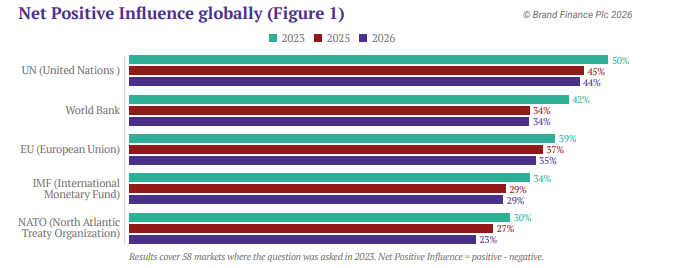
With hard power often chosen over soft power by national leaders, trust in international institutions is beginning to show visible signs of strain. Net Positive Influence data (see chart 1), which captures whether institutions are seen more as a force for good than a negative influence, suggests that many of the world’s most prominent international bodies, particularly those associated with Western leadership, are losing ground in the eyes of global audiences. While most organisations continue to be viewed positively overall, the trend over time is unmistakable.
Whether this marks a rejection of multilateralism remains open to debate. What is clearer is a broader shift in mood, influenced by uncertainty, fatigue, and growing doubts about the ability of institutions to deliver on their promises. It reflects a broader pattern in this year’s Global Soft Power Index with many established Western powerhouses also showing signs of soft power erosion. As confidence in traditional centres of influence weakens, the goodwill once extended to the systems and structures underpinning international cooperation also appears to be under pressure.
Trust in global institutions softens amid political and geopolitical volatility
These shifts do not exist in isolation. They are unfolding against a backdrop of political and geopolitical volatility that is beginning to erode confidence in institutions that have underpinned the international system for generations. The impact of President Donald Trump’s ‘America First’ agenda continues to loom large in this context. Ongoing questions about whether a more inward-looking or transactional approach could re-emerge have added to doubts about the durability of the institutions that rely on consistent US engagement.
Nowhere is this tension more evident than in NATO. Despite its renewed strategic relevance amid heightened geopolitical pressures, public sentiment has moved in the opposite direction. Prolonged conflict, fears of escalation, and the prominence of military responses over diplomatic outcomes appear to be weighing on perceptions. Rather than reinforcing confidence, the current environment is prompting questions about whether security is increasingly being defined through force rather than cooperation
If NATO highlights how security institutions are being reassessed under pressure, the picture is more nuanced for bodies with broader diplomatic and economic mandates. The United Nations, while still registering the highest positive influence overall, has nevertheless seen its standing soften since 2023. This does not point to a loss of relevance, but rather to growing frustration with the organisation’s limited ability to prevent or resolve major conflicts, most notably those in Ukraine and Gaza. While the UN continues to be viewed as a force for good, expectations around delivery appear to be rising faster than perceptions of impact.
A similar softening is evident among economic institutions such as the IMF and the World Bank. Both remain net positive, yet their influence has also weakened over time, reflecting persistent concerns around inequality, austerity, and elite decision-making. These narratives tend to gain traction during periods of economic stress, and recent global pressures appear to have reinforced them, contributing to a more cautious and questioning public mood.
Diverging sentiment within member nations
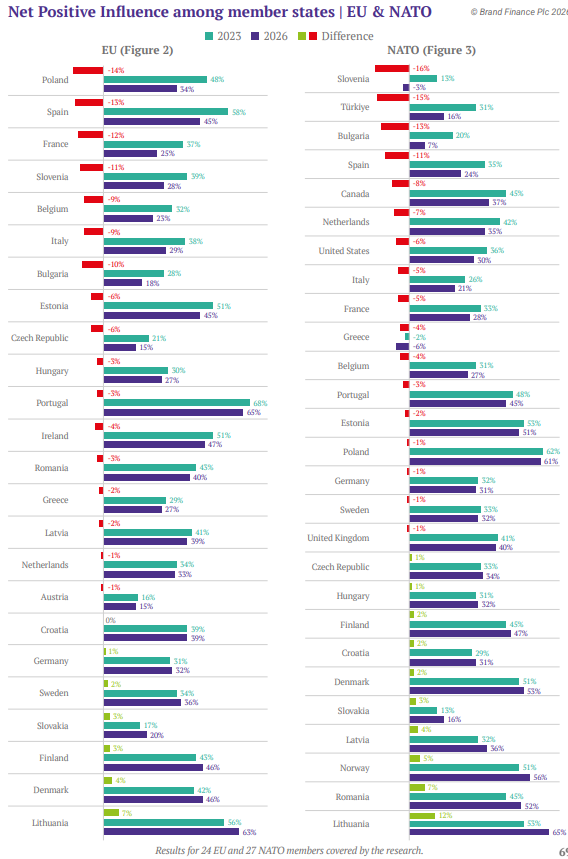
Importantly, this softening in perceptions is not confined to audiences outside these institutions. A closer look at sentiment within member states themselves suggests a similar pattern. Among European Union nations, 17 of the 24 included in the analysis (see chart 2) registered a decline in perceptions of the EU’s net positive influence since 2023. The same pattern appears within NATO, where also 17 of the 27 NATO member nations researched (see chart 3) recorded a softening in sentiment. This points to a more complex dynamic, in which confidence is being reassessed not only from the outside, but from within.
The global mood matters
At the heart of these trends lies a broader deterioration in global mood. Armed conflicts continue to dominate headlines and daily consciousness. Cost-of-living pressures persist across both developed and emerging markets. At the same time, uncertainty about the global economy, whether linked to inflation, debt, or fears of a sudden market correction associated with emerging technologies such as AI, has left many people feeling uneasy about the future.
Brand Finance’s Global Soft Power Index research consistently shows that soft power is highly sensitive to this emotional climate. When optimism fades, appreciation becomes harder to sustain. Institutions that once symbolised reassurance and stability are more readily associated with inadequacy, even when their underlying role remains vital.
A lesson in brand management
Importantly, there are reasons to believe that this erosion of trust could prove cyclical rather than permanent. History suggests that confidence in international institutions rises and falls alongside broader economic and geopolitical conditions. As uncertainty recedes and stability returns, perceptions can and often do recover.
Despite current pressures, international institutions remain central to addressing shared global challenges, from security and development to climate and technological change. Importantly, net positive sentiment across many institutions suggests that they continue to be seen as a force for good, even as confidence has softened. Rebuilding trust will take time, but the foundations of cooperation remain firmly in place.
For institutions themselves, the lesson is clear. Maintaining soft power in today’s environment requires more than technical competence. It demands clarity of purpose, visible impact, and the ability to communicate relevance in a world where patience is limited and expectations are high.