





Brand Finance data reveals Chinese brands show category-wide gains as food, beverage, and dairy players build global momentum
BEIJING, 27 August 2026 – Chinese food and drinks brands are strengthening their positions in global rankings, according to the Food & Drinks 2026 report by Brand Finance, the world's leading brand valuation consultancy. Across the Food 100, Non-Alcoholic Drinks 50 and Dairy 10 rankings, 12 Chinese brands now hold a combined brand value of USD63.4 billion, with every Chinese brand in the ranking recording year-on-year brand value growth.
Their performance reflects a wider shift underway across the global food and drinks sector. As inflationary pressure eases, leading brands are increasingly moving beyond price-led growth and placing greater emphasis on innovation, portfolio expansion, operational efficiency and brand investment. Consumer demand is also shifting towards products that are healthier, more functional, more convenient, and offer better value, favoring brands that can adapt quickly to changing consumption habits.
This creates a particularly strong backdrop for China’s leading food and beverage brands. While brand value growth reflects stronger financial performance and future earnings potential, Brand Strength Index (BSI) measures metrics such as familiarity, consideration, reputation, loyalty and stakeholder perceptions. In 2026, eight of the 10 Chinese brands mentioned also improved their BSI scores, indicating that many are strengthening consumer equity alongside commercial performance.
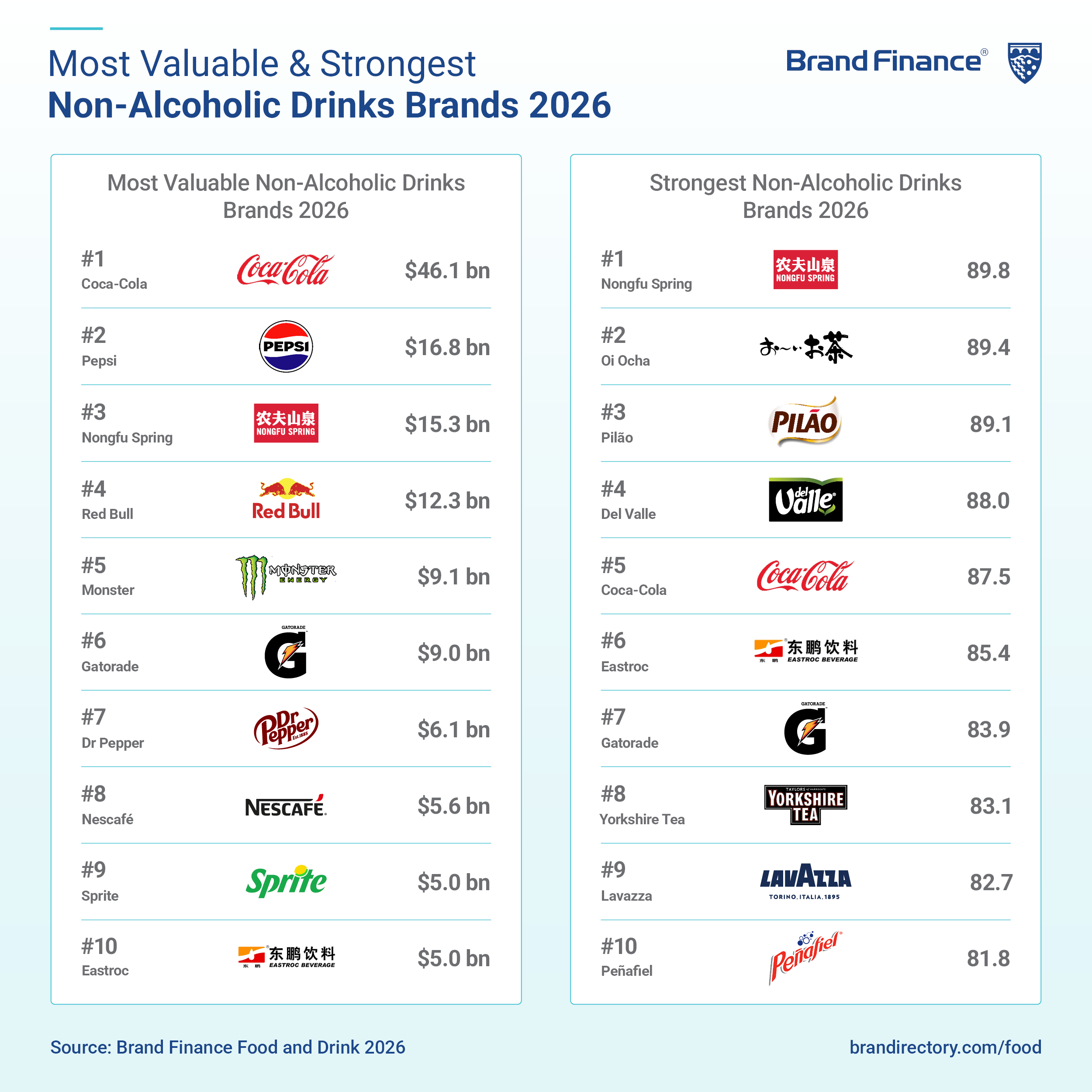
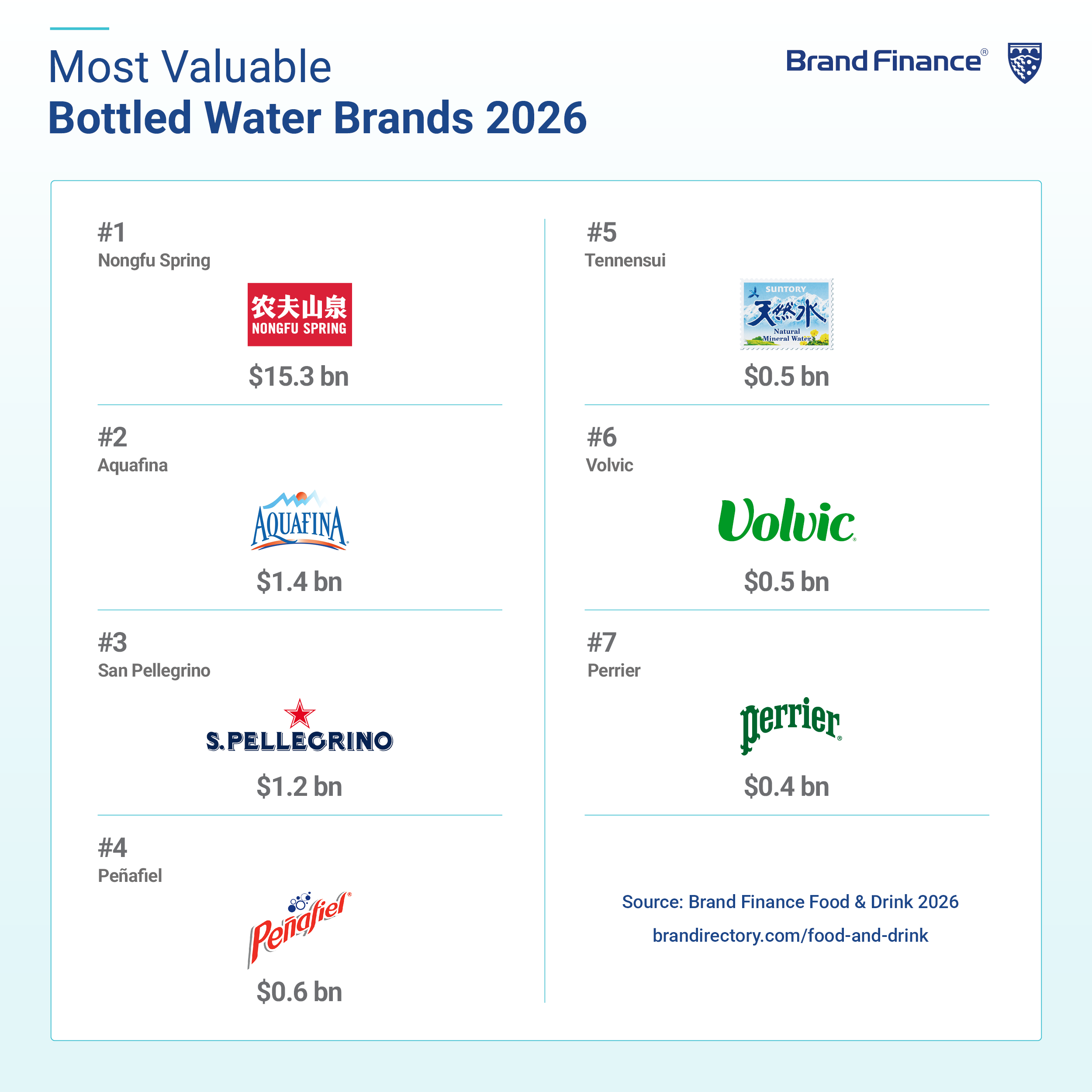
The clearest example is Nongfu Spring, which places third in the Brand Finance Non-Alcoholic Drinks 50 ranking. Its brand value rose 38% to USD15.3 billion, while its BSI score of 89.8/100 and AAA+ brand strength rating make it the strongest non-alcoholic drinks brand globally, overtaking Coca-Cola on brand strength. Its performance reflects continued demand across bottled water, ready-to-drink tea and no-sugar beverages, as consumers increasingly prioritise healthier hydration and reduced-sugar choices.
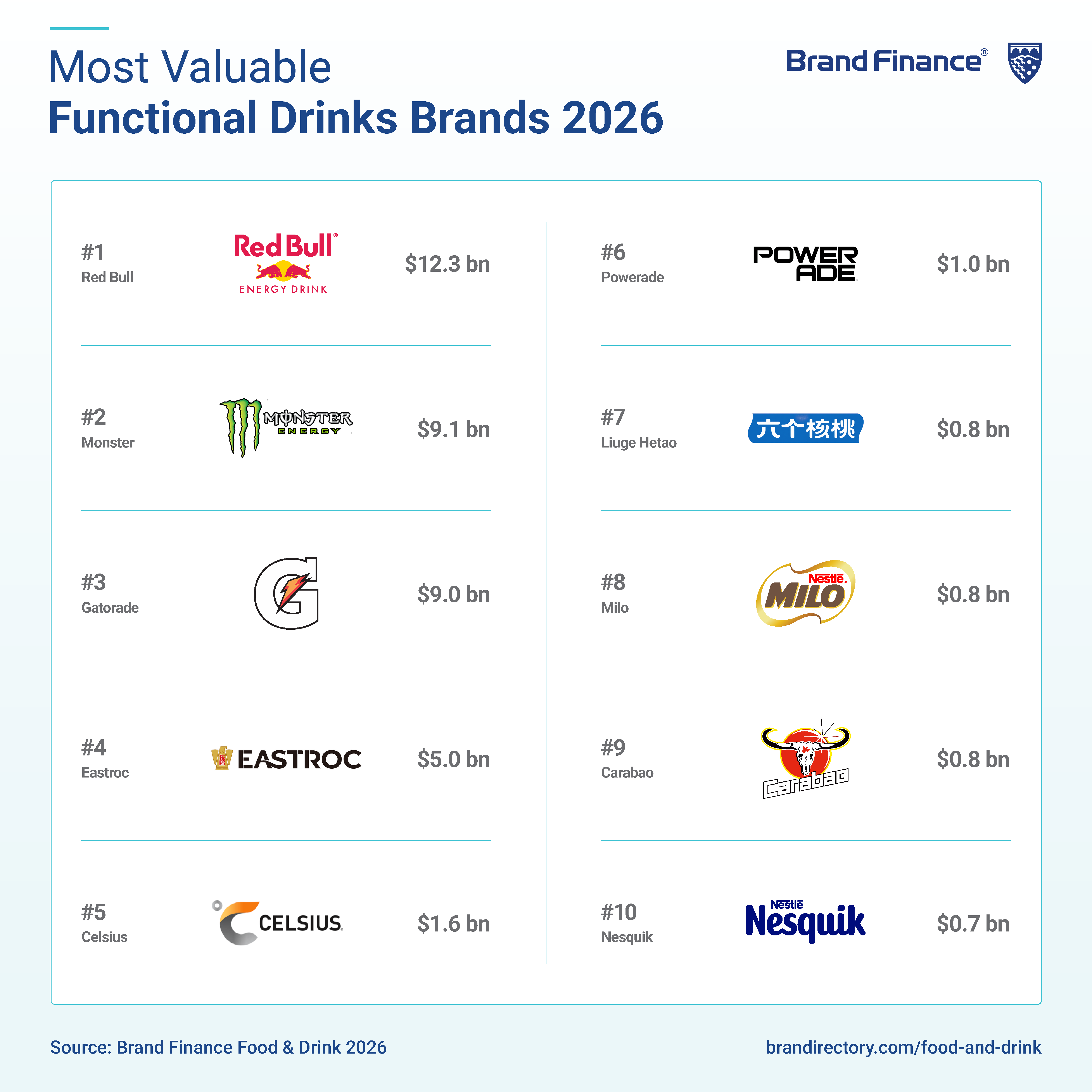
Eastroc also demonstrates how Chinese brands are gaining ground in high-growth beverage occasions. Coming in 10th in the Non-Alcoholic Drinks 50 ranking by brand value, the brand’s value increased 62% to USD5 billion. Its BSI score rose from 82.8/100 in 2025 to 85.4/100 this year, lifting the brand from AAA- to AAA. The brand’s expansion beyond its core energy drinks franchise into electrolyte and functional beverages has helped it capture rising consumer demand for hydration, wellness and performance-focused products.
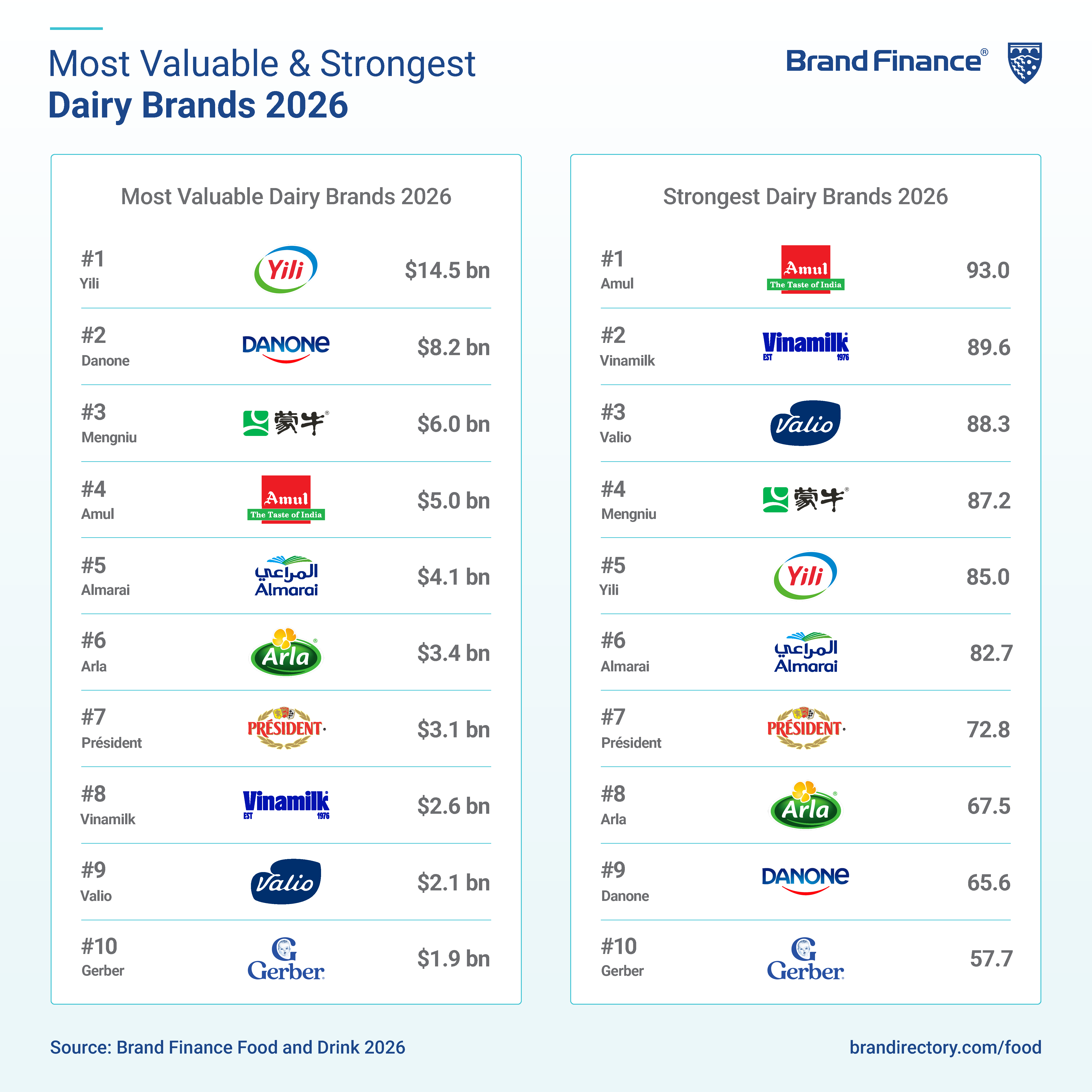
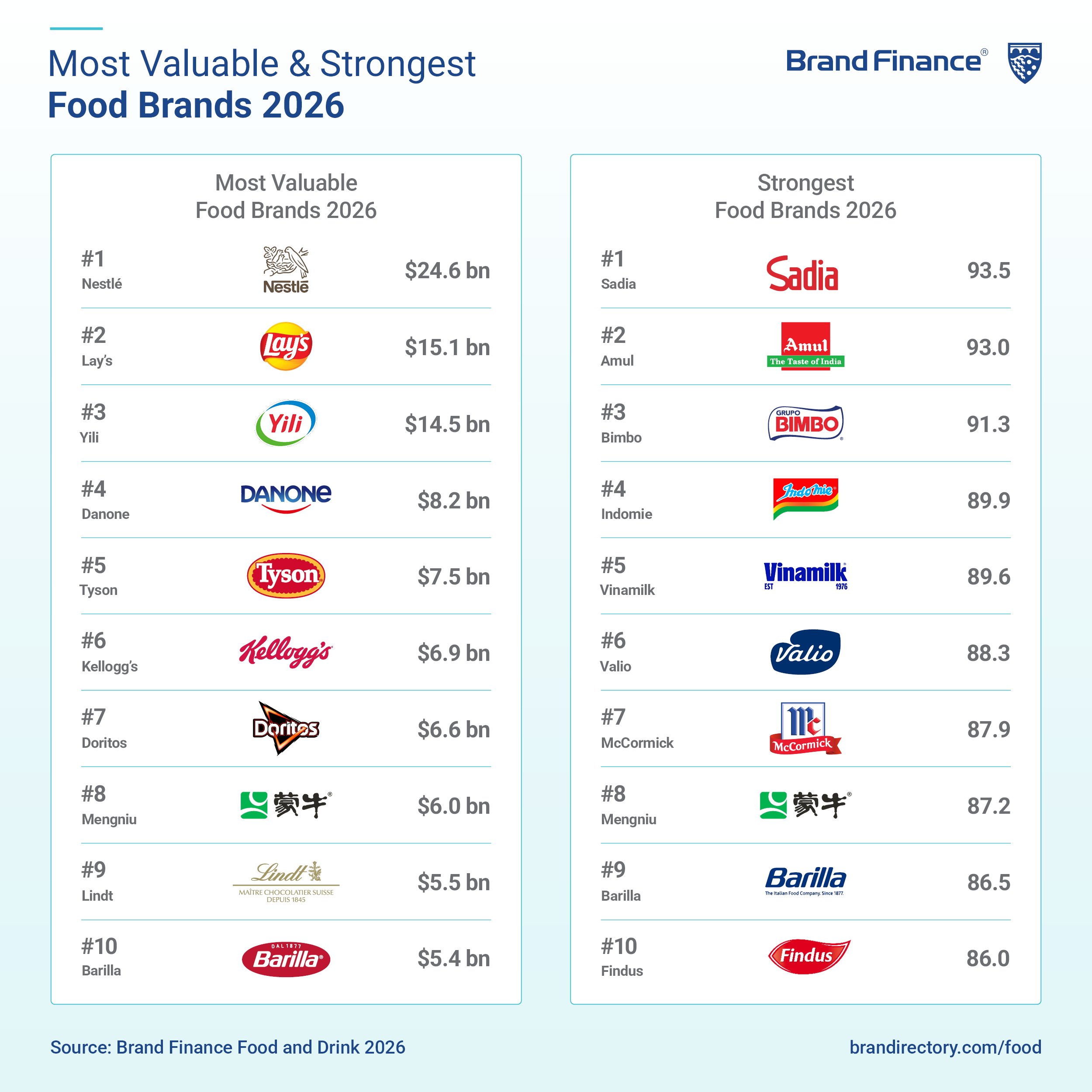
China’s dairy leaders show a similar pattern of growth, supported by demand for higher-value nutrition, functional dairy and premium products. Yili remains the most valuable dairy brand globally, placing first in the Dairy 10 ranking and third in the Food 100 ranking by brand value. Its brand value increased 29% to USD14.5 billion, while its BSI score rose from 82.0/100 in 2025 to 85.0/100 this year, improving its brand strength rating from AAA- to AAA. The brand’s diversified portfolio across liquid milk, milk powder, yoghurt, ice cream and nutritional products has enabled it to respond to evolving consumer demand for healthier and more functional dairy options.
Mengniu further reinforces the strength of China’s dairy sector. Ranking third in the Dairy 10 ranking and eighth in the Food 100 ranking by brand value, Mengniu recorded a 26% increase in brand value to USD6 billion, while its BSI score rose from 82.6/100 to 87.2/100 year on year, improving its brand strength rating from AAA- to AAA. Its performance reflects strong consumer equity in China, continued premiumisation and sustained product innovation across mainstream dairy and nutrition categories.
Beyond beverages and dairy, the trend extends across China’s wider food sector, suggesting that growth is not concentrated in one or two standout brands. Haitian places 15th in the Food 100 ranking by brand value, rising 36% to USD4.9 billion, with its BSI score improving from 68.8/100 in 2026 to 73.2/100 in 2026, and its brand strength rating moving from AA- to AA. Arawana ranks 29th, with its brand value up 16% to USD2.9 billion and BSI score rising from 54.9/100 to 64.2/100 year on year. Master Kong ranks 33rd, with its brand value up 17% to USD2.8 billion and BSI score rising from 72.4/100 in 2025 to 80.9/100 in 2026, improving its brand strength rating from AA to AAA-.
Shineway and Bright Dairy also recorded gains in both brand value and brand strength. Shineway ranks 49th in the Food 100 ranking by brand value, up 22% to USD1.8 billion, with its BSI score rising from 63.0/100 to 70.4/100 year on year, and its brand strength rating improving from A+ to AA. Bright Dairy ranks 97th, with its brand value up 29% to USD839 million and BSI score rising from 61.9/100 in 2025 to 68.8/100 this year, improving its brand strength rating from A+ to AA-.
In non-alcoholic drinks, Liuge Hetao ranks 30th by brand value, up 5% to USD772 million. Its BSI score declined from 81.7/100 to 76.2/100, with its rating moving from AAA- to AA+, but the brand remains within the global Non-Alcoholic Drinks 50 ranking, adding to China’s broader representation across the category.
Scott Chen, Managing Director China, Brand Finance, commented:
“The global food and beverage sector is changing rapidly. After two years in which price increases led to revenue growth without meaningful increase in profitability, brands now need to show where long-term value will come from. Those pulling ahead are using broad, flexible portfolios to capture growth and defend market share across categories against upstart challenger brands, rather than relying only on historically strong positions. Diversification will become even more important as trends such as GLP-1 weight-loss drugs begin to reshape consumer demand. Brands that build flexibility into their portfolios now will be better placed as these shifts accelerate.”
As consumer demand continues to shift towards health, functionality, premium quality and trusted domestic brands, China’s leading food and beverage companies appear increasingly well positioned to strengthen their presence both domestically and internationally. Their performance in this year’s rankings suggests that China’s role in the global food and drinks sector is no longer defined only by scale, but increasingly by innovation, consumer relevance and brand strength.
Global Insights
The global food and drinks sector records a combined brand value of USD448.7 billion in 2026, as growth across food, non-alcoholic drinks, and dairy brands continues despite a shift away from inflation-led price increases. The world’s 100 most valuable food brands are collectively worth USD278.3 billion, while the top 50 non-alcoholic drinks brands account for USD170.4 billion and the top 10 dairy brands for USD50.8 billion.
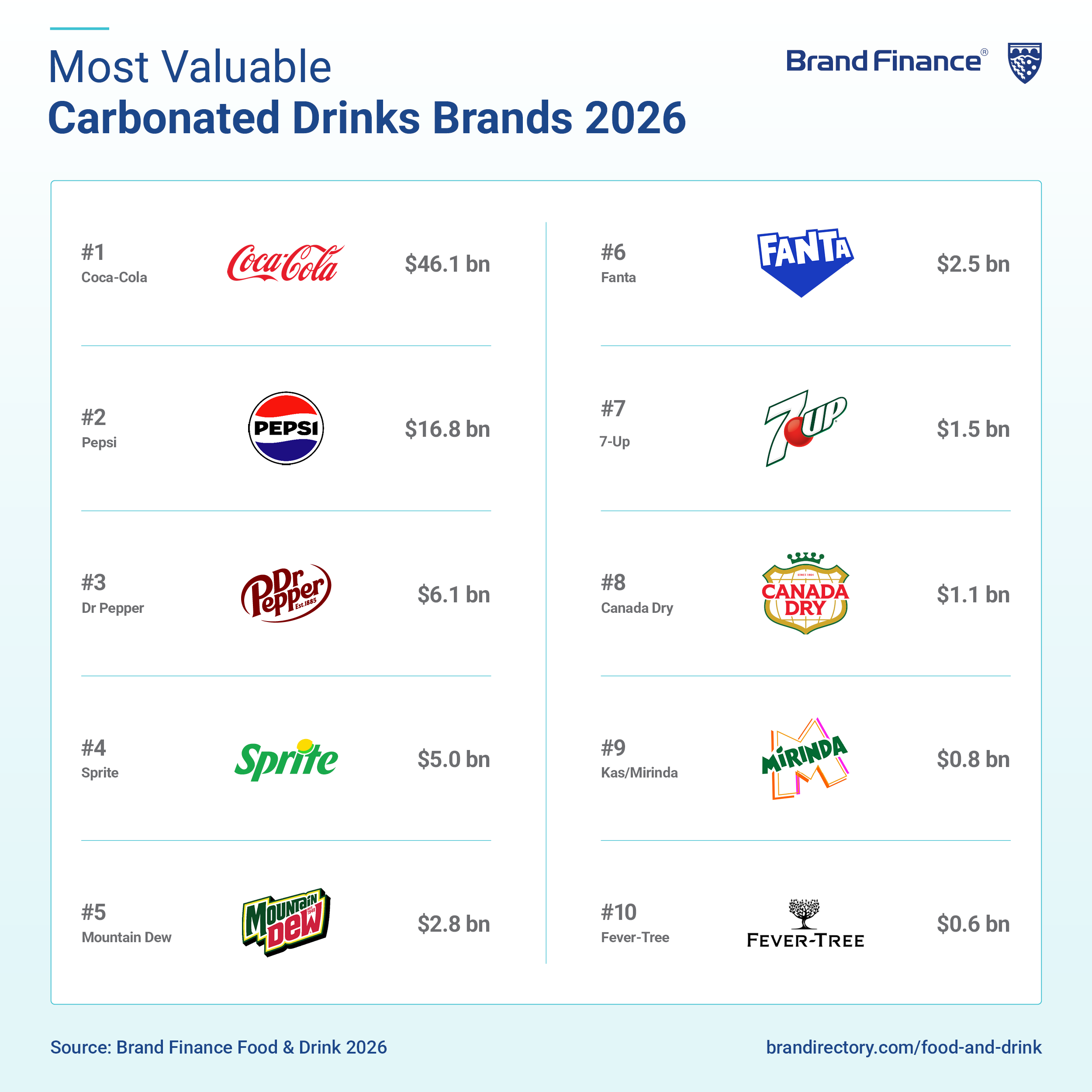
Incumbent category leaders continue to hold their ground: Nestlé remains the world’s most valuable food brand, following a 23% increase in brand value to USD24.6 billion; Coca-Cola retains its position as the world’s most valuable non-alcoholic drinks brand, despite a slight 1% decline in brand value to USD46.1 billion; and Yili remains the world’s most valuable dairy brand, with brand value rising 29% to USD14.5 billion. However, the rankings also highlight shifting dynamics in brand strength and growth, with Nongfu Spring overtaking Coca-Cola as the world’s strongest non-alcoholic drinks brand, Sadia ranking as the world’s strongest food brand, and Amul leading the dairy ranking for brand strength. Growth is increasingly being driven by innovation, health-led positioning, and portfolio diversification, with Canada Dry emerging as the fastest-growing non-alcoholic drinks brand, Eastroc rising strongly as it expands into electrolyte and functional beverages, and functional drinks now accounting for a combined USD33.4 billion in brand value.




Brand Finance is the world’s leading brand valuation consultancy. Bridging the gap between marketing and finance, Brand Finance evaluates the strength of brands and quantifies their financial value to help organisations make strategic decisions.
Headquartered in London, Brand Finance operates in over 25 countries. Every year, Brand Finance conducts more than 6,000 brand valuations, supported by original market research, and publishes over 100 reports which rank brands across all sectors and countries.
Brand Finance also operates the Global Brand Equity Monitor, conducting original market research annually on 6,000 brands, surveying more than 175,000 respondents across 41 countries and 31 industry sectors. By combining perceptual data from the Global Brand Equity Monitor with data from its valuation database — the largest brand value database in the world — Brand Finance equips ambitious brand leaders with the data, analytics, and the strategic guidance they need to enhance brand and business value.
In addition to calculating brand value, Brand Finance also determines the relative strength of brands through a balanced scorecard of metrics, compliant with ISO 20671.
Brand Finance is a regulated accountancy firm and a committed leader in the standardisation of the brand valuation industry. Brand Finance was the first to be certified by independent auditors as compliant with both ISO 10668 and ISO 20671 and has received the official endorsement of the Marketing Accountability Standards Board (MASB) in the United States.
Brand is defined as a marketing-related intangible asset including, but not limited to, names, terms, signs, symbols, logos, and designs, intended to identify goods, services, or entities, creating distinctive images and associations in the minds of stakeholders, thereby generating economic benefits.
Brand strength is the efficacy of a brand’s performance on intangible measures relative to its competitors. Brand Finance evaluates brand strength in a process compliant with ISO 20671, looking at Marketing Investment, Stakeholder Equity, and the impact of those on Business Performance. The data used is derived from Brand Finance’s proprietary market research programme and from publicly available sources.
Each brand is assigned a Brand Strength Index (BSI) score out of 100, which feeds into the brand value calculation. Based on the score, each brand is assigned a corresponding Brand Rating up to AAA+ in a format similar to a credit rating.
Brand Finance calculates the values of brands in its rankings using the Royalty Relief approach – a brand valuation method compliant with the industry standards set in ISO 10668. It involves estimating the likely future revenues that are attributable to a brand by calculating a royalty rate that would be charged for its use, to arrive at a ‘brand value’ understood as a net economic benefit that a brand owner would achieve by licensing the brand in the open market.
The steps in this process are as follows:
1 Calculate brand strength using a balanced scorecard of metrics assessing Marketing Investment, Stakeholder Equity, and Business Performance. Brand strength is expressed as a Brand Strength Index (BSI) score on a scale of 0 to 100.
2 Determine royalty range for each industry, reflecting the importance of brand to purchasing decisions. In luxury, the maximum percentage is high, while in extractive industry, where goods are often commoditised, it is lower. This is done by reviewing comparable licensing agreements sourced from Brand Finance’s extensive database.
3 Calculate royalty rate. The BSI score is applied to the royalty range to arrive at a royalty rate. For example, if the royalty range in a sector is 0-5% and a brand has a BSI score of 80 out of 100, then an appropriate royalty rate for the use of this brand in the given sector will be 4%.
4 Determine brand-specific revenues by estimating a proportion of parent company revenues attributable to a brand.
5 Determine forecast revenues using a function of historic revenues, equity analyst forecasts, and economic growth rates.
6 Apply the royalty rate to the forecast revenues to derive brand revenues.
7 Discount post-tax brand revenues to a net present value which equals the brand value.
Brand Finance has produced this study with an independent and unbiased analysis. The values derived and opinions presented in this study are based on publicly available information and certain assumptions that Brand Finance used where such data was deficient or unclear. Brand Finance accepts no responsibility and will not be liable in the event that the publicly available information relied upon is subsequently found to be inaccurate. The opinions and financial analysis expressed in the study are not to be construed as providing investment or business advice. Brand Finance does not intend the study to be relied upon for any reason and excludes all liability to any body, government, or organisation.
The data presented in this study form part of Brand Finance's proprietary database, are provided for the benefit of the media, and are not to be used in part or in full for any commercial or technical purpose without written permission from Brand Finance.