





Brand Finance’s Aerospace & Defence 25 2026 report highlights a 52% growth in sector’s total brand value driven by rising global defence investment
LONDON, 9 April 2026 – The global aerospace and defence sector enters 2026 with a 52% growth in total brand value, primarily driven by increased military demand according to the Aerospace & Defence 25 2026 report by Brand Finance, the world’s leading brand valuation consultancy.
Amid heightened geopolitical tensions, shifting global sentiment is influencing defence procurement decisions, with some countries reassessing reliance on US suppliers. Ongoing conflicts and evolving foreign policy dynamics have, in certain markets, tempered the appeal of American defence exports, prompting governments to diversify partnerships and reduce dependency on a single geopolitical bloc. This is creating opportunities for non-US brands to strengthen their positioning through closer regional alignment and increased trust, accelerating the shift toward a more multipolar landscape.
Growth in this sector is further supported by record global defence spending of around USD2.6 trillion in 2025, with multi-year programmes in fighter jets, bombers, tankers, missile defence, and space systems providing long-term visibility. Investments in AI, autonomous platforms, and secure communications are creating additional revenue opportunities for contractors.
South Korea's rise to 11th in the Global Soft Power Index reflects a structural shift in defence export competitiveness. As the gap with the United States narrows down from 27 points in 2022 to 15.7 in 2026, its defence primes are converting soft power gains directly into procurement wins across Europe and the Indo-Pacific.
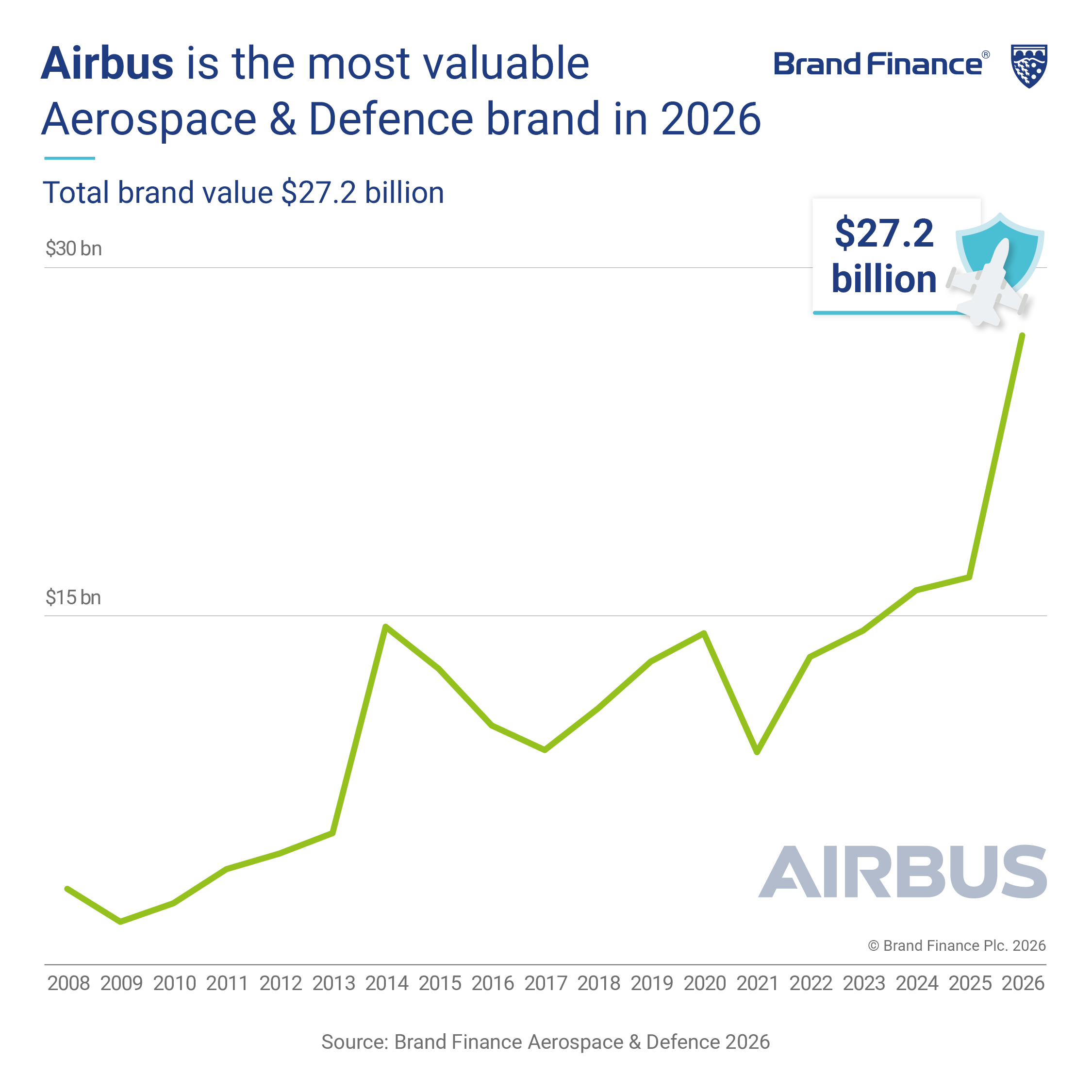
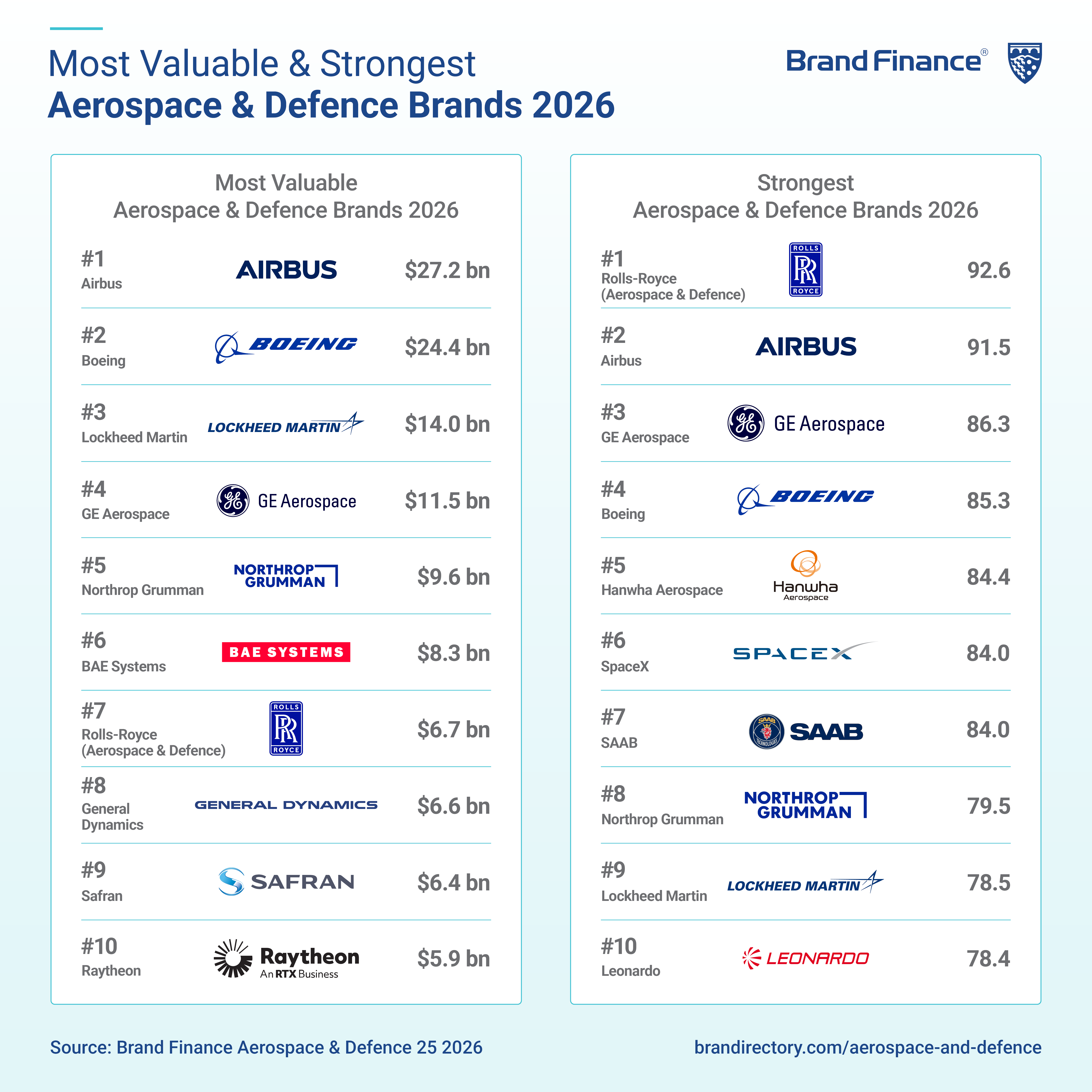
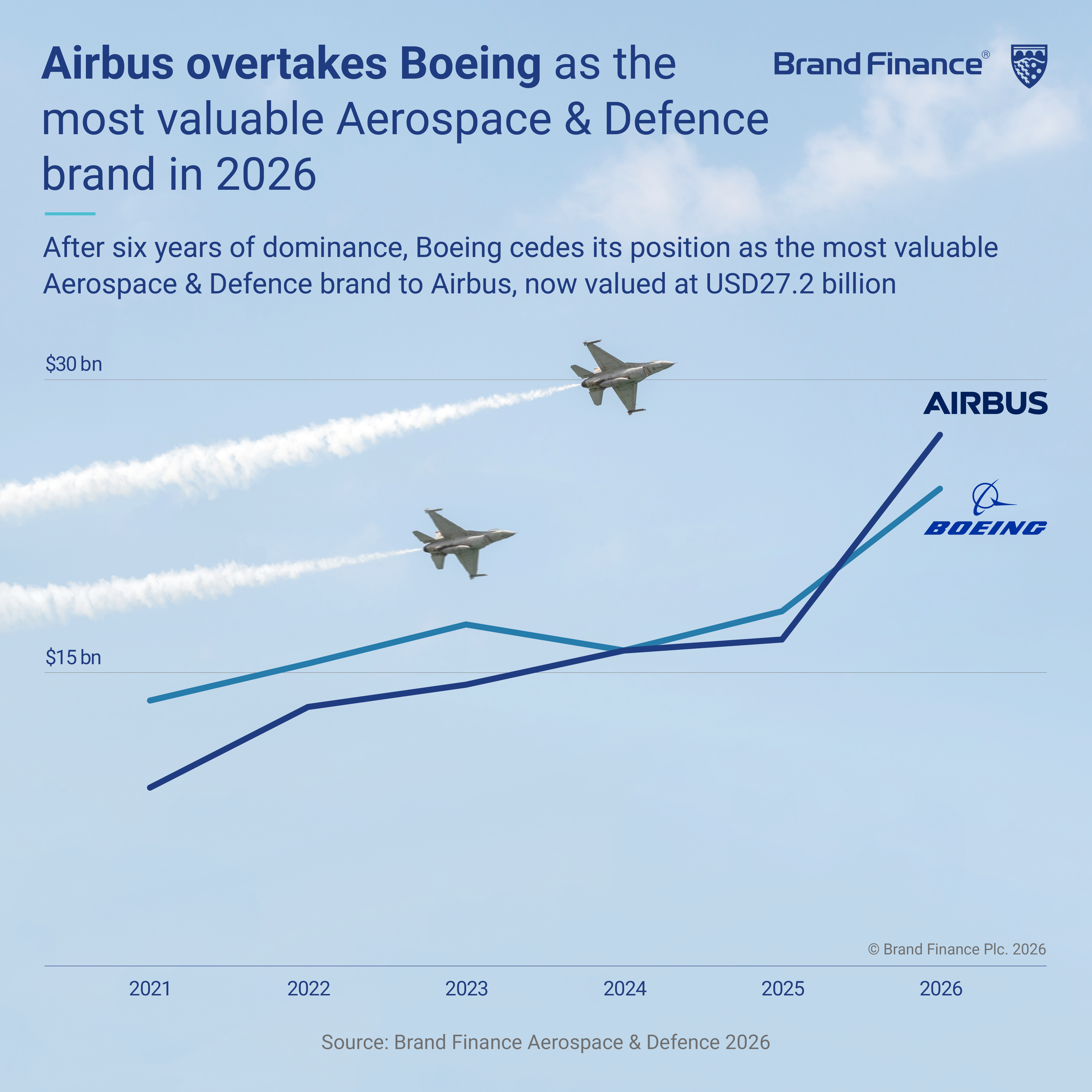
Airbus (brand value up 63% to USD27.2 billion) overtakes Boeing as the world’s most valuable aerospace brand in 2026. Deliveries of over 700 commercial aircraft, particularly the A320neo family, A321XLR, and A350 supported revenue growth and improved profitability. The brand’s balanced portfolio across commercial, defence, and space operations, combined with efficient production platforms and robust order intake from airlines and lessors globally has strengthened both financial performance and market perception. Operational scale, disciplined execution, and focus on fuel-efficient aircraft reinforce Airbus’s long-term strategic relevance.
Boeing (brand value up 34% to USD24.4 billion) slips to second place as it continues a disciplined recovery. The brand benefits from a diversified backlog of over USD500 billion across commercial aircraft, defence, and services, providing multi-year revenue visibility. Defence, Space & Security division returned revenue growth, while strong demand for the 737 MAX and 787 supports commercial performance. Investments in production stability, quality, and supply-chain resilience underpin its growth.
Lockheed Martin (brand value up 27% to USD14 billion) ranks third, supported by strong demand for its core defence programmes amid rising global military spending. Strong momentum across key platforms, including the F-35 and missile systems, drives revenue growth, while a substantial order backlog provides long-term visibility. Expanding international contracts and continued investment in next-generation technologies, such as hypersonics and missile defence, further strengthen the brand’s financial performance.
Hanwha Aerospace (brand value up 118% to USD3.1 billion) is the fastest-growing Aerospace & Defence brand in 2026, supported by strong global demand for advanced defence systems and a rapidly expanding international order book. Growth is driven by exports of K9 howitzers and Chunmoo rocket systems, alongside the consolidation of Hanwha Ocean, which has broadened its defence portfolio. A substantial backlog provides strong revenue visibility, while expansion in maintenance and overhaul capabilities further enhances profitability and market reach.
Savio D’Souza, Global Sector Head of Aerospace & Defence, Brand Finance, commented:
“The 52% surge in sector brand value reflects a structural transformation. Defence budgets have reached record levels globally, and commercial aviation until recently was back in full fleet-renewal mode, creating a rare moment where both engines of this sector are firing simultaneously. What makes 2026 particularly significant is the reshaping of brand leadership: non-US brands are not just growing faster, they are growing stronger, as measured by brand strength. Airbus overtaking Boeing is emblematic of this shift. In a sector where governments and airlines make multi-decade commitments, trust and consistent execution outweigh legacy. The brands that understand this and invest accordingly are the ones redefining the pecking order.”
Rolls-Royce (brand value up 51% to USD6.7 billion) is the strongest brand in the ranking with a Brand Strength Index (BSI) score of 92.6/100, earning an AAA+ rating. Strong operational performance and high-value, long-term defence contracts, including the UK submarine programme, have reinforced the brand’s credibility. Leadership in small modular reactor (SMR) technology and advanced aerospace systems has strengthened perceptions of innovation and future readiness, supporting both reputation and stakeholder trust.
Airbus ranks second with a BSI score of 91.5/100. The brand’s strength is underpinned by sustained leadership in commercial aircraft deliveries and consistent production performance. Strong demand for the A320neo family reinforces perceptions of efficiency and versatility, while operational stability supports stakeholder confidence, cementing Airbus’s reputation as a reliable aerospace brand.
GE Aerospace (brand value up 32% to USD11.4 billion) ranks third strongest with a BSI score of 86.3/100. The brand benefits from broad technical credibility and reliability, reinforced by strong performance across commercial and defence sectors. Record deliveries of LEAP engines and sustained military engine output demonstrate operational consistency and stakeholder confidence. Improved supply‑chain management and robust aftermarket support further strengthen perceptions of reliability and market leadership, underpinning GE Aerospace’s standing as a trusted partner in both civil and defence aviation.




Brand Finance is the world’s leading brand valuation consultancy. Bridging the gap between marketing and finance, Brand Finance evaluates the strength of brands and quantifies their financial value to help organisations make strategic decisions.
Headquartered in London, Brand Finance operates in over 25 countries. Every year, Brand Finance conducts more than 6,000 brand valuations, supported by original market research, and publishes over 100 reports which rank brands across all sectors and countries.
Brand Finance also operates the Global Brand Equity Monitor, conducting original market research annually on 6,000 brands, surveying more than 175,000 respondents across 41 countries and 31 industry sectors. By combining perceptual data from the Global Brand Equity Monitor with data from its valuation database — the largest brand value database in the world — Brand Finance equips ambitious brand leaders with the data, analytics, and the strategic guidance they need to enhance brand and business value.
In addition to calculating brand value, Brand Finance also determines the relative strength of brands through a balanced scorecard of metrics, compliant with ISO 20671.
Brand Finance is a regulated accountancy firm and a committed leader in the standardisation of the brand valuation industry. Brand Finance was the first to be certified by independent auditors as compliant with both ISO 10668 and ISO 20671 and has received the official endorsement of the Marketing Accountability Standards Board (MASB) in the United States.
Brand is defined as a marketing-related intangible asset including, but not limited to, names, terms, signs, symbols, logos, and designs, intended to identify goods, services, or entities, creating distinctive images and associations in the minds of stakeholders, thereby generating economic benefits.
Brand strength is the efficacy of a brand’s performance on intangible measures relative to its competitors. Brand Finance evaluates brand strength in a process compliant with ISO 20671, looking at Marketing Investment, Stakeholder Equity, and the impact of those on Business Performance. The data used is derived from Brand Finance’s proprietary market research programme and from publicly available sources.
Each brand is assigned a Brand Strength Index (BSI) score out of 100, which feeds into the brand value calculation. Based on the score, each brand is assigned a corresponding Brand Rating up to AAA+ in a format similar to a credit rating.
Brand Finance calculates the values of brands in its rankings using the Royalty Relief approach – a brand valuation method compliant with the industry standards set in ISO 10668. It involves estimating the likely future revenues that are attributable to a brand by calculating a royalty rate that would be charged for its use, to arrive at a ‘brand value’ understood as a net economic benefit that a brand owner would achieve by licensing the brand in the open market.
The steps in this process are as follows:
1 Calculate brand strength using a balanced scorecard of metrics assessing Marketing Investment, Stakeholder Equity, and Business Performance. Brand strength is expressed as a Brand Strength Index (BSI) score on a scale of 0 to 100.
2 Determine royalty range for each industry, reflecting the importance of brand to purchasing decisions. In luxury, the maximum percentage is high, while in extractive industry, where goods are often commoditised, it is lower. This is done by reviewing comparable licensing agreements sourced from Brand Finance’s extensive database.
3 Calculate royalty rate. The BSI score is applied to the royalty range to arrive at a royalty rate. For example, if the royalty range in a sector is 0-5% and a brand has a BSI score of 80 out of 100, then an appropriate royalty rate for the use of this brand in the given sector will be 4%.
4 Determine brand-specific revenues by estimating a proportion of parent company revenues attributable to a brand.
5 Determine forecast revenues using a function of historic revenues, equity analyst forecasts, and economic growth rates.
6 Apply the royalty rate to the forecast revenues to derive brand revenues.
7 Discount post-tax brand revenues to a net present value which equals the brand value.
Brand Finance has produced this study with an independent and unbiased analysis. The values derived and opinions presented in this study are based on publicly available information and certain assumptions that Brand Finance used where such data was deficient or unclear. Brand Finance accepts no responsibility and will not be liable in the event that the publicly available information relied upon is subsequently found to be inaccurate. The opinions and financial analysis expressed in the study are not to be construed as providing investment or business advice. Brand Finance does not intend the study to be relied upon for any reason and excludes all liability to any body, government, or organisation.
The data presented in this study form part of Brand Finance's proprietary database, are provided for the benefit of the media, and are not to be used in part or in full for any commercial or technical purpose without written permission from Brand Finance.