Brand Financeデータ:2025年と比較してサステナビリティの影響力が低下している業界は減少、「ESGへの逆風」の限界を示唆
東京、2026年4月8日 — 世界有数のブランド評価コンサルティング会社Brand Financeによるサステナビリティ・パーセプション・インデックス2026によると、Asahi、Toyota、Aupres (オプレ)、ANA、Bridgestoneを含む日本ブランドは、環境、社会、ガバナンスの各柱において強いサステナビリティ認知を示している。
サステナビリティ・パーセプション・インデックス2026は、世界で最も強いサステナビリティへのコミットメントを持つと認識されているブランド、需要を牽引する要因としてのサステナビリティの役割の変化、そして世界最大級のブランドにおいてサステナビリティに結びつく大きな価値を明らかにしている。
Brand Financeのデータによると、消費者の選択を牽引する要因としてのサステナビリティの影響力は、世界の業界全体で安定しつつある。分析対象となった48セクターのうち、2025年から2026年にかけてサステナビリティの影響力が低下したのは24セクターで、前回の38セクターから減少した。
日本のハイライト
日本では、サステナビリティ認知はセクターによって異なり、AsahiとToyotaが環境サステナビリティで、Aupres (オプレ)とANAが社会的インパクトで、ANAとBridgestoneがガバナンスと「よく管理されている」認知で評価されている。
Asahiは、2040年までにバリューチェーン全体で温室効果ガスのネットゼロ排出を目指す「Asahi Carbon Zero」イニシアチブを通じて環境ポジショニングを強化しており、再生可能エネルギーの採用とサーキュラーパッケージングイニシアチブに支えられている。
同様に、Toyotaは、長期的な環境チャレンジ2050フレームワークの下で、電気、水素、低炭素燃料技術への投資を行う脱炭素化へのマルチパスウェイアプローチを通じて、環境サステナビリティを強化している。
社会的側面では、Aupres (オプレ)がサーキュラープロダクトデザイン、サステナブルな調達、ダイバーシティ&インクルージョンの取り組みに注力している一方、ANAはESG原則を事業全体に統合し、安全性、ステークホルダーエンゲージメント、持続可能な調達を重視している。
ガバナンスにおいては、ANAとBridgestoneが構造化されたESGフレームワークと透明性のある管理システムで評価されており、説明責任と長期的なサステナビリティパフォーマンスを強化している。
Brand Finance アジア太平洋地域マネージングディレクターのアレックス・ヘイグ氏は次のようにコメントしている:
「日本では、AsahiやToyotaなどのブランドが、脱炭素化戦略と環境イノベーションがいかにサステナビリティ認知を強化できるかを示しており、Aupres (オプレ)とANAは、インクルーシブな取り組みとステークホルダーエンゲージメントが社会的インパクトを生み出す役割を浮き彫りにしています。同時に、ANAとBridgestoneは、サステナビリティパフォーマンスを強化する上で、構造化されたガバナンスフレームワークと透明性の重要性を強調しています。サステナビリティは依然としてブランド選択を形成する役割を果たしていますが、その世界的な影響は安定しつつあり、以前の年と比較して影響力が低下するセクターが減少しています。」
グローバルのハイライト
Patagonia、Lush、Alnatura、Michelin、Tata Groupは、米国、英国、ドイツ、フランス、インドにおけるサステナビリティ認知のリーダー
Googleが最高のサステナビリティパーセプションバリュー419億米ドルでAppleを抜き、全ブランド中トップに
Appleはサステナビリティについてより明確に伝えることで得られるものが最も大きい:その「サステナビリティギャップバリュー」は26億米ドル
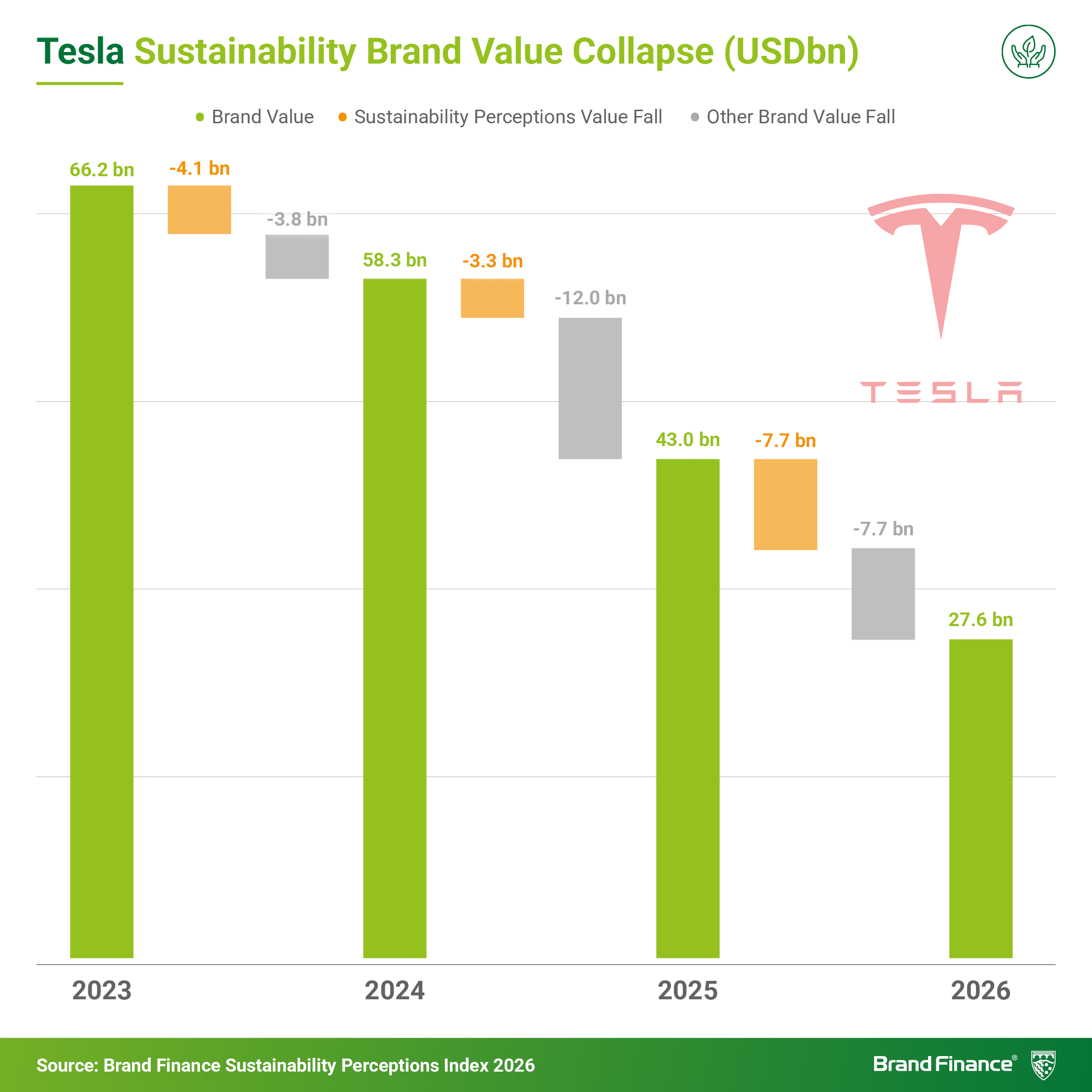
Teslaのグリーン評価は3年連続で低下を続け、サステナビリティ関連ブランド価値77億米ドルを失った





Brand Finance is the world’s leading brand valuation consultancy. Bridging the gap between marketing and finance, Brand Finance evaluates the strength of brands and quantifies their financial value to help organisations make strategic decisions.
Headquartered in London, Brand Finance operates in over 25 countries. Every year, Brand Finance conducts more than 6,000 brand valuations, supported by original market research, and publishes over 100 reports which rank brands across all sectors and countries.
Brand Finance also operates the Global Brand Equity Monitor, conducting original market research annually on 6,000 brands, surveying more than 175,000 respondents across 41 countries and 31 industry sectors. By combining perceptual data from the Global Brand Equity Monitor with data from its valuation database — the largest brand value database in the world — Brand Finance equips ambitious brand leaders with the data, analytics, and the strategic guidance they need to enhance brand and business value.
In addition to calculating brand value, Brand Finance also determines the relative strength of brands through a balanced scorecard of metrics, compliant with ISO 20671.
Brand Finance is a regulated accountancy firm and a committed leader in the standardisation of the brand valuation industry. Brand Finance was the first to be certified by independent auditors as compliant with both ISO 10668 and ISO 20671 and has received the official endorsement of the Marketing Accountability Standards Board (MASB) in the United States.
Brand is defined as a marketing-related intangible asset including, but not limited to, names, terms, signs, symbols, logos, and designs, intended to identify goods, services, or entities, creating distinctive images and associations in the minds of stakeholders, thereby generating economic benefits.
Brand strength is the efficacy of a brand’s performance on intangible measures relative to its competitors. Brand Finance evaluates brand strength in a process compliant with ISO 20671, looking at Marketing Investment, Stakeholder Equity, and the impact of those on Business Performance. The data used is derived from Brand Finance’s proprietary market research programme and from publicly available sources.
Each brand is assigned a Brand Strength Index (BSI) score out of 100, which feeds into the brand value calculation. Based on the score, each brand is assigned a corresponding Brand Rating up to AAA+ in a format similar to a credit rating.
Brand Finance calculates the values of brands in its rankings using the Royalty Relief approach – a brand valuation method compliant with the industry standards set in ISO 10668. It involves estimating the likely future revenues that are attributable to a brand by calculating a royalty rate that would be charged for its use, to arrive at a ‘brand value’ understood as a net economic benefit that a brand owner would achieve by licensing the brand in the open market.
The steps in this process are as follows:
1 Calculate brand strength using a balanced scorecard of metrics assessing Marketing Investment, Stakeholder Equity, and Business Performance. Brand strength is expressed as a Brand Strength Index (BSI) score on a scale of 0 to 100.
2 Determine royalty range for each industry, reflecting the importance of brand to purchasing decisions. In luxury, the maximum percentage is high, while in extractive industry, where goods are often commoditised, it is lower. This is done by reviewing comparable licensing agreements sourced from Brand Finance’s extensive database.
3 Calculate royalty rate. The BSI score is applied to the royalty range to arrive at a royalty rate. For example, if the royalty range in a sector is 0-5% and a brand has a BSI score of 80 out of 100, then an appropriate royalty rate for the use of this brand in the given sector will be 4%.
4 Determine brand-specific revenues by estimating a proportion of parent company revenues attributable to a brand.
5 Determine forecast revenues using a function of historic revenues, equity analyst forecasts, and economic growth rates.
6 Apply the royalty rate to the forecast revenues to derive brand revenues.
7 Discount post-tax brand revenues to a net present value which equals the brand value.
Brand Finance has produced this study with an independent and unbiased analysis. The values derived and opinions presented in this study are based on publicly available information and certain assumptions that Brand Finance used where such data was deficient or unclear. Brand Finance accepts no responsibility and will not be liable in the event that the publicly available information relied upon is subsequently found to be inaccurate. The opinions and financial analysis expressed in the study are not to be construed as providing investment or business advice. Brand Finance does not intend the study to be relied upon for any reason and excludes all liability to any body, government, or organisation.
The data presented in this study form part of Brand Finance's proprietary database, are provided for the benefit of the media, and are not to be used in part or in full for any commercial or technical purpose without written permission from Brand Finance.