






Neue Daten von Brand Finance zeigen die 500 wertvollsten und stärksten Marken der Welt im Jahr 2026
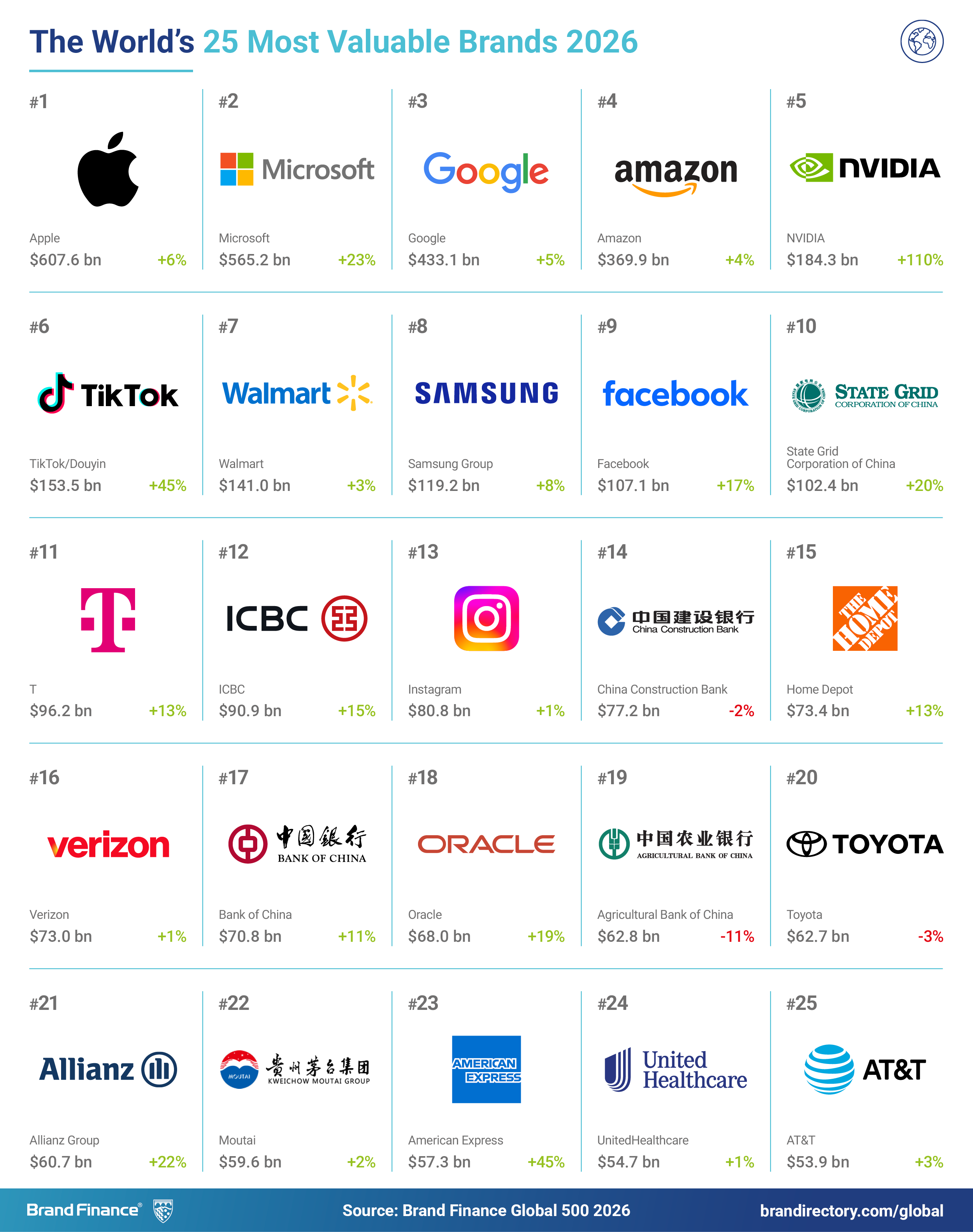
LONDON, 20 January 2026 – Deutsche Telekom ist erneut die wertvollste Telekommunikationsmarke weltweit, rangiert auf Platz 11 der wertvollsten Marken der Welt und ist als einzige europäische Marke unter den globalen Top 20 vertreten, laut einem neuen Bericht von Brand Finance.
Die Forschung von Brand Finance zeigt, dass das Wachstum der Deutschen Telekom von der konsequenten Umsetzung der Masterbrand-Strategie und der fortschreitenden Marktintegration getragen wird – gestärkt durch anhaltenden Rückenwind in den USA, einschließlich der Akquisitionen im Mobilfunk- und Glasfaserbereich, sowie in den europäischen Märkten.
T übertrifft globale Wettbewerber weiterhin bei den zentralen Treibern der Consideration, darunter Vertrauen, Kundenerlebnis, Netzabdeckung und Preis-Leistungs-Verhältnis. Die Marke führt bei den meisten Kennzahlen in Deutschland und Europa; in den USA hebt sie sich durch marktführenden Kundenservice, starke Wertwahrnehmung, hohes Vertrauen und wettbewerbsfähige Netzperformance ab. Die konsistente internationale Markenpräsenz stärkt zudem die Wahrnehmung des Unternehmens als globaler Player. Die kontinuierliche Integration der Dachmarke in Griechenland hat die internationale Präsenz erweitert und sich ebenfalls positiv auf den Markenwert ausgewirkt. Diese Ergebnisse spiegeln die erfolgreiche Umsetzung der Markenstrategie der Telekom und ihrer Kernpfeiler wider.
Allianz Group ist in der Global-500-Rangliste auf Platz 21 gestiegen und hat ihren Markenwert um 22% auf USD 60,7 Mrd. erhöht. Mercedes-Benz und BMW sind auf die Plätze 36 und 41 zurückgefallen – ein Spiegel der anhaltenden Herausforderungen in der Automobilbranche, darunter eine schwächere globale Nachfrage, zunehmender Wettbewerb und die Komplexität des Übergangs zu elektrischer und softwaregetriebener Mobilität.
Cristobal Pohle Vazquez, Regional Lead DACH, Brand Finance, kommentiert:
„Insgesamt behaupten sich deutsche Marken weiterhin stark auf der globalen Bühne und leisten – nach den USA und China – den drittgrößten Beitrag zur Global-500-Rangliste. Die stabile Performance Deutschlands wird von T angeführt, der einzigen europäischen Marke in den globalen Top 20. Die Ergebnisse in anderen Branchen sind gemischt: Führende Automobilmarken verzeichneten Rückgänge beim Markenwert, während der Softwarekonzern SAP erstmals in die Top 50 eingezogen ist. Gleichzeitig zeigten Versicherungsmarken ein starkes Wachstum – angeführt von der Allianz Group und Munich Re; zudem feiert Hannover Re sein Debüt in der Global 500.“
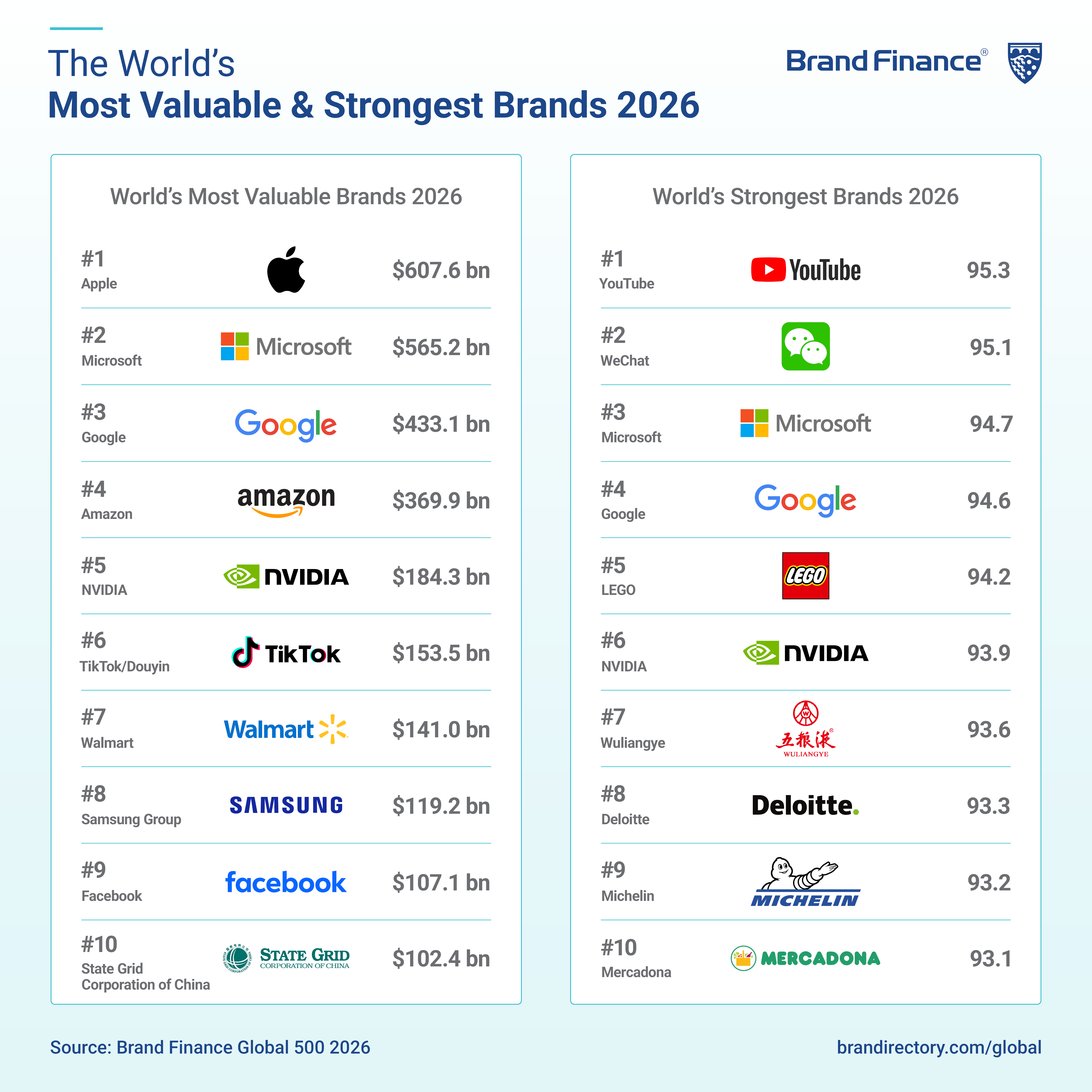
Apple verteidigt seine Position als wertvollste Marke der Welt und steigert den Markenwert um 6% auf USD 607,6 Mrd. Dahinter ist Microsoft die zweitwertvollste Marke der Welt – der Markenwert wächst um 23% und überschreitet 2026 USD 565,2 Mrd. Google (plus 5% auf USD 433,1 Mrd.) und Amazon (plus 4% auf USD 369,9 Mrd.) behaupten die Plätze drei und vier und unterstreichen die anhaltende Dominanz führender US-Technologiemarken.
YouTube ist nun die stärkste Marke der Welt – mit einem Brand Strength Index (BSI) von 95,3/100, nach Platz acht im Jahr 2025.




Brand Finance is the world’s leading brand valuation consultancy. Bridging the gap between marketing and finance, Brand Finance evaluates the strength of brands and quantifies their financial value to help organisations make strategic decisions.
Headquartered in London, Brand Finance operates in over 25 countries. Every year, Brand Finance conducts more than 6,000 brand valuations, supported by original market research, and publishes over 100 reports which rank brands across all sectors and countries.
Brand Finance also operates the Global Brand Equity Monitor, conducting original market research annually on 6,000 brands, surveying more than 175,000 respondents across 41 countries and 31 industry sectors. By combining perceptual data from the Global Brand Equity Monitor with data from its valuation database — the largest brand value database in the world — Brand Finance equips ambitious brand leaders with the data, analytics, and the strategic guidance they need to enhance brand and business value.
In addition to calculating brand value, Brand Finance also determines the relative strength of brands through a balanced scorecard of metrics, compliant with ISO 20671.
Brand Finance is a regulated accountancy firm and a committed leader in the standardisation of the brand valuation industry. Brand Finance was the first to be certified by independent auditors as compliant with both ISO 10668 and ISO 20671 and has received the official endorsement of the Marketing Accountability Standards Board (MASB) in the United States.
Brand is defined as a marketing-related intangible asset including, but not limited to, names, terms, signs, symbols, logos, and designs, intended to identify goods, services, or entities, creating distinctive images and associations in the minds of stakeholders, thereby generating economic benefits.
Brand strength is the efficacy of a brand’s performance on intangible measures relative to its competitors. Brand Finance evaluates brand strength in a process compliant with ISO 20671, looking at Marketing Investment, Stakeholder Equity, and the impact of those on Business Performance. The data used is derived from Brand Finance’s proprietary market research programme and from publicly available sources.
Each brand is assigned a Brand Strength Index (BSI) score out of 100, which feeds into the brand value calculation. Based on the score, each brand is assigned a corresponding Brand Rating up to AAA+ in a format similar to a credit rating.
Brand Finance calculates the values of brands in its rankings using the Royalty Relief approach – a brand valuation method compliant with the industry standards set in ISO 10668. It involves estimating the likely future revenues that are attributable to a brand by calculating a royalty rate that would be charged for its use, to arrive at a ‘brand value’ understood as a net economic benefit that a brand owner would achieve by licensing the brand in the open market.
The steps in this process are as follows:
1 Calculate brand strength using a balanced scorecard of metrics assessing Marketing Investment, Stakeholder Equity, and Business Performance. Brand strength is expressed as a Brand Strength Index (BSI) score on a scale of 0 to 100.
2 Determine royalty range for each industry, reflecting the importance of brand to purchasing decisions. In luxury, the maximum percentage is high, while in extractive industry, where goods are often commoditised, it is lower. This is done by reviewing comparable licensing agreements sourced from Brand Finance’s extensive database.
3 Calculate royalty rate. The BSI score is applied to the royalty range to arrive at a royalty rate. For example, if the royalty range in a sector is 0-5% and a brand has a BSI score of 80 out of 100, then an appropriate royalty rate for the use of this brand in the given sector will be 4%.
4 Determine brand-specific revenues by estimating a proportion of parent company revenues attributable to a brand.
5 Determine forecast revenues using a function of historic revenues, equity analyst forecasts, and economic growth rates.
6 Apply the royalty rate to the forecast revenues to derive brand revenues.
7 Discount post-tax brand revenues to a net present value which equals the brand value.
Brand Finance has produced this study with an independent and unbiased analysis. The values derived and opinions presented in this study are based on publicly available information and certain assumptions that Brand Finance used where such data was deficient or unclear. Brand Finance accepts no responsibility and will not be liable in the event that the publicly available information relied upon is subsequently found to be inaccurate. The opinions and financial analysis expressed in the study are not to be construed as providing investment or business advice. Brand Finance does not intend the study to be relied upon for any reason and excludes all liability to any body, government, or organisation.
The data presented in this study form part of Brand Finance's proprietary database, are provided for the benefit of the media, and are not to be used in part or in full for any commercial or technical purpose without written permission from Brand Finance.