





New Brand Finance data reveals top 50 global engineering brands’ collective value drops 2% to $360.6 billion
LONDON, 27 January 2026 – The collective value of the top 50 global engineering brands dropped 2% from USD366.9 billion in 2025 to USD360.6 billion in 2026 amidst on-going economic uncertainty. According to a new report from Brand Finance, the world's leading brand valuation consultancy, both Chinese and American engineering brands held a 30% value representation in the rankings respectively.
This year, China’s engineering sector took a slight (5%) downturn as the real estate and construction market slowed down, while 13 brands from the US remained steadfast as the need for datacentres and AI-driven power demand resulted in steady overall growth.
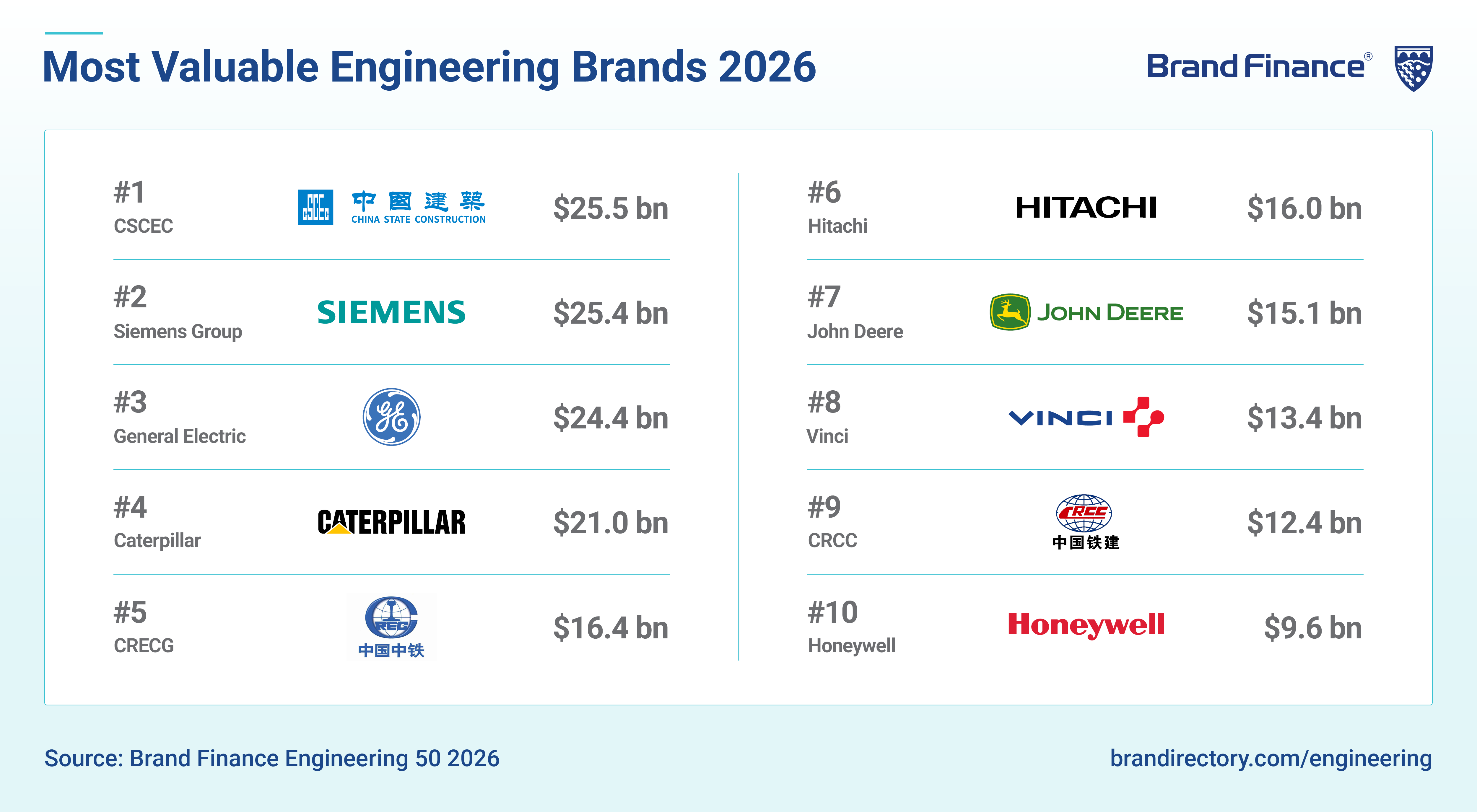
Albeit funding constraints and market headwinds impacting China’s engineering sector, CSCEC maintained its top spot as the industry’s most valuable brand despite a 10% drop in value to USD25.5 billion in 2026. The housing construction brand experienced a decrease in new contracts from its primary segment but an expansion in industrial processing and manufacturing facilities construction contracts, offsetting the decline in its niche market and underscoring the brands resilience amidst a volatile ecosystem.
Siemens Group (brand value down 2% to USD25.4 billion), a German conglomerate, maintained its second position in the ranking. Factors impacting its performance stemmed internally with the deconsolidation of Siemens Healthineers and the removal of non-core businesses.
General Electric records a double win this year, placed as the third most valuable brand with an increase of 23% to USD24.4 billion and emerging as the sector’s fastest growing brand. The conglomerate's growth was driven by its spinoffs such as GE Healthcare, GE Aerospace, and, most notably, GE Verona which had its orders increase by 55% due to massive grid investments in North America, Europe, and the Middle East. The brand’s decision to restructure with the spinoffs resulted in a more simplified business and allowed investors to value each part on its own fundamentals.
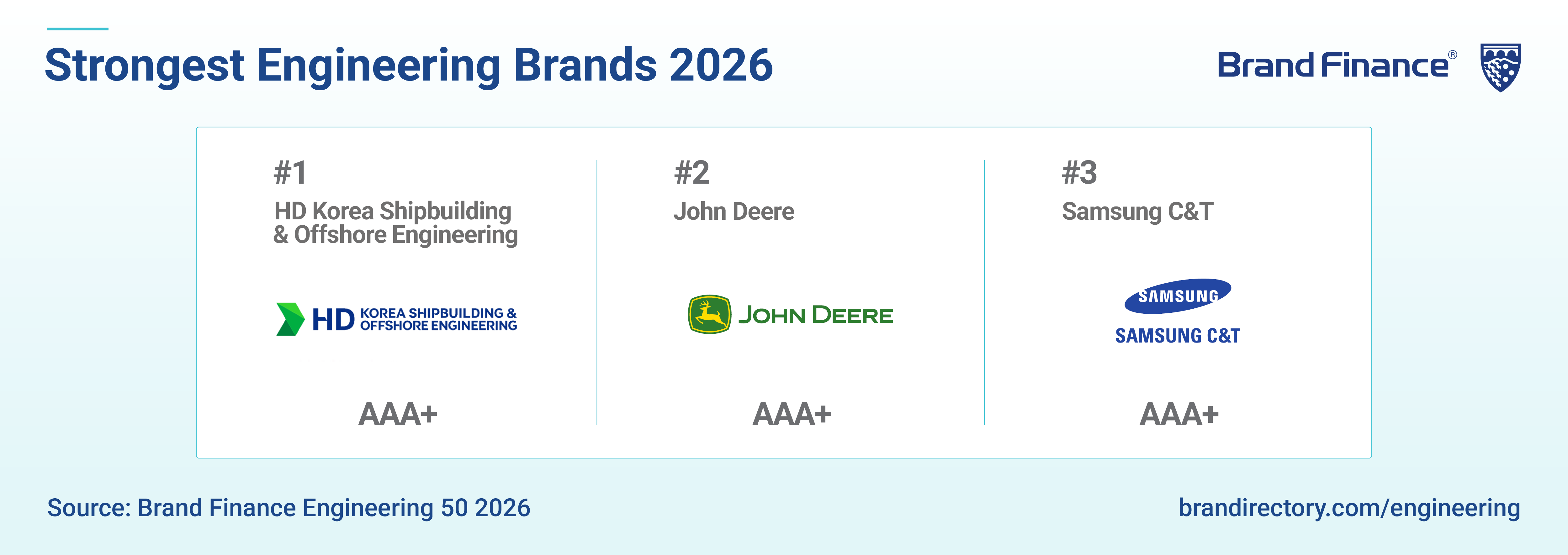
The US’ John Deere (brand value up 12% to USD15.1 billion) received Brand Finance’s highest brand strength rating of AAA+ this year. The agricultural machinery specialist committed to ambitious environmental targets which included the delivery of electric and hybrid-electric products while ensuring 95% recyclable product content by 2030. Its efforts improved environmental contributions and reputation among sustainability-conscious stakeholders.
Chenlin Tong, Associate Director, Brand Finance, commented:
“The engineering sector is going through an evolution driven by demand for future-ready solutions as opposed to legacy markets. Investments and diversification into electrification, AI-enabled infrastructure, and sustainable solutions are widening the gap between the brands that endure volatile ecosystems from those that thrive within it.”
The global engineering sector showed a downward trend caused by slowed activity throughout the year, particularly in rate-sensitive real estate segments. However, some end-markets, most notably, infrastructure, utilities, energy, and AI-related facilities demonstrated relative resilience. This downturn impacted European brands the most, resulting in a 6% drop in collective value when compared to 2025 while Asia Pacific brands showed more resilience with only a 1% dip.
Europe was represented by 12 brands this year with Germany’s sole brand, Siemens Group, leading as the region’s most valuable brand. Following suit was France’s Vinci (brand value up 9% to USD13.4 billion) and Bouygues (brand value at USD7.9 billion) which held steady despite a construction volume decline in the country. The solid growth of infrastructure concessions Vinci managed lent to the brand’s performance this year with passenger numbers increasing at airports and traffic levels rising on motorways, both in France and abroad.
Brands from the Asia Pacific region constitute about half of the rankings (25 brands). China’s CSCEC and CREGG (brand value down 10% to USD16.4 billion),held the region’s first and second spot despite both experiencing a brand value decline caused by the aforementioned market declines. Hitachi (brand value up 10% to USD16 billion) came in third regionally after a one spot climb in the global rankings, driven by strong momentum primarily in the Japanese IT business and continued strength in the power grids business which was fuelled by robust demand for transmission upgrades and renewable energy connections.
Japanese brands demonstrated resilience this year through a 9% increase of their collective brand value to USD47.8 billion, representing 13% of the industry’s total, despite a sector-wide downtrend. A highlight of this achievement was Taisei’s (brand value up 6% to USD2.2 billion) entry into the ranking at 49th after a strong performance of its domestic subsidiaries and large-scale civil engineering projects. In addition, Komatsu’s (brand value up 18% to USD3.1 billion) innovation within its product line alongside rising demands in Southeast Asia drove the brand to become the fastest growing engineering brand in the Asia Pacific region.
General Electric led the charge of 13 American brands that made the 2026 sector ranking with Caterpillar (brand value up 14% to USD21 billion) following in second, and John Deere (brand value up 12% to USD15.1 billion) in third. Caterpillar’s performance was driven by robust power generation sales driven by datacentre demand. The American construction and mining equipment manufacturer had also recently acquired RPMGlobal, an Australian mining software firm, which would be capable of advancing its autonomous equipment and creating better product offerings and revenue streams.
Amid the broader decline in China’s engineering sector, notably CNBM (brand up 1% to USD9.2 billion) climbed one place to 11th in the rankings. This was driven by its active response to the Belt and Road Initiative through global expansions, cross-border collaboration, and the integration of sustainable, low-emission production practices that strengthened both brand value and reputation.
Other brands featured in the Engineering 50 2026 rankings are:




Brand Finance is the world’s leading brand valuation consultancy. Bridging the gap between marketing and finance, Brand Finance evaluates the strength of brands and quantifies their financial value to help organisations make strategic decisions.
Headquartered in London, Brand Finance operates in over 25 countries. Every year, Brand Finance conducts more than 6,000 brand valuations, supported by original market research, and publishes over 100 reports which rank brands across all sectors and countries.
Brand Finance also operates the Global Brand Equity Monitor, conducting original market research annually on 6,000 brands, surveying more than 175,000 respondents across 41 countries and 31 industry sectors. By combining perceptual data from the Global Brand Equity Monitor with data from its valuation database — the largest brand value database in the world — Brand Finance equips ambitious brand leaders with the data, analytics, and the strategic guidance they need to enhance brand and business value.
In addition to calculating brand value, Brand Finance also determines the relative strength of brands through a balanced scorecard of metrics, compliant with ISO 20671.
Brand Finance is a regulated accountancy firm and a committed leader in the standardisation of the brand valuation industry. Brand Finance was the first to be certified by independent auditors as compliant with both ISO 10668 and ISO 20671 and has received the official endorsement of the Marketing Accountability Standards Board (MASB) in the United States.
Brand is defined as a marketing-related intangible asset including, but not limited to, names, terms, signs, symbols, logos, and designs, intended to identify goods, services, or entities, creating distinctive images and associations in the minds of stakeholders, thereby generating economic benefits.
Brand strength is the efficacy of a brand’s performance on intangible measures relative to its competitors. Brand Finance evaluates brand strength in a process compliant with ISO 20671, looking at Marketing Investment, Stakeholder Equity, and the impact of those on Business Performance. The data used is derived from Brand Finance’s proprietary market research programme and from publicly available sources.
Each brand is assigned a Brand Strength Index (BSI) score out of 100, which feeds into the brand value calculation. Based on the score, each brand is assigned a corresponding Brand Rating up to AAA+ in a format similar to a credit rating.
Brand Finance calculates the values of brands in its rankings using the Royalty Relief approach – a brand valuation method compliant with the industry standards set in ISO 10668. It involves estimating the likely future revenues that are attributable to a brand by calculating a royalty rate that would be charged for its use, to arrive at a ‘brand value’ understood as a net economic benefit that a brand owner would achieve by licensing the brand in the open market.
The steps in this process are as follows:
1 Calculate brand strength using a balanced scorecard of metrics assessing Marketing Investment, Stakeholder Equity, and Business Performance. Brand strength is expressed as a Brand Strength Index (BSI) score on a scale of 0 to 100.
2 Determine royalty range for each industry, reflecting the importance of brand to purchasing decisions. In luxury, the maximum percentage is high, while in extractive industry, where goods are often commoditised, it is lower. This is done by reviewing comparable licensing agreements sourced from Brand Finance’s extensive database.
3 Calculate royalty rate. The BSI score is applied to the royalty range to arrive at a royalty rate. For example, if the royalty range in a sector is 0-5% and a brand has a BSI score of 80 out of 100, then an appropriate royalty rate for the use of this brand in the given sector will be 4%.
4 Determine brand-specific revenues by estimating a proportion of parent company revenues attributable to a brand.
5 Determine forecast revenues using a function of historic revenues, equity analyst forecasts, and economic growth rates.
6 Apply the royalty rate to the forecast revenues to derive brand revenues.
7 Discount post-tax brand revenues to a net present value which equals the brand value.
Brand Finance has produced this study with an independent and unbiased analysis. The values derived and opinions presented in this study are based on publicly available information and certain assumptions that Brand Finance used where such data was deficient or unclear. Brand Finance accepts no responsibility and will not be liable in the event that the publicly available information relied upon is subsequently found to be inaccurate. The opinions and financial analysis expressed in the study are not to be construed as providing investment or business advice. Brand Finance does not intend the study to be relied upon for any reason and excludes all liability to any body, government, or organisation.
The data presented in this study form part of Brand Finance's proprietary database, are provided for the benefit of the media, and are not to be used in part or in full for any commercial or technical purpose without written permission from Brand Finance.