





The Brand Finance Canada 100 2026 report reveals the nation’s top 100 brands have collectively grown by 16% in value
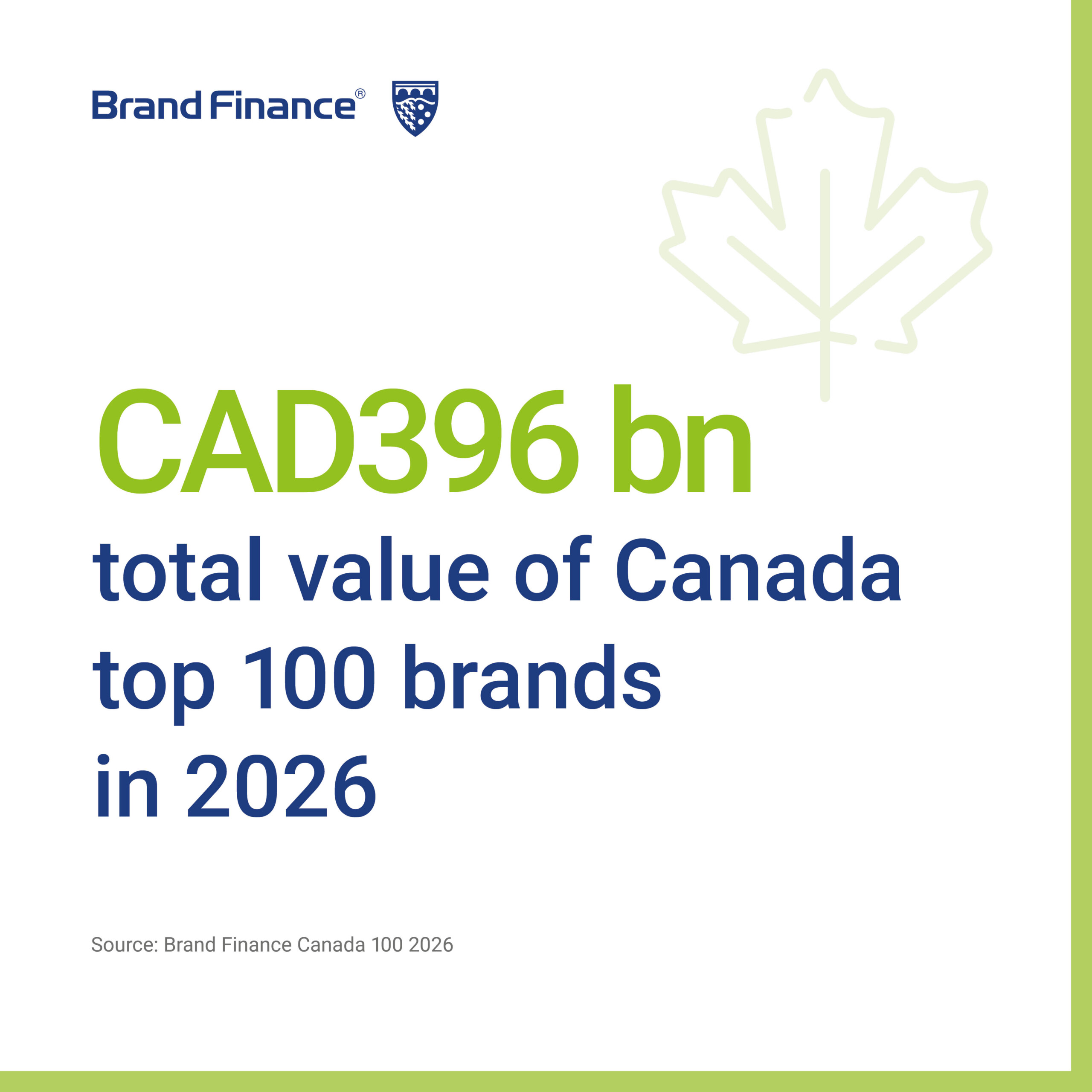
VANCOUVER, 23 April 2026 – Canada’s leading brands have demonstrated strong and broad-based growth in 2026, with the total value of the country’s top 100 brands rising to CAD396 billion, up 16% year-on-year, according to a new report from Brand Finance, the world's leading brand valuation consultancy.
This performance reflects a resilient economic backdrop, supported by steady domestic demand, easing inflation, and a stabilizing interest rate environment. Growth is increasingly diversified, with 14 of 20 sectors recording gains, signaling a gradual shift away from reliance on banking alone.
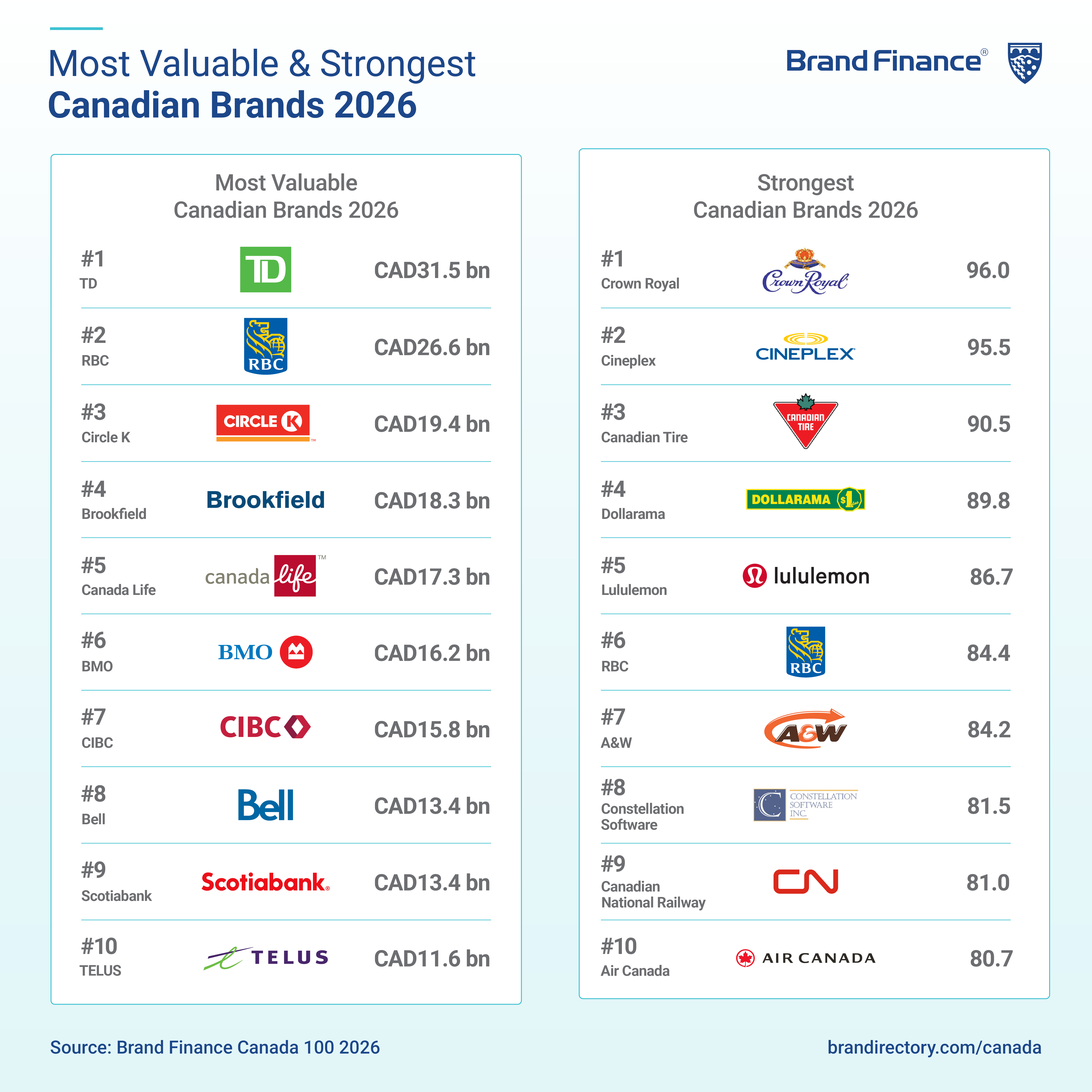
The country’s five most valuable brands remain unchanged from 2025, all recording growth in brand value and underscoring the stability and scale of Canada’s largest corporate players. TD retains its position as the nation’s most valuable brand, up 35% to CAD31.5 billion, driven by growth in lending, deposits, and insurance.
TD’s continued leadership is underpinned by consistently strong brand fundamentals. Brand Finance research in Canada shows that TD continues to score best-in-class for Understanding, a key driver of brand strength. The nation's most valuable banking brand further scores top marks for its digital banking capabilities, perceived to have ‘excellent online or mobile banking’, being ‘widely available’ and ‘keeping customers’ data completely secure’.
Beyond these metrics, TD’s continued investment in digital capabilities, customer experience, and its North American banking platform reinforces its scale and relevance. This consistent, customer-focused approach continues to support TD’s leadership position in Canada’s banking sector.
RBC follows in second, rising 19% to CAD26.6 billion, supported by broad-based revenue growth and the integration of HSBC Bank Canada. Circle K ranks third, up 13% to CAD19.4 billion, benefiting from international expansion and investment in EV infrastructure.
Momentum beyond traditional banking leaders is evident further down the ranking. Bell’s brand value grew 48% to CAD13.4 billion, while CIBC rose 32% to CAD15.8 billion, reflecting strong performances despite shifting customer perceptions and competitive pressures.
Intact emerged as the fastest-growing Canadian brand, more than doubling its value from 2025 to CAD6 billion this year, driven by underwriting strength, higher premium rates, and sustained demand for insurance amid rising climate-related risks. The brand continues to benefit from its acquisition of RSA Insurance Group, strengthening its international footprint, while investments in digital claims processing and customer experience reinforce efficiency and consumer confidence.
Crown Royal remains Canada’s strongest brand, achieving a Brand Strength Index (BSI) score of 96/100 and an AAA+ rating, the highest accolade for brand strength awarded by Brand Finance. Its strength is underpinned by credibility, price acceptance, and product innovation, including expansion into ready-to-drink formats that enhance relevance among younger consumers. Cineplex and Canadian Tire follow as the second and third strongest brands, with BSI scores of 95.5/100 and 90.5/100 respectively, both benefiting from strong familiarity, customer engagement, and strategic transformation initiatives.
Dollarama has emerged as a brand to watch, with its brand value rising 57% to CAD3.6 billion and ranking as the fourth strongest Canadian brand. Its growth reflects a structural shift in consumer expectations, where value has become an enduring priority. Expansion of private-label offerings, pricing flexibility, and store growth across Canada and Latin America have reinforced its position as a leading value retailer.
Alfred DuPuy, Managing Director, Brand Finance North America, commented:
“Canada’s brand landscape in 2026 reflects both stability and evolution. While the country’s largest brands continue to anchor value creation, growth is becoming more diversified across sectors, from utilities to retail and insurance. What stands out is how closely brand performance aligns with structural shifts in the economy and consumer behaviour. Value-driven consumption, energy transition, and digital infrastructure are no longer emerging themes; they are now central to how Canadian brands build strength and sustain growth.”
While banking remains Canada’s largest contributor to overall brand value, its relative dominance is easing as other sectors accelerate. Insurance, telecoms, utilities, and retail all recorded strong growth, supported by structural tailwinds including infrastructure investment, digital transformation, and shifting consumer demand.
Utilities emerged as the fastest-growing sector, driven by energy transition policies, while telecoms benefitted from continued investment in 5G and bundled services. Retail performance highlighted divergence between value-driven and premium segments, reflecting evolving consumer priorities.
The Sustainability Perceptions Index 2026 further highlights how Canadian brands are aligning ESG with tangible community and environmental impact. Hospitality giant, Four Seasons Hotels and Resorts leads ESG perceptions. On the social front, Emera is perceived positively, investing in resilience, affordability, and community‑focused renewable projects. Canadian Tire is perceived as having strong environmental commitments, supported by circular-economy work, repurposing used tires, and announced climate-resiliency measures. Utilities brands including Hydro-Québec and BC Hydro also have high perceptions scores for environmental commitments, recognized for their role in decarbonization and infrastructure development. Fairmont leads in governance perceptions, having achieved widespread eco-certification across its portfolio by 2025 while advancing zero-carbon retrofits and waste-reduction strategies under Accor’s “Eat, Stay, Explore” pillars. Across sectors, sustainability leadership is closely tied to local relevance, from renewable energy investment to community-focused initiatives, reinforcing trust and long-term brand equity.




Brand Finance is the world’s leading brand valuation consultancy. Bridging the gap between marketing and finance, Brand Finance evaluates the strength of brands and quantifies their financial value to help organisations make strategic decisions.
Headquartered in London, Brand Finance operates in over 25 countries. Every year, Brand Finance conducts more than 6,000 brand valuations, supported by original market research, and publishes over 100 reports which rank brands across all sectors and countries.
Brand Finance also operates the Global Brand Equity Monitor, conducting original market research annually on 6,000 brands, surveying more than 175,000 respondents across 41 countries and 31 industry sectors. By combining perceptual data from the Global Brand Equity Monitor with data from its valuation database — the largest brand value database in the world — Brand Finance equips ambitious brand leaders with the data, analytics, and the strategic guidance they need to enhance brand and business value.
In addition to calculating brand value, Brand Finance also determines the relative strength of brands through a balanced scorecard of metrics, compliant with ISO 20671.
Brand Finance is a regulated accountancy firm and a committed leader in the standardisation of the brand valuation industry. Brand Finance was the first to be certified by independent auditors as compliant with both ISO 10668 and ISO 20671 and has received the official endorsement of the Marketing Accountability Standards Board (MASB) in the United States.
Brand is defined as a marketing-related intangible asset including, but not limited to, names, terms, signs, symbols, logos, and designs, intended to identify goods, services, or entities, creating distinctive images and associations in the minds of stakeholders, thereby generating economic benefits.
Brand strength is the efficacy of a brand’s performance on intangible measures relative to its competitors. Brand Finance evaluates brand strength in a process compliant with ISO 20671, looking at Marketing Investment, Stakeholder Equity, and the impact of those on Business Performance. The data used is derived from Brand Finance’s proprietary market research programme and from publicly available sources.
Each brand is assigned a Brand Strength Index (BSI) score out of 100, which feeds into the brand value calculation. Based on the score, each brand is assigned a corresponding Brand Rating up to AAA+ in a format similar to a credit rating.
Brand Finance calculates the values of brands in its rankings using the Royalty Relief approach – a brand valuation method compliant with the industry standards set in ISO 10668. It involves estimating the likely future revenues that are attributable to a brand by calculating a royalty rate that would be charged for its use, to arrive at a ‘brand value’ understood as a net economic benefit that a brand owner would achieve by licensing the brand in the open market.
The steps in this process are as follows:
1 Calculate brand strength using a balanced scorecard of metrics assessing Marketing Investment, Stakeholder Equity, and Business Performance. Brand strength is expressed as a Brand Strength Index (BSI) score on a scale of 0 to 100.
2 Determine royalty range for each industry, reflecting the importance of brand to purchasing decisions. In luxury, the maximum percentage is high, while in extractive industry, where goods are often commoditised, it is lower. This is done by reviewing comparable licensing agreements sourced from Brand Finance’s extensive database.
3 Calculate royalty rate. The BSI score is applied to the royalty range to arrive at a royalty rate. For example, if the royalty range in a sector is 0-5% and a brand has a BSI score of 80 out of 100, then an appropriate royalty rate for the use of this brand in the given sector will be 4%.
4 Determine brand-specific revenues by estimating a proportion of parent company revenues attributable to a brand.
5 Determine forecast revenues using a function of historic revenues, equity analyst forecasts, and economic growth rates.
6 Apply the royalty rate to the forecast revenues to derive brand revenues.
7 Discount post-tax brand revenues to a net present value which equals the brand value.
Brand Finance has produced this study with an independent and unbiased analysis. The values derived and opinions presented in this study are based on publicly available information and certain assumptions that Brand Finance used where such data was deficient or unclear. Brand Finance accepts no responsibility and will not be liable in the event that the publicly available information relied upon is subsequently found to be inaccurate. The opinions and financial analysis expressed in the study are not to be construed as providing investment or business advice. Brand Finance does not intend the study to be relied upon for any reason and excludes all liability to any body, government, or organisation.
The data presented in this study form part of Brand Finance's proprietary database, are provided for the benefit of the media, and are not to be used in part or in full for any commercial or technical purpose without written permission from Brand Finance.