





MADRID, 5 febrero 2026 - Los hospitales universitarios son cada vez más importantes para la economía intangible mundial. Según datos de Brand Finance, el valor total global de la propiedad intelectual y los intangibles en manos de empresas sanitarias que cotizan en bolsa ha alcanzado los 10 billones de dólares, lo que representa el 84% del valor total del negocio.
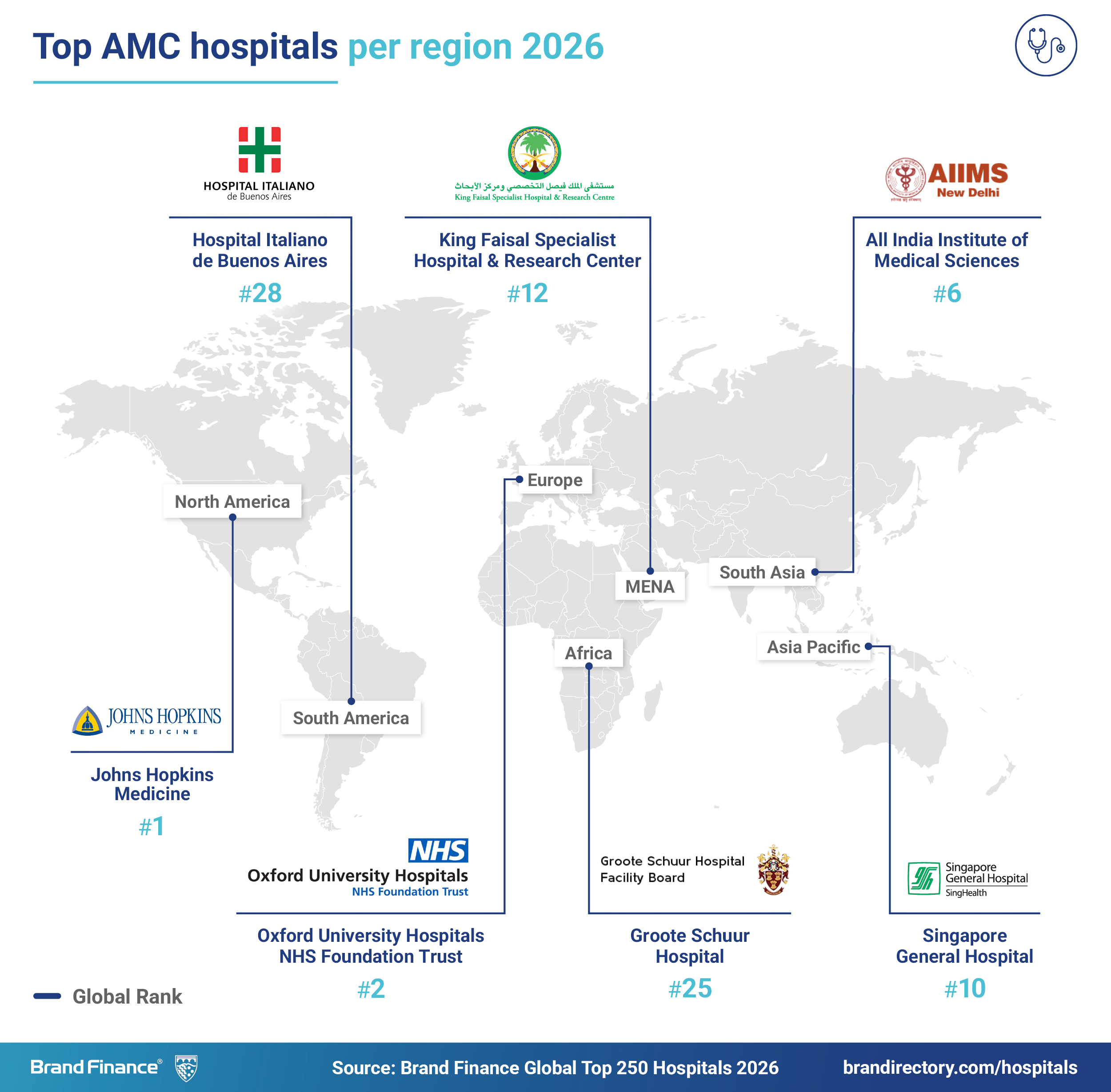
En este contexto, los profesionales sanitarios perciben a Johns Hopkins Medicine en USA y a Oxford University Hospitals NHS Foundation Trust en Reino Unido como las marcas hospitalarias más fuertes a nivel mundial por segundo año consecutivo, según un nuevo informe de Brand Finance, consultora líder mundial en valoración de marcas. El estudio de Brand Finance muestra que Johns Hopkins lidera la clasificación gracias a su excepcional rendimiento en el embudo de conversión de marca, que combina conocimiento, familiaridad, consideración y recomendación, así como una sólida percepción en métricas clave de atención al paciente. Además, alcanza la mejor puntuación entre las 500 marcas analizadas por ofrecer a los pacientes acceso a los ensayos clínicos más recientes, lo que refuerza su reputación entre los profesionales sanitarios en cuanto a excelencia en investigación e innovación.
Pilar Alonso Ulloa, Managing Director de Iberia (España y Portugal) y Sudamérica comentó:
“El análisis estadístico realizado a partir de las encuestas a 2.500 profesionales sanitarios en 30 países, muestra que las métricas más importantes para impulsar la reputación en el sector sanitario son: “tener reconocimiento internacional y las acreditaciones pertinentes”, “ofrecer los mejores resultados para los pacientes” y “la atención especializada”. Si bien la IA está recibiendo cada vez más atención e inversión, el atributo “utilizar y aplicar inteligencia artificial” se sitúa en la mitad inferior de los factores de reputación a nivel mundial y ha perdido importancia relativa durante el último año”.
Hay 10 hospitales universitarios españoles dentro del Top 250 mundial, entre los que obtienen mayor puntuación el Hospital Clínic de Barcelona, el Hospital Universitari Vall d'Hebron, el Hospital Universitario La Paz, el Hospital General Universitario Gregorio Marañón y el Hospital Universitario 12 de Octubre.
El hospital universitario español que más posiciones escala en el ranking es el Hospital Universitario Fundación Jiménez Díaz y el que más cae en posiciones es el Hospital Universitario Virgen del Rocío.
En Sudamérica, el Hospital Italiano de Buenos Aires en Argentina ha subido ocho posiciones en el ranking hasta el puesto 28 a nivel mundial para convertirse en la marca más prestigiosa en América del Sur.




Brand Finance is the world’s leading brand valuation consultancy. Bridging the gap between marketing and finance, Brand Finance evaluates the strength of brands and quantifies their financial value to help organisations make strategic decisions.
Headquartered in London, Brand Finance operates in over 25 countries. Every year, Brand Finance conducts more than 6,000 brand valuations, supported by original market research, and publishes over 100 reports which rank brands across all sectors and countries.
Brand Finance also operates the Global Brand Equity Monitor, conducting original market research annually on 6,000 brands, surveying more than 175,000 respondents across 41 countries and 31 industry sectors. By combining perceptual data from the Global Brand Equity Monitor with data from its valuation database — the largest brand value database in the world — Brand Finance equips ambitious brand leaders with the data, analytics, and the strategic guidance they need to enhance brand and business value.
In addition to calculating brand value, Brand Finance also determines the relative strength of brands through a balanced scorecard of metrics, compliant with ISO 20671.
Brand Finance is a regulated accountancy firm and a committed leader in the standardisation of the brand valuation industry. Brand Finance was the first to be certified by independent auditors as compliant with both ISO 10668 and ISO 20671 and has received the official endorsement of the Marketing Accountability Standards Board (MASB) in the United States.
Brand is defined as a marketing-related intangible asset including, but not limited to, names, terms, signs, symbols, logos, and designs, intended to identify goods, services, or entities, creating distinctive images and associations in the minds of stakeholders, thereby generating economic benefits.
Brand strength is the efficacy of a brand’s performance on intangible measures relative to its competitors. Brand Finance evaluates brand strength in a process compliant with ISO 20671, looking at Marketing Investment, Stakeholder Equity, and the impact of those on Business Performance. The data used is derived from Brand Finance’s proprietary market research programme and from publicly available sources.
Each brand is assigned a Brand Strength Index (BSI) score out of 100, which feeds into the brand value calculation. Based on the score, each brand is assigned a corresponding Brand Rating up to AAA+ in a format similar to a credit rating.
Brand Finance calculates the values of brands in its rankings using the Royalty Relief approach – a brand valuation method compliant with the industry standards set in ISO 10668. It involves estimating the likely future revenues that are attributable to a brand by calculating a royalty rate that would be charged for its use, to arrive at a ‘brand value’ understood as a net economic benefit that a brand owner would achieve by licensing the brand in the open market.
The steps in this process are as follows:
1 Calculate brand strength using a balanced scorecard of metrics assessing Marketing Investment, Stakeholder Equity, and Business Performance. Brand strength is expressed as a Brand Strength Index (BSI) score on a scale of 0 to 100.
2 Determine royalty range for each industry, reflecting the importance of brand to purchasing decisions. In luxury, the maximum percentage is high, while in extractive industry, where goods are often commoditised, it is lower. This is done by reviewing comparable licensing agreements sourced from Brand Finance’s extensive database.
3 Calculate royalty rate. The BSI score is applied to the royalty range to arrive at a royalty rate. For example, if the royalty range in a sector is 0-5% and a brand has a BSI score of 80 out of 100, then an appropriate royalty rate for the use of this brand in the given sector will be 4%.
4 Determine brand-specific revenues by estimating a proportion of parent company revenues attributable to a brand.
5 Determine forecast revenues using a function of historic revenues, equity analyst forecasts, and economic growth rates.
6 Apply the royalty rate to the forecast revenues to derive brand revenues.
7 Discount post-tax brand revenues to a net present value which equals the brand value.
Brand Finance has produced this study with an independent and unbiased analysis. The values derived and opinions presented in this study are based on publicly available information and certain assumptions that Brand Finance used where such data was deficient or unclear. Brand Finance accepts no responsibility and will not be liable in the event that the publicly available information relied upon is subsequently found to be inaccurate. The opinions and financial analysis expressed in the study are not to be construed as providing investment or business advice. Brand Finance does not intend the study to be relied upon for any reason and excludes all liability to any body, government, or organisation.
The data presented in this study form part of Brand Finance's proprietary database, are provided for the benefit of the media, and are not to be used in part or in full for any commercial or technical purpose without written permission from Brand Finance.