





New Brand Finance data reveals the global gambling sector’s brand value is up 27%, with Europe emerging as the sector's fastest-growing region over five years
LONDON, 19 August 2026 – Gambling brands are becoming more valuable, but one of their most visible routes into mainstream audiences is disappearing. The combined value of gambling brands tracked by Brand Finance has risen27% from USD52.4 billion in 2021 to USD66.4 billion in 2026, as the Premier League ends front-of-shirt gambling sponsorship from the 2026/27 season.
According to Gambling 25 rankings from Brand Finance, the world's leading brand valuation consultancy, the growth has been particularly striking in Europe, where gambling brand value has surged 345% over five years, while Asia has recorded 75% growth. From the 2026/27 season, Premier League clubs can no longer feature gambling companies on the front of matchday shirts, bringing an end to one of the industry's most prominent forms of sports sponsorship.
For years, the football shirt has given betting brands repeated exposure across live broadcasts, international coverage, social media, photography, and fan content. Its disappearance therefore raises a broader question for the sector: can gambling brands continue building visibility and value without one of their most recognisable marketing platforms? The answer may increasingly depend on where and how gambling brands engage consumers.
Brand Finance analysis of the 11 gambling brands losing front-of-shirt placement for the 2026/27 season suggests the sponsorship channel has been driving around 427,000 new customer accounts and GBP28.4 million (approximately USD37.9 million) in attributable annual revenue. Assuming three seasons of lost visibility before brands rebuild equivalent reach through other channels, around GBP85.3 million (approximately USD113.8 million) of revenue is at risk across these brands.
That exposure is heavily concentrated. Only four of the eleven brands hold a Great Britain license and can legally take a UK bet: Bally's, Hollywoodbets, Betano and BoyleSports. Between them they account for GBP14.8 million (approximately USD 20 million) of the value at risk. The other seven brands are geo-blocked in Great Britain. They appeared on Premier League shirts watched by 33.9 million people in the UK, yet their UK revenue exposure is nil, and their GBP13.6 million (approximately USD18 million) of value at risk sits entirely in overseas markets.
Individual brand exposure ranges from GBP0.6 million (approximately USD0.81 million) to GBP4.4 million (approximately USD5.9 million) a year, and the set of markets a brand is licensed in matters more than the size of the audience it reaches. The contrast is starkest in Asia. Six of the seven brands that cannot legally take a UK bet are Asia-facing, and the Asian markets they serve deliver an estimated 371 million Premier League viewers, close to eleven times the UK audience.
Europe has been the standout growth market over the past five years, with combined brand value of the brands surging 345% from USD6.7 billion in 2021 to USD29.8 billion in 2026. Europe now represents a significantly larger share of the gambling brand economy than it did five years ago. Asia's gambling brands have also recorded strong growth, with their combined brand value increasing 75% from USD3.1 billion to USD5.3 billion over the same period. The contrasting regional performances point to an increasingly diverse gambling landscape, with brand growth extending beyond traditional sports betting markets into casino, gaming and entertainment.
Henry Farr, Global Sector Head of Gambling, Brand Finance, commented:
“The gambling sector is entering this transition from a position of strength, with brands continuing to grow and expand across markets. But that growth is now being tested by the loss of one of the industry’s most visible mainstream marketing platforms. Football shirt sponsorship has long given betting brands a shortcut to awareness and cultural relevance, and its disappearance will force the sector to work harder to prove the depth of its brand equity. What comes next will be a shift from visibility-led growth to relationship-led growth, where trust, distinctiveness, digital engagement, and responsible positioning become much more important drivers of brand value."
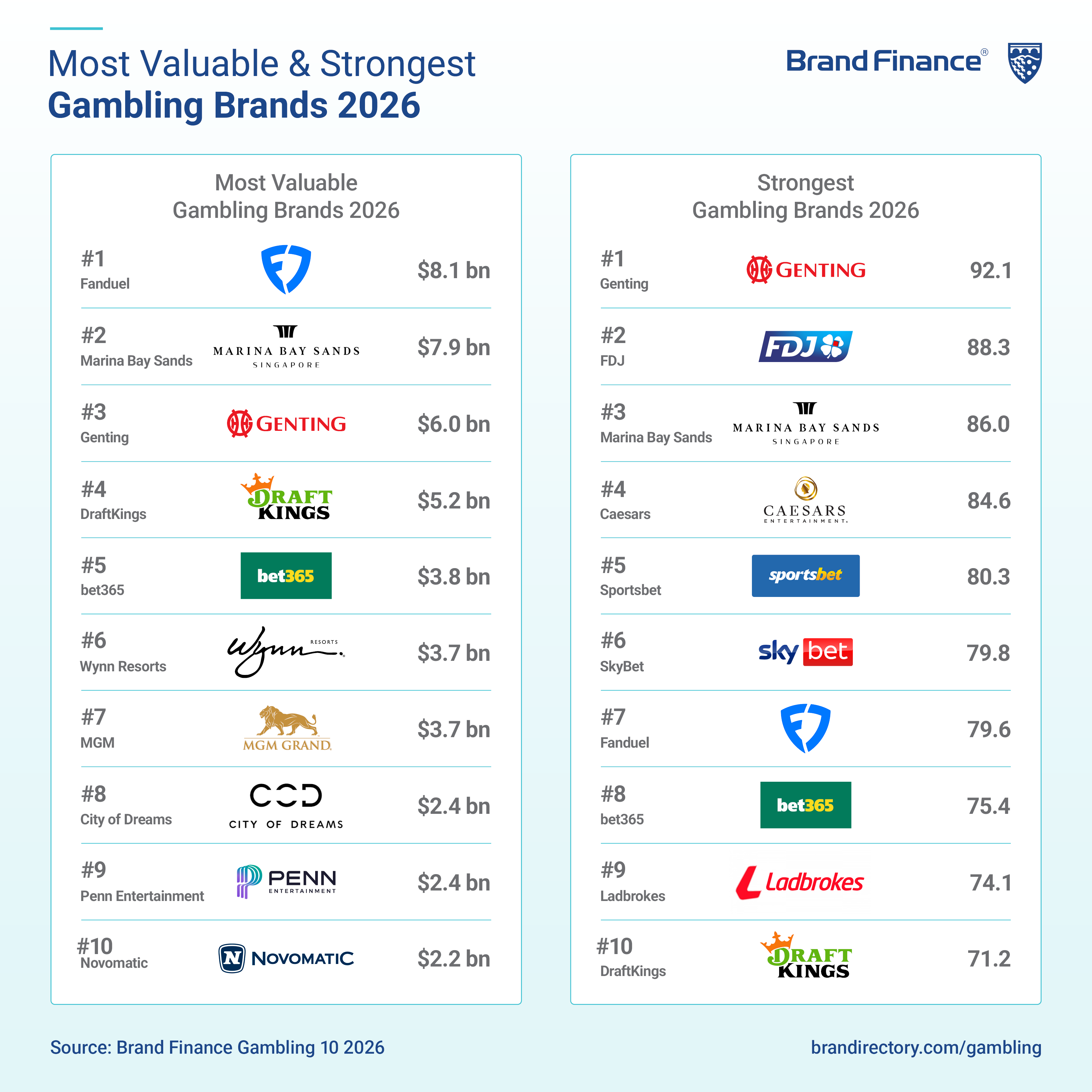
The growth is reflected in the performance of individual brands whereby FanDuel (brand value up 16% to USD8.1 billion) remains the world's most valuable gambling brand, followed by Marina Bay Sands at USD8 billion and Genting at USD6 billion, up 35% and 23% respectively.
Among the brands most closely associated with sports betting and football, bet365 recorded a20% increase to USD3.8 billion, while Sky Bet grew 26% to USD1.2 billion, and Ladbrokes rose 23% to USD921 million. William Hill also recorded growth, increasing 4% to USD1.2 billion.
These results suggest that the changing sponsorship landscape has not, so far, prevented major betting brands from strengthening their financial value. But brand growth is not confined to traditional betting operators. The wider gambling and gaming ecosystem is also producing strong performers.
Light & Wonder recorded the fastest growth among established brands in the ranking, with its brand value increasing52% to USD1.6 billion.
Meanwhile, Malaysia's Genting has overtaken DraftKings (brand value up 23% to USD6 billion) to enter the global top three for the first time, a reversal of fortune for the US operator. The slowdown comes as several US states raise sports betting tax rates in 2024 and operators respond by pulling back marketing spend and introducing per-bet fees to offset the cost, dynamics that appear to be denting brand momentum even as the underlying market keeps growing.
Genting also strengthened its position as strongest with Brand Strength Index (BSI) score of 92.1/100 and AAA+ brand strength rating ahead of the FDJ and Marina Bay Sands, which both received AAA brand strength ratings, with BSI scores of 88.3/100 and 86/100 respectively. The performance of casino and gaming brands such as Genting also highlights how the sector's brand economy is broader than sports betting alone. This diversification could become increasingly important as betting operators look for new ways to build relevance and reach audiences beyond football sponsorship.




Brand Finance is the world’s leading brand valuation consultancy. Bridging the gap between marketing and finance, Brand Finance evaluates the strength of brands and quantifies their financial value to help organisations make strategic decisions.
Headquartered in London, Brand Finance operates in over 25 countries. Every year, Brand Finance conducts more than 6,000 brand valuations, supported by original market research, and publishes over 100 reports which rank brands across all sectors and countries.
Brand Finance also operates the Global Brand Equity Monitor, conducting original market research annually on 6,000 brands, surveying more than 175,000 respondents across 41 countries and 31 industry sectors. By combining perceptual data from the Global Brand Equity Monitor with data from its valuation database — the largest brand value database in the world — Brand Finance equips ambitious brand leaders with the data, analytics, and the strategic guidance they need to enhance brand and business value.
In addition to calculating brand value, Brand Finance also determines the relative strength of brands through a balanced scorecard of metrics, compliant with ISO 20671.
Brand Finance is a regulated accountancy firm and a committed leader in the standardisation of the brand valuation industry. Brand Finance was the first to be certified by independent auditors as compliant with both ISO 10668 and ISO 20671 and has received the official endorsement of the Marketing Accountability Standards Board (MASB) in the United States.
Brand is defined as a marketing-related intangible asset including, but not limited to, names, terms, signs, symbols, logos, and designs, intended to identify goods, services, or entities, creating distinctive images and associations in the minds of stakeholders, thereby generating economic benefits.
Brand strength is the efficacy of a brand’s performance on intangible measures relative to its competitors. Brand Finance evaluates brand strength in a process compliant with ISO 20671, looking at Marketing Investment, Stakeholder Equity, and the impact of those on Business Performance. The data used is derived from Brand Finance’s proprietary market research programme and from publicly available sources.
Each brand is assigned a Brand Strength Index (BSI) score out of 100, which feeds into the brand value calculation. Based on the score, each brand is assigned a corresponding Brand Rating up to AAA+ in a format similar to a credit rating.
Brand Finance calculates the values of brands in its rankings using the Royalty Relief approach – a brand valuation method compliant with the industry standards set in ISO 10668. It involves estimating the likely future revenues that are attributable to a brand by calculating a royalty rate that would be charged for its use, to arrive at a ‘brand value’ understood as a net economic benefit that a brand owner would achieve by licensing the brand in the open market.
The steps in this process are as follows:
1 Calculate brand strength using a balanced scorecard of metrics assessing Marketing Investment, Stakeholder Equity, and Business Performance. Brand strength is expressed as a Brand Strength Index (BSI) score on a scale of 0 to 100.
2 Determine royalty range for each industry, reflecting the importance of brand to purchasing decisions. In luxury, the maximum percentage is high, while in extractive industry, where goods are often commoditised, it is lower. This is done by reviewing comparable licensing agreements sourced from Brand Finance’s extensive database.
3 Calculate royalty rate. The BSI score is applied to the royalty range to arrive at a royalty rate. For example, if the royalty range in a sector is 0-5% and a brand has a BSI score of 80 out of 100, then an appropriate royalty rate for the use of this brand in the given sector will be 4%.
4 Determine brand-specific revenues by estimating a proportion of parent company revenues attributable to a brand.
5 Determine forecast revenues using a function of historic revenues, equity analyst forecasts, and economic growth rates.
6 Apply the royalty rate to the forecast revenues to derive brand revenues.
7 Discount post-tax brand revenues to a net present value which equals the brand value.
Brand Finance has produced this study with an independent and unbiased analysis. The values derived and opinions presented in this study are based on publicly available information and certain assumptions that Brand Finance used where such data was deficient or unclear. Brand Finance accepts no responsibility and will not be liable in the event that the publicly available information relied upon is subsequently found to be inaccurate. The opinions and financial analysis expressed in the study are not to be construed as providing investment or business advice. Brand Finance does not intend the study to be relied upon for any reason and excludes all liability to any body, government, or organisation.
The data presented in this study form part of Brand Finance's proprietary database, are provided for the benefit of the media, and are not to be used in part or in full for any commercial or technical purpose without written permission from Brand Finance.