





Brand Finance’s first ranking of Major League Soccer club brands reveals top 30 worth combined $2.1 billion
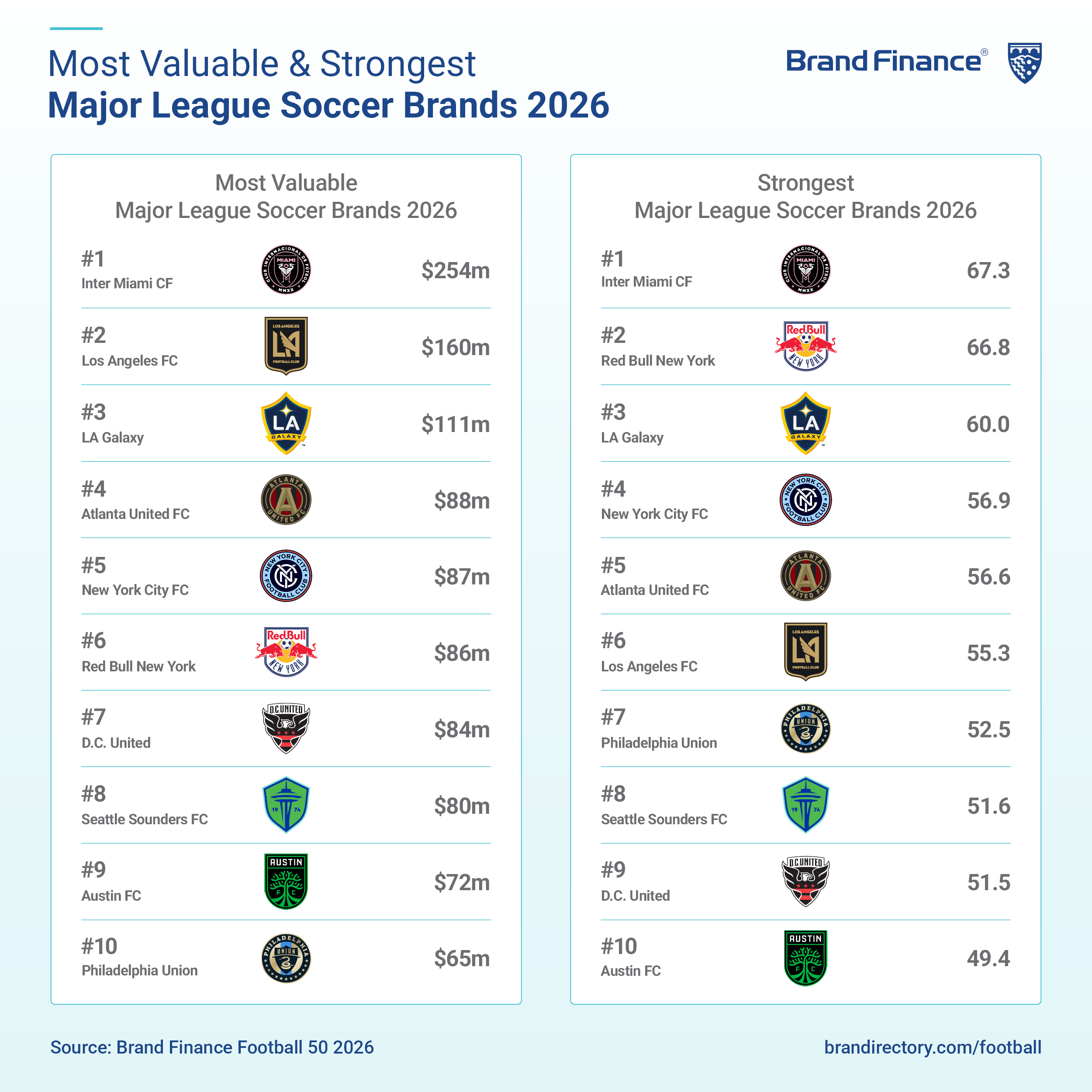
SAN JOSE, 13 October 2026 – Club Internacional de Fútbol Miami (Inter Miami) is the most valuable and strongest club brand in Major League Soccer, with a brand value of USD254 million and Brand Strength Index (BSI) score of 67.3 out of 100, according to new data from Brand Finance, the world's leading brand valuation consultancy. The top 30 MLS club brands are worth a combined USD2.1 billion.
The 10 most valuable MLS club brands are worth a combined USD1.1 billion, almost 60% more than the top 10 club brands in Brazil (USD684 million). Inter Miami’s brand value would place it 22nd in the Brand Finance Football 50 2026, and the top three MLS club brands would all make the ranking.
Inter Miami leads on and off the field
Inter Miami’s brand value is around 59% higher than that of Los Angeles FC, its nearest rival. The club’s rise has been closely linked to Lionel Messi’s arrival in 2023, with on-field success reinforcing it: Inter Miami won its first MLS Cup in 2025, finished as Leagues Cup runners-up and reached the CONCACAF Champions Cup semi-finals.
According to Brand Finance data, Inter Miami performs strongly on how appealing and credible the brand is seen to be. It also earns top scores for the pull of its star players when benchmarked against MLS peers. Thirty-eight percent of domestic fans and 37% of international fans say the club has star players, twice the league’s average. That appeal has held up despite the retirements of Jordi Alba and Segio Busquets, following Casemiro’s signing and Messi’s renewal until 2028. Off the pitch, the club opened its new stadium in April 2026 under a naming rights deal with Nubank. It also signed a multi-year partnership with IM8, the supplements brand co-founded by David Beckham, which marks the first time the club has taken an equity stake in a sponsor.
Los Angeles FC and LA Galaxy complete the top three
Los Angeles FC is the second most valuable MLS club brand at USD160 million and ranks sixth for brand strength with a BSI score of 55.3 out of 100.
LA Galaxy ranks third for both value (USD111 million) and strength (BSI 60.0). The league’s most successful franchise won the MLS Cup in 2024 but endured a historically poor title defense in 2025, failing to win any of its first 16 matches, before improving in 2026. LA Galaxy has a long history of attracting global stars, from David Beckham to Zlatan Ibrahimović, and that legacy may still lend the brand a halo effect, with today’s squad including Marco Reus. However, Brand Finance research finds the club’s star power has dipped, down 6% among domestic fans, partly reflecting another injury in Riqui Puig. Herbalife, the longest-running shirt sponsor in MLS, gives the club a strong and recognizable commercial partner. LA Galaxy also earns top scores for innovation and for the passion of its fans.
New York City FC builds towards a new home
Atlanta United FC is fourth by brand value at USD88 million, with a BSI score of 56.6. New York City FC follows closely at USD87 million and is the fourth strongest MLS club brand with a BSI score of 56.9. NYCFC reached the Eastern Conference final in 2025, its best run since its 2021 MLS Cup win. Etihad Park is expected to be completed before the 2027-28 season, ending more than a decade of shared baseball stadiums, and is likely to strengthen matchday revenue and the club’s brand.
Red Bull New York punches above its value
Red Bull New York is the second strongest MLS brand with a BSI score of 66.8, despite ranking sixth for brand value at USD86 million. After reaching the MLS Cup final in 2024, the club missed the playoffs in 2025 for the first time in 15 years. Brand Finance research reflects weaker perceptions of the club’s ambition, declining 8% among domestic fans. The club’s star power remains strong, with Emil Forsberg, Eric Maxim Choupo-Moting and 18-year-old academy striker Julian Hall, the team’s top goalscorer.
Red Bull and a series of new partnerships give the club a strong, high-profile line-up of sponsors. These include a 13-year naming rights deal with SI Tickets worth more than USD100 million for Sports Illustrated Stadium, and RWJBarnabas Health’s naming rights to the club’s new performance center. Red Bull New York also earned top marks for innovation, ranked first among international fans, and for its stadium – 22 percentage points higher than the league average among domestic fans – in Brand Finance’s research.
Scott Moore, Head of Sports Services, Brand Finance commented:
“Major League Soccer has built a portfolio of club brands worth USD2.1 billion, and its top 10 are now worth more than Brazil’s, long seen as the benchmark in the Americas. But compared with Europe’s leading leagues, MLS is still largely a one-market show. Its broadcasting has yet to travel far beyond North America and it has few international sponsors. Star players are the single biggest driver of fan following, and while MLS has attracted some of the game’s biggest names, most have arrived in the latter years of their careers. The franchise model, with no promotion or relegation, also limited the competitive tension that keeps fans engaged.
“There are good reasons for optimism. Aligning with the European calendar should make it easier to sign players in their prime during transfer windows, and MLS clubs have the financial backing to do so. Soccer also has real momentum in the U.S. after the World Cup. The open question is how much room there is to grow in a market already crowded with the NFL, NBA, MLB and NHL. If the appetite is there, MLS club brands could be at an inflection point.”




Brand Finance is the world’s leading brand valuation consultancy. Bridging the gap between marketing and finance, Brand Finance evaluates the strength of brands and quantifies their financial value to help organisations make strategic decisions.
Headquartered in London, Brand Finance operates in over 25 countries. Every year, Brand Finance conducts more than 6,000 brand valuations, supported by original market research, and publishes over 100 reports which rank brands across all sectors and countries.
Brand Finance also operates the Global Brand Equity Monitor, conducting original market research annually on 6,000 brands, surveying more than 175,000 respondents across 41 countries and 31 industry sectors. By combining perceptual data from the Global Brand Equity Monitor with data from its valuation database — the largest brand value database in the world — Brand Finance equips ambitious brand leaders with the data, analytics, and the strategic guidance they need to enhance brand and business value.
In addition to calculating brand value, Brand Finance also determines the relative strength of brands through a balanced scorecard of metrics, compliant with ISO 20671.
Brand Finance is a regulated accountancy firm and a committed leader in the standardisation of the brand valuation industry. Brand Finance was the first to be certified by independent auditors as compliant with both ISO 10668 and ISO 20671 and has received the official endorsement of the Marketing Accountability Standards Board (MASB) in the United States.
Brand is defined as a marketing-related intangible asset including, but not limited to, names, terms, signs, symbols, logos, and designs, intended to identify goods, services, or entities, creating distinctive images and associations in the minds of stakeholders, thereby generating economic benefits.
Brand strength is the efficacy of a brand’s performance on intangible measures relative to its competitors. Brand Finance evaluates brand strength in a process compliant with ISO 20671, looking at Marketing Investment, Stakeholder Equity, and the impact of those on Business Performance. The data used is derived from Brand Finance’s proprietary market research programme and from publicly available sources.
Each brand is assigned a Brand Strength Index (BSI) score out of 100, which feeds into the brand value calculation. Based on the score, each brand is assigned a corresponding Brand Rating up to AAA+ in a format similar to a credit rating.
Brand Finance calculates the values of brands in its rankings using the Royalty Relief approach – a brand valuation method compliant with the industry standards set in ISO 10668. It involves estimating the likely future revenues that are attributable to a brand by calculating a royalty rate that would be charged for its use, to arrive at a ‘brand value’ understood as a net economic benefit that a brand owner would achieve by licensing the brand in the open market.
The steps in this process are as follows:
1 Calculate brand strength using a balanced scorecard of metrics assessing Marketing Investment, Stakeholder Equity, and Business Performance. Brand strength is expressed as a Brand Strength Index (BSI) score on a scale of 0 to 100.
2 Determine royalty range for each industry, reflecting the importance of brand to purchasing decisions. In luxury, the maximum percentage is high, while in extractive industry, where goods are often commoditised, it is lower. This is done by reviewing comparable licensing agreements sourced from Brand Finance’s extensive database.
3 Calculate royalty rate. The BSI score is applied to the royalty range to arrive at a royalty rate. For example, if the royalty range in a sector is 0-5% and a brand has a BSI score of 80 out of 100, then an appropriate royalty rate for the use of this brand in the given sector will be 4%.
4 Determine brand-specific revenues by estimating a proportion of parent company revenues attributable to a brand.
5 Determine forecast revenues using a function of historic revenues, equity analyst forecasts, and economic growth rates.
6 Apply the royalty rate to the forecast revenues to derive brand revenues.
7 Discount post-tax brand revenues to a net present value which equals the brand value.
Brand Finance has produced this study with an independent and unbiased analysis. The values derived and opinions presented in this study are based on publicly available information and certain assumptions that Brand Finance used where such data was deficient or unclear. Brand Finance accepts no responsibility and will not be liable in the event that the publicly available information relied upon is subsequently found to be inaccurate. The opinions and financial analysis expressed in the study are not to be construed as providing investment or business advice. Brand Finance does not intend the study to be relied upon for any reason and excludes all liability to any body, government, or organisation.
The data presented in this study form part of Brand Finance's proprietary database, are provided for the benefit of the media, and are not to be used in part or in full for any commercial or technical purpose without written permission from Brand Finance.