





New Brand Finance data shows the Nordic region’s top 150 brands grow 5% in 2026
LONDON, 28 September 2026 - The Nordic region’s 150 most valuable brands have reached a combined brand value of EUR238 billion in 2026, according to a new report from Brand Finance, the world’s leading brand valuation consultancy.
This growth is broad-based across the region, although its distribution remains uneven. Sweden remains the largest contributor, accounting for 42% of total brand value at EUR99.5 billion across 54 brands. Denmark follows with 26%, with its 41 brands valued at EUR62.4 billion. Norway’s 24 brands account for EUR38.1 billion, while Finland’s 31 brands reach EUR37.9 billion.
Across the region, the strongest momentum comes from Nordic brands that combine trust, technical strength, sustainability credentials, and relevance to long-term demand. Defence, banking, AI infrastructure, household products, insurance, food, and electronics are gaining ground. Apparel, telecoms, and parts of pharmaceuticals face pressure from changing demand, competition, and market disruption.
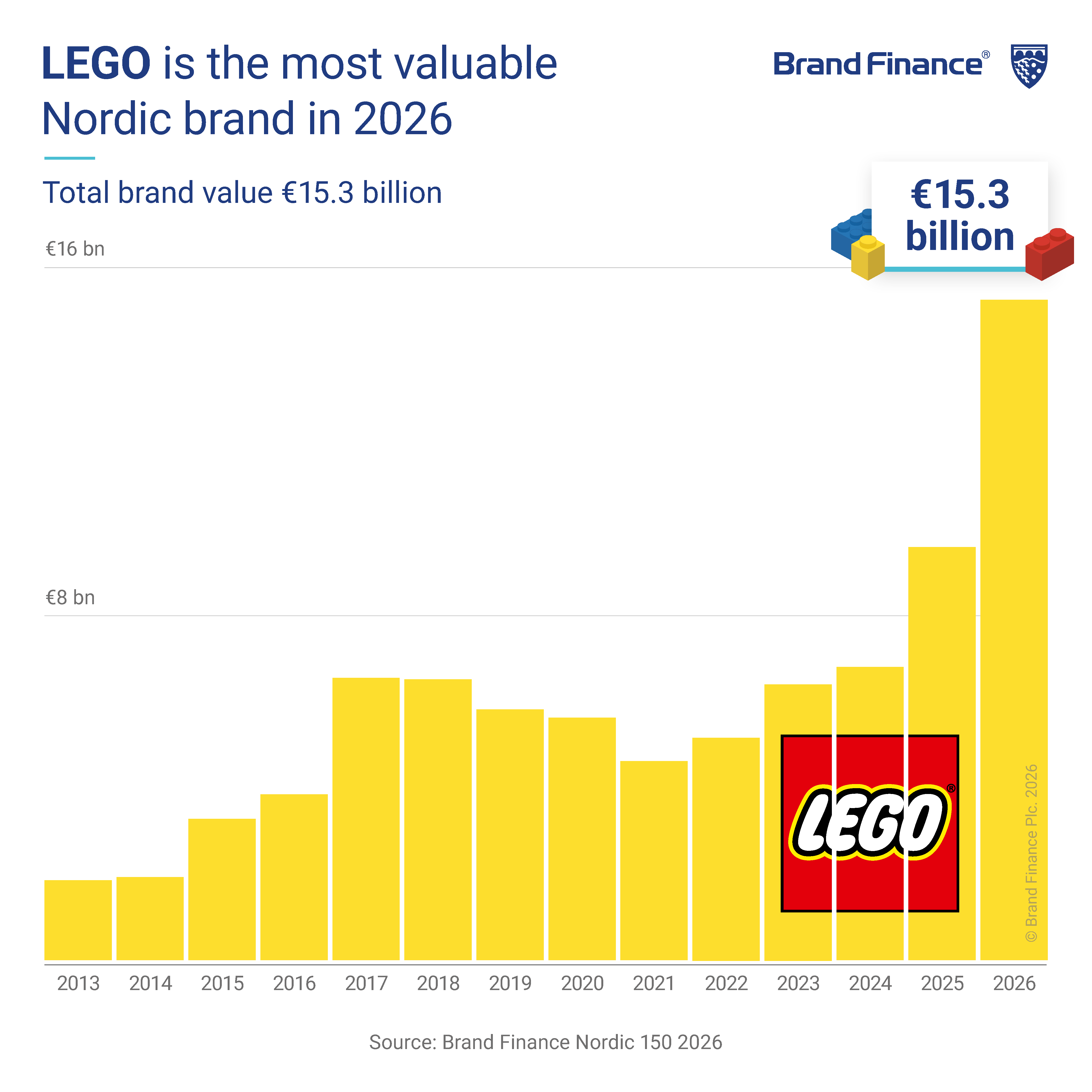
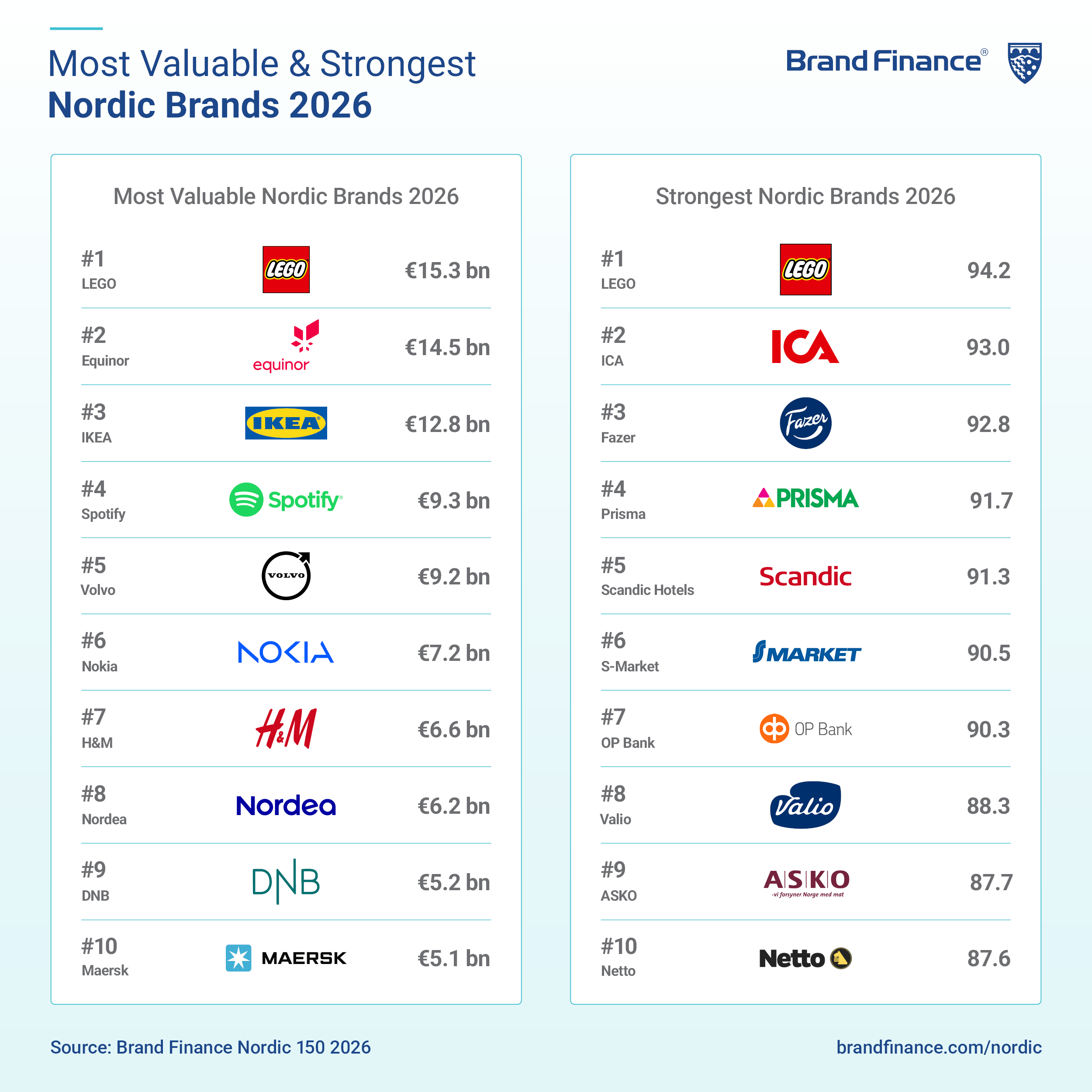
LEGO ranks first in the Nordic 150 ranking for the first time, with its brand value up 54% to EUR15.3 billion. The brand’s rise is supported by revenue of USD12 billion and an 18% increase in operating profit in March 2026. Sustained demand, a growing product portfolio, Formula 1 and Ferrari collaborations, and the CES 2026 Smart Play system further strengthen LEGO’s cross-generational relevance.
Equinor drops to second position despite its brand value growing 3% to EUR14.5 billion. Stronger production, a positive revenue outlook, and its role as a major European gas supplier reinforce perceptions of reliability and energy security. Completing the top three, IKEA rises 6% to EUR12.8 billion, showing resilience despite margin pressure, tariffs, and operating cost challenges.
Mike Rocha, Chief Commercial Officer, Brand Finance, commented:
“The Nordic 150 2026 ranking show that Nordic brands continue to create value by combining trust, innovation, and relevance to long-term demand. While growth is not uniform across countries or sectors, the strongest brands in the ranking are those linking heritage and credibility with future-facing capabilities, whether in AI infrastructure, financial services, energy transition, health and hygiene, or everyday consumer goods. LEGO’s rise to the top of the ranking is a clear example of how a deeply trusted brand can continue to expand its relevance across generations, markets, and formats.”
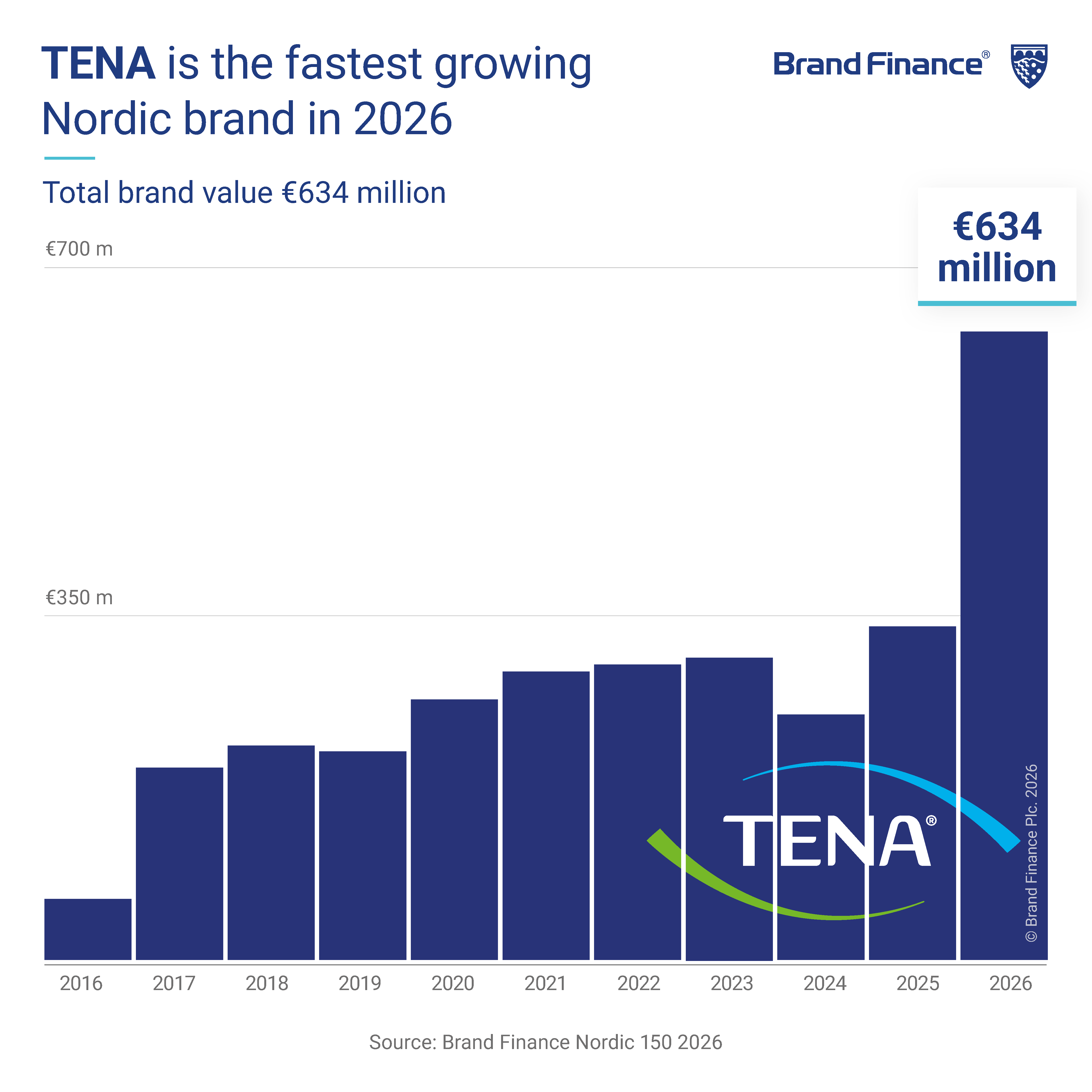
TENA is the Nordic 150’s fastest-growing brand, with its brand value up 81% to EUR634 million and its rank improving by 40 places to 87th. Growth is driven by rising demand for incontinence care, ageing populations, healthcare awareness, and product innovation. Trust, discretion, and performance also matter in a category shaped by reassurance.
Beyond the largest names, Arla, Wolt, and Fortum highlight where Nordic brand momentum is building next. Their growth reflects how brands aligned with changing consumer needs, daily convenience, and long-term transition themes are performing strongly in the Nordic 150 2026. Arla is tapping into rising demand for protein and nutrition, lifting its brand value 34% to EUR3 billion. Wolt is expanding its role in urban consumer life, advancing 14 places to 68th as its brand value grows 19% to EUR857 million. Fortum shows how energy transition and stronger operating conditions can support brand growth, rising 36% to EUR888 million with a BSI score of 70.6/100 and an AA brand strength rating. Together, these shifts make them standout brands to watch in the Nordic 150 2026.
Brand strength further underlines the resilience of Nordic brands. LEGO leads with a BSI score of 94.2/100 and an AAA+ brand strength rating. Brand Finance market research data shows familiarity of 90% among 18–24-year-olds and 86% among 55–64-year-olds. ICA follows with 93.0/100 and an AAA+ brand strength rating, supported by reliability, meaning consumers see the brand as dependable and consistent. Fazer completes the top three with 92.8/100 and an AAA+ brand strength rating, helped by strong admiration and emotional connection in Finland.
Banking is the Nordic 150’s largest sector by brand value, with 16 brands contributing EUR30 billion. Growth is supported by customer trust, digital engagement, and demand for broader financial services. Nordea grows 23% to EUR6.2 billion, while DNB also grows 23% to EUR5.2 billion. OP Bank is the fastest-growing Nordic banking brand, up 75% to EUR497 million.
Electronics is one of the Nordic 150’s clearest technology-led growth stories, with the five ranked brands reaching EUR12.7 billion. Nokia leads growth, up 30% to EUR7.2 billion, as AI, cloud demand, and network infrastructure reshape its brand momentum. Ericsson also grows 7% to EUR3.8 billion, reinforcing the region’s role in global communications infrastructure.
Food and insurance also show the value of everyday trust.
Food brands contribute EUR10.7billion, led by growth from Lurpak, Gøl, and SalMar. Insurance brands contribute EUR7.1 billion, with Tryg, Gjensidige, and If Insurance highlighting the importance of trusted protection and claims support.




Brand Finance is the world’s leading brand valuation consultancy. Bridging the gap between marketing and finance, Brand Finance evaluates the strength of brands and quantifies their financial value to help organisations make strategic decisions.
Headquartered in London, Brand Finance operates in over 25 countries. Every year, Brand Finance conducts more than 6,000 brand valuations, supported by original market research, and publishes over 100 reports which rank brands across all sectors and countries.
Brand Finance also operates the Global Brand Equity Monitor, conducting original market research annually on 6,000 brands, surveying more than 175,000 respondents across 41 countries and 31 industry sectors. By combining perceptual data from the Global Brand Equity Monitor with data from its valuation database — the largest brand value database in the world — Brand Finance equips ambitious brand leaders with the data, analytics, and the strategic guidance they need to enhance brand and business value.
In addition to calculating brand value, Brand Finance also determines the relative strength of brands through a balanced scorecard of metrics, compliant with ISO 20671.
Brand Finance is a regulated accountancy firm and a committed leader in the standardisation of the brand valuation industry. Brand Finance was the first to be certified by independent auditors as compliant with both ISO 10668 and ISO 20671 and has received the official endorsement of the Marketing Accountability Standards Board (MASB) in the United States.
Brand is defined as a marketing-related intangible asset including, but not limited to, names, terms, signs, symbols, logos, and designs, intended to identify goods, services, or entities, creating distinctive images and associations in the minds of stakeholders, thereby generating economic benefits.
Brand strength is the efficacy of a brand’s performance on intangible measures relative to its competitors. Brand Finance evaluates brand strength in a process compliant with ISO 20671, looking at Marketing Investment, Stakeholder Equity, and the impact of those on Business Performance. The data used is derived from Brand Finance’s proprietary market research programme and from publicly available sources.
Each brand is assigned a Brand Strength Index (BSI) score out of 100, which feeds into the brand value calculation. Based on the score, each brand is assigned a corresponding Brand Rating up to AAA+ in a format similar to a credit rating.
Brand Finance calculates the values of brands in its rankings using the Royalty Relief approach – a brand valuation method compliant with the industry standards set in ISO 10668. It involves estimating the likely future revenues that are attributable to a brand by calculating a royalty rate that would be charged for its use, to arrive at a ‘brand value’ understood as a net economic benefit that a brand owner would achieve by licensing the brand in the open market.
The steps in this process are as follows:
1 Calculate brand strength using a balanced scorecard of metrics assessing Marketing Investment, Stakeholder Equity, and Business Performance. Brand strength is expressed as a Brand Strength Index (BSI) score on a scale of 0 to 100.
2 Determine royalty range for each industry, reflecting the importance of brand to purchasing decisions. In luxury, the maximum percentage is high, while in extractive industry, where goods are often commoditised, it is lower. This is done by reviewing comparable licensing agreements sourced from Brand Finance’s extensive database.
3 Calculate royalty rate. The BSI score is applied to the royalty range to arrive at a royalty rate. For example, if the royalty range in a sector is 0-5% and a brand has a BSI score of 80 out of 100, then an appropriate royalty rate for the use of this brand in the given sector will be 4%.
4 Determine brand-specific revenues by estimating a proportion of parent company revenues attributable to a brand.
5 Determine forecast revenues using a function of historic revenues, equity analyst forecasts, and economic growth rates.
6 Apply the royalty rate to the forecast revenues to derive brand revenues.
7 Discount post-tax brand revenues to a net present value which equals the brand value.
Brand Finance has produced this study with an independent and unbiased analysis. The values derived and opinions presented in this study are based on publicly available information and certain assumptions that Brand Finance used where such data was deficient or unclear. Brand Finance accepts no responsibility and will not be liable in the event that the publicly available information relied upon is subsequently found to be inaccurate. The opinions and financial analysis expressed in the study are not to be construed as providing investment or business advice. Brand Finance does not intend the study to be relied upon for any reason and excludes all liability to any body, government, or organisation.
The data presented in this study form part of Brand Finance's proprietary database, are provided for the benefit of the media, and are not to be used in part or in full for any commercial or technical purpose without written permission from Brand Finance.